







Offered by:
Thomsen Gallery
8 East 67th Street
New York City, NY 10065 , United States
Call Seller
212.288.2588
Showrooms
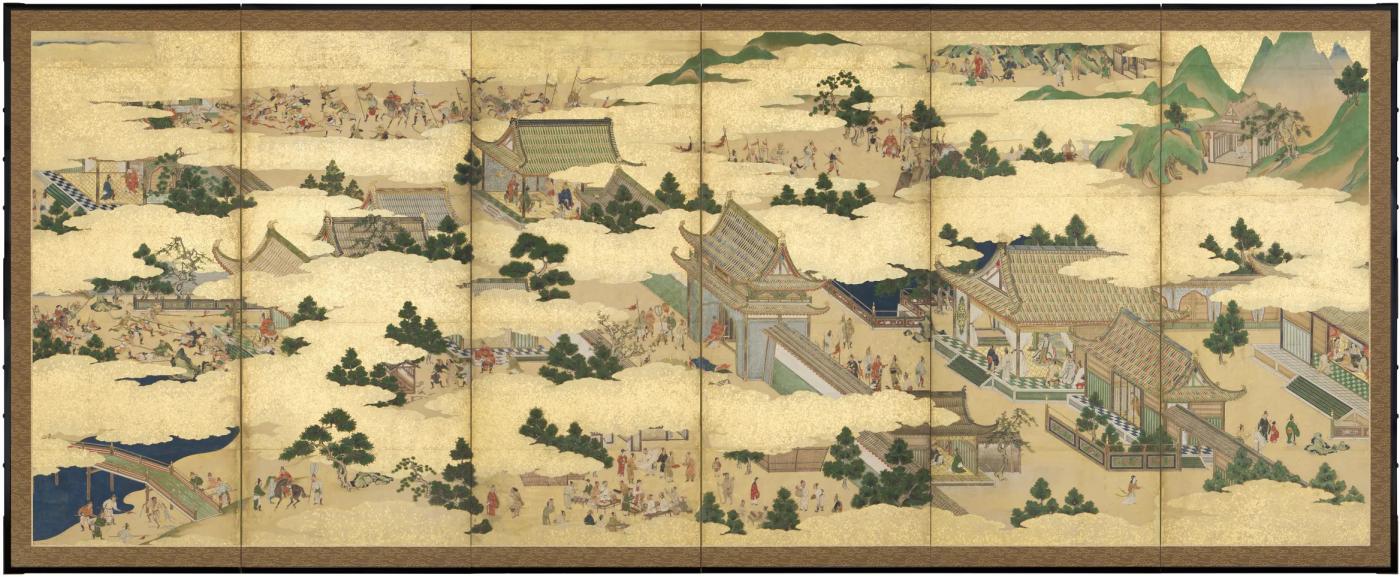
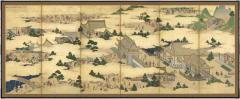
Scenes from Life at the Chinese Imperial Court, early 17th century
-
Description
Six-panel folding screen; ink, mineral colors and gold on paper with gold leaf and gold wash
Size 60 x 146¼ in. (152.3 x 371.8 cm)
T-3549
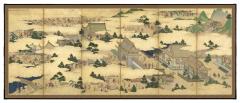
Building on a tradition established toward the end of the sixteenth century, this ambitious composition combines a large number of scenes from the history of the Chinese Imperial Court, some of them connected to the story of Emperor Ming Huang, also known as Xuanzong (685–762, reigned 712–¬756) and his beloved favorite concubine Yang Guifei or Yang "The Precious Consort" (719–756). Skillfully separated by golden clouds in a manner that had been developed earlier for screens depicting multiple scenes from Genji monogatari (The Tale of Genji), the classic Japanese romance of Japanese court life and intrigue, the meticulously painted episodes included here were drawn from a wide variety of sources. The ultimate literary inspiration was Changhenge (in Japanese Chōgonka, The Song of Everlasting Sorrow), a long poem composed by the great Chinese poet Bai Juyi (772–846) which relates the tragic tale of the exemplary emperor's fall from grace through his infatuation with Yang, an infatuation that led to an armed insurrection by general An Lushan and ended with the execution of Yang and the Emperor's flight into exile. Not long after its composition, the text of the poem reached Japan where it has remained ever since one of the most beloved of Chinese literary masterpieces.
In terms of visual resources, the anonymous painter would have taken some of his imagery, directly or indirectly, from Dijian tushuo (in Japanese Teikan zusetsu, Illustrated Stories of the Conduct of Chinese Emperors), a lavishly illustrated woodblock-printed book first published in China in 1573, that chronicles the exemplary behavior of both exemplary emperors and others who fell short of the ideal. A copy of this work was brought to Japan just over two decades later during the Korean campaigns of Toyotomi Hideyoshi (1536–1598) and was inherited by Toyotomi Hideyori (1593–1615) who commissioned a Japanese reprint in 1606. The Kano academy was soon making large-scale painted versions of Teikan zusetsu: Ming Huang, as an emperor who started out by bringing the Tang dynasty to the height of its glory but then plunged the country into civil war thanks to his self-indulgence, was a natural subject for such screens.
Many of the lavish, formal palatial scenes depicted by the artist, especially those involving conventional courtly comings and goings and imperial audiences, are hard to match with specific events in the story of Ming Huang and Yang Guifei but likely occur early in the narrative. Some of the larger and more dramatic pictorial episodes, however, clearly fit into the story of The Song of Everlasting Sorrow and bear some resemblance to other seventeenth-century versions. At top left, covering parts of three panels, the forces of general An Lushan (who was also Yang Guifei's adopted son and lover) attack the imperial palace; just below, on the leftmost panel, a courtier tries to console the grieving emperor following Yang's execution; while further down another attack on the palace is in progress; and lower still is the beginning of the "plank walkways" by which the Emperor escaped through the mountains to temporary exile in the region of Shu (present-day Sichuan Province). -
More Information
Period: Pre 18th Century Creation Date: Early 17th century Styles / Movements: Asian Art Incollect Reference #: 873071 -
Dimensions
W. 146.25 in; H. 60 in; W. 371.48 cm; H. 152.4 cm;
Message from Seller:
Thomsen Gallery, now located at 8 East 67th Street, New York City, NY 10065, specializes in important Japanese paintings, folding screens, hanging scrolls, ceramics, ikebana bamboo baskets, lacquerware, and contemporary works by select artists. Owned and directed by Erik and Cornelia Thomsen, the gallery brings decades of expertise in Japanese art to a global clientele, including private collectors and major museums. For inquiries, contact them at 212-288-2588 or info@thomsengallery.com.
More Listings from Thomsen Gallery View all 198 listings
-
Scenes of the Twelve Months, circa 1915-25
-
Bronze as Bronze II, 2025
-
Vase with Slip Decor (T-5158)
-
Flask with Maple Glaze, 1993
-
"Ki no toki" (Resolute Spirit), 2002
-
Enjoying a Cool Evening on Ponto-chō, Kyoto (T-4852)
-
Shamisen Player, ca. 1930
-
Mizu 09

-
Vase with Brilliant Glaze (T-5161)
-
Three-Seat Sofa
-
Blooming Plum and Cherry Trees along Stream, ca 1800
-
Vase with Marbleized Clay (T-5157)
-
Mountain Landscape, 1916
-
Tea Bowl (T-4838)