



Listings / Fine Art / Photographs / Abstract

Showrooms
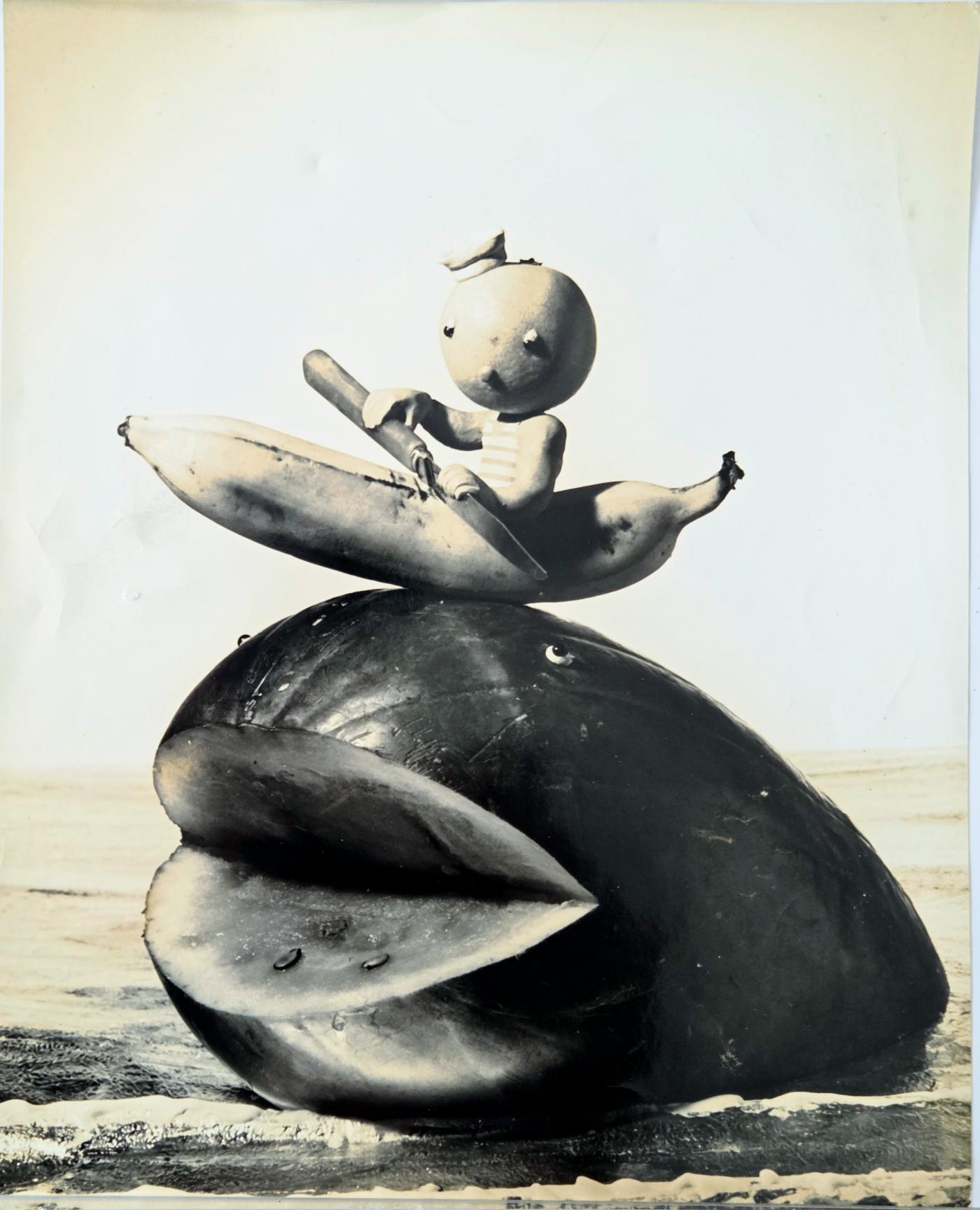
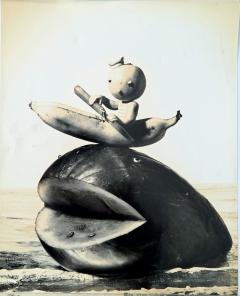
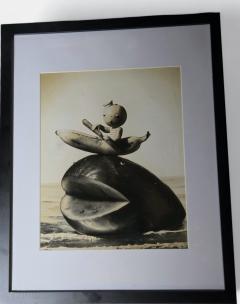
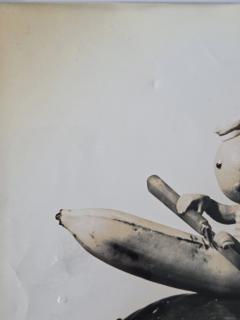
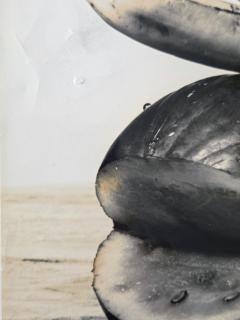
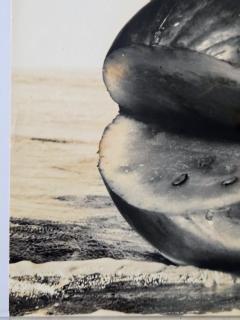
Banana Canoe on Watermelon Whale, Vintage Silver Print c.1944
-
Description
Henry Rox (1899–1967)
Banana Canoe on Watermelon Whale
c. 1940–1945
Vintage silver gelatin print
8 x 10 inches
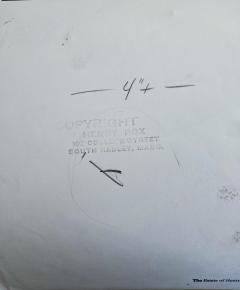
Verso copyright stamp:
“Copyright Henry Rox, 102 College Street, South Hadley, Mass.”
Estate stamp verso
Pencil notation “4” verso
No known negatives extant
This 8 × 10 inch vintage silver gelatin print presents a characteristic example of Henry Rox’s photo-sculptural practice from his American period. A fruit-formed rider—head modeled from an orange and body articulated with applied details—paddles a banana “boat” while holding a paddle formed from a steak knife, balanced atop the massive head of a whale constructed from a halved watermelon. The whale’s open mouth, carved from rind and flesh, reveals seeds and interior structure, transforming botanical matter into a convincing marine form.
The composition is formally disciplined despite its playful narrative. Rox isolates the figures against an open sky and controlled horizon line, allowing the sculptural forms to dominate the frame. The banana establishes a horizontal axis that counters the rounded mass of the watermelon whale, while the rider’s paddle introduces a diagonal element that activates the composition. Lighting is frontal and precise, rendering textures with clarity while maintaining the illusion of scale and environment.
Unlike the London publication works created in collaboration with James Laver in the mid-1930s, this photograph reflects Rox’s later development in the United States following his arrival in 1938 and subsequent settlement in South Hadley, Massachusetts. During this period, he expanded his photo-sculptural vocabulary into independent, self-contained constructions rooted in everyday materials. Humor remains present, but it is structurally resolved through careful modeling, controlled lighting, and spatial clarity.
Rox referred to these works as “photo-sculptures.” Rather than photographing existing subjects, he constructed miniature sculptural environments from fruit, vegetables, and fabricated elements, staging them specifically for photographic realization. The resulting images synthesize sculpture, theatrical staging, and photography into a single resolved composition.
Rox’s photo-sculptures circulated widely within mid-twentieth-century illustrated magazine culture. His constructed images appeared in publications including Life, Vogue, Town & Country, Harper’s Bazaar, Mademoiselle, Seventeen, Coronet, Collier’s, and The New York Times Magazine, participating in the expanding visual publishing environment associated with Time Inc. and Condé Nast.
Context and Development
Rox’s constructed photographs emerge from the late Weimar photographic environment in which experimental approaches to lighting, object study, and staged imagery were actively developing. His photographic training in 1933 at the Berliner Fotoschule placed him within this context shortly before leaving Germany. Following his arrival in London in May 1934, he translated his sculptural training into what he termed “photo-sculpture”: carefully constructed three-dimensional tableaux created specifically for photographic realization. While often employing modest and playful materials, these works operate within a broader modernist exploration of perception, construction, and image-making, anticipating later traditions of staged and conceptual photography.
A documented 1930 photograph of Rox’s Berlin studio confirms the scale and sophistication of his sculptural practice prior to exile. The space—featuring modern architectural elements, substantial ceiling height, and dedicated working areas—reflects an established professional position within the late Weimar cultural environment. His subsequent photographic training in 1933 would have taken place within this same milieu of advanced design and photographic education.
In London, Rox’s work entered publication through his collaboration with James Laver, resulting in Tommy Apple and His Adventures in Banana-Land (1935) and Tommy Apple and Peggy Pear (1936), where sculptural construction, photography, and narrative illustration are fully integrated.
General Overview
Henry Rox (born Heinz Rosenberg, Berlin, 1899) was trained as a sculptor in Berlin and Paris before exile in 1934 necessitated a transformation in his working method. Operating first in London and later in the United States, he developed a hybrid practice in which sculptural construction, theatrical staging, and photography were fully integrated. His images appeared widely in mid-20th century publications associated with Condé Nast and Time Inc., while his sculpture continued to be exhibited in American museum contexts, including the Whitney Annual exhibitions.
Beginning in 1992, Rox’s photographs were reintroduced through a series of Modernism exhibitions in the United States, where they were engaged primarily as objects within a broader decorative and material context. This mode of presentation differs from more recent European scholarship and exhibition, which has begun to situate Rox more fully within a photographic and art-historical framework.
In recent years, Rox’s work has undergone renewed European institutional reassessment through the research of Wolfgang Vollmer (Cologne). This includes exhibition at Fotohof, Salzburg (2021); participation in the European Month of Photography, Berlin; presentations in Paris; and inclusion in the exhibition at the Bonartes Photo Institute, Vienna (December 2025 – February 2026).
Rox’s career bridges European avant-garde sculpture, émigré reinvention, British publishing culture, American commercial modernism, and postwar academic practice. His photo-sculptures stand as hybrid works—simultaneously sculptural, performative, and photographic—reflecting a practice shaped by displacement, adaptation, and sustained formal inquiry.
Rox illustrated three books: Tommy Apple and His Adventures in Banana-Land (1935), Tommy Apple and Peggy Pear (1936), and Banana Circus (1940).
No known negatives survive, and Rox’s photographs do not appear to have been produced in formal editions. Based on the surviving material, individual images exist in varying and often limited numbers, with some examples appearing to be unique or known in only a small number of prints. As a result, each photograph functions less as part of an editioned corpus and more as an individual artifact within the artist’s working process.
Provenance and Survival
This group of photographs originates from Henry Rox’s final residence in South Hadley, Massachusetts, where a substantial body of material—comprising photo-sculptures, documentation of his sculpture, and self-portraits—remained stored following the deaths of the artist and his wife, Lotte Rox. The material was preserved in situ until the eventual dispersal of the property, after which it entered private hands. No known negatives are extant, and these prints constitute a primary material record of the artist’s photographic practice.
Condition
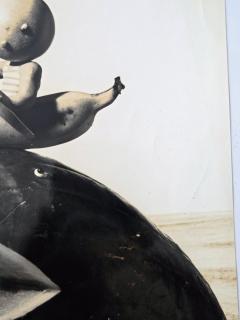
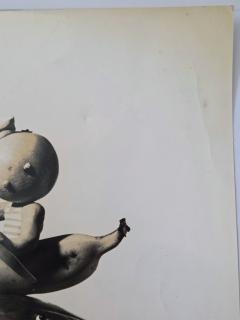
Very good vintage condition. Minor handling marks consistent with age. Verso with handwritten elements and later collection stamp. -
More Information
Documentation: Signed Origin: United States, Massachusetts Period: 1920-1949 Materials: Vintage silver gelitan print Condition: Good. Condition: Strong tonal range with minor edge wear and light surface handling consistent with age. Verso copyright and estate stamps clear; pencil notation present. Very good vintage condition overall. Two areas of aged surface. Creation Date: c. 1944 Styles / Movements: Conceptualism, Other , Black & White Incollect Reference #: 849811 -
Dimensions
W. 8 in; H. 10 in; W. 20.32 cm; H. 25.4 cm;
Shipping Information:
Ask about competitive S&H rates.
Message from Seller:
Established in 1984, Appleton offers a curated selection of 20th Century furniture, tables, chairs, and décor, featuring works by iconic designers like Frank Lloyd Wright and Edward Wormley. For inquiries, contact us at appletonarts@gmail.com.
More Listings from Appleton View all 221 listings
-
Stilnovo Floor Lamp Red and White Plexiglass and Marble, Italy, 1960

-
Italianate Lead Crystal Chandelier Floor Lamps Circa 1940
-
Paul Frankel 72" Cork Top Sideboard Johnson Furniture Co. 1950s
-
Liteline Glass Cane Table Lamp in the Style Gaetano Scolari, circa 1970
-
Warren McArthur Vanity Stool Style No. 1131 circa !936
-
Jerry Johnson Pair of Wrought Iron Sling Chairs Leathercraft C. 1954
-
Set of 3 John Hutton Lounge Chairs for Donghia Merbau Coastal Collection1995
-
Pair of Chased Brass and Mirrored Glass End Tables from Semon Bache, 1959

-
Rare Mid Century Pair Iron Palm Frond Fine Art Lamp Co. Lamps, circa 1985

-
Paul Frankl Mahogany Coffee Table with Cork Tops Johnson Furniture c. 1940s

-
Paul Puccio Giallo Siena Marble Dining Table/ Console 1976 New York
-
Arden Riddle Studio Craft Unique Storage Cabinet Solid Cherry 1966
-
Enrique Garcel Greek Key Mirror Tessellated Bone 1970s Studio Crafted Columbia
-
Studio Crafted Spider Leg Oval Writing Desk, 1970s