





Listings / Fine Art / Photographs / Abstract



Showrooms
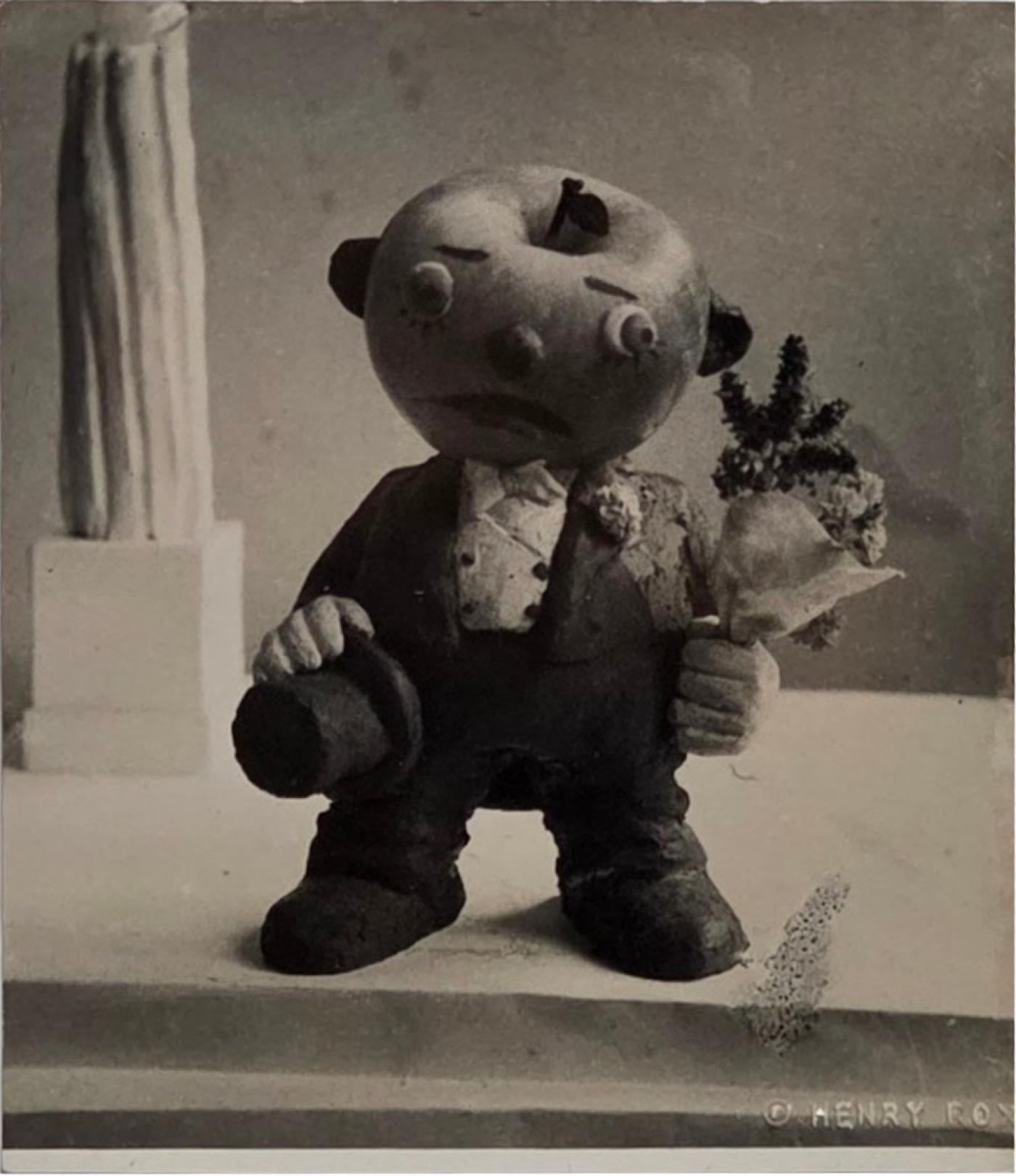
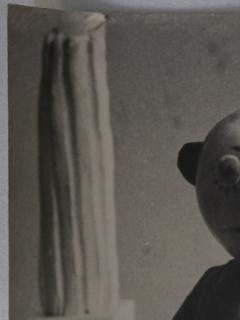
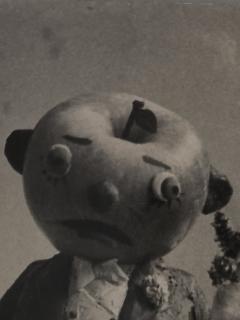
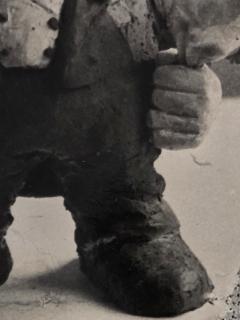
"Tommy Apple" Frontispiece "Tommy Apple and his Adventures in Banana-Land" 1940
-
Description
Henry Rox (1899–1967)
Tommy Apple (Frontispiece)
From Tommy Apple and His Adventures in Banana-Land
by James Laver
Jonathan Cape, London, 1935
Vintage silver gelatin print
6 x 5 inches
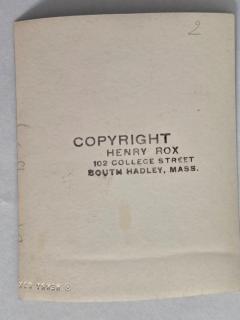
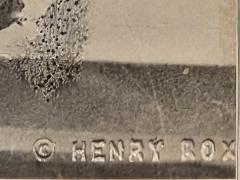
Verso copyright stamp:
“Copyright Henry Rox, 102 College Street, South Hadley, Mass.”
Estate stamp verso
No known negatives extant
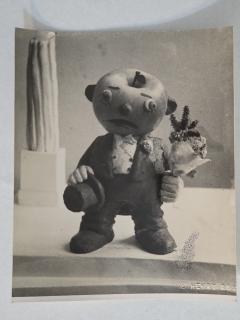
This vintage silver gelatin photograph depicts the character “Tommy Apple,” conceived and photographed by Henry Rox in London in 1934 and published in 1935 in Tommy Apple and His Adventures in Banana-Land. The present example is a period print, printed circa 1939, bearing Rox’s South Hadley studio copyright stamp and estate stamp verso.
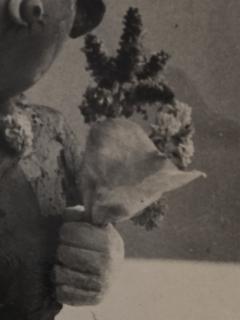
Although presented within a children’s book, the image represents one of the earliest fully resolved expressions of Rox’s mature “photo-sculptural” practice. The figure is constructed rather than depicted: an apple forms the head, with applied elements articulating facial features, while the body is modeled to suggest clothing, stance, and gesture. In his hands, Tommy holds a small bouquet of plant material and a hat, reinforcing both character and narrative presence.
The composition is direct and tightly controlled. The figure is placed frontally within a shallow stage defined by a simplified architectural backdrop—a vertical column and planar ground. This restraint isolates the figure and concentrates attention on proportion, gesture, and expression. The contrast between the smooth, rounded surface of the apple head and the more textured, modeled body reinforces the distinction between organic material and constructed form.
Rox’s method is entirely synthetic. Rather than photographing an existing subject, he assembled the figure from organic and fabricated materials, staged the environment, and lit the scene specifically for photographic realization. The photograph is not documentation of a sculpture; it is the final work in which sculpture, staging, and photography are inseparable.
This image marks a critical development within Rox’s early London work. His initial commercial constructions of 1934—produced for advertising—demonstrate technical invention but remain object-centered. In contrast, the Tommy Apple series introduces sustained narrative, character identity, and environmental coherence. By 1935, Rox had consolidated a fully articulated method in which sculptural fabrication, lighting, and spatial control operate together within a single photographic frame.
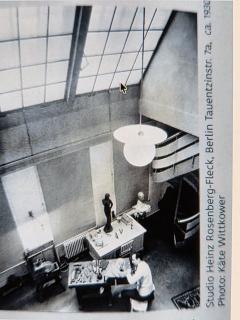
Rox’s ability to construct and control such images is grounded in extensive academic training. Between 1919 and 1933 he studied art history and sculpture in Berlin and Paris, including at the University of Berlin, the Charlottenburger Kunstgewerbeschule, and later at the Académie Julian and Académie Colarossi. By 1930 he maintained an active sculptural studio in Berlin, documented in period photographs, and in 1933 he undertook advanced photographic training at the Berliner Fotoschule to refine the photographic presentation of his work. This trajectory was interrupted by the political conditions in Germany, leading to his relocation to London in 1934.
In London, Rox developed what he termed “photo-sculpture”: constructed three-dimensional tableaux created specifically for photographic realization. His collaboration with James Laver resulted in Tommy Apple and His Adventures in Banana-Land (1935) and Tommy Apple and Peggy Pear (1936), establishing the first sustained body of this work.
General Overview
Beginning in 1993, Rox’s photographs were reintroduced through a series of Modernism exhibitions in the United States, where they were presented within a broader design and material culture context rather than as a defined photographic corpus. These exhibitions were instrumental in reestablishing visibility and an initial market for his work.
In recent years, Rox’s work has undergone renewed European institutional reassessment through the research of Wolfgang Vollmer (Cologne). This includes exhibition at Fotohof, Salzburg (2021); participation in the European Month of Photography, Berlin; presentations in Paris; and inclusion in the exhibition at the Bonartes Photo Institute, Vienna (December 2025 – February 2026). These efforts have begun to situate Rox more fully within the history of 20th-century constructed and staged photography.
Rox’s career bridges European avant-garde sculpture, émigré reinvention, British publishing culture, American commercial modernism, and postwar academic practice. His photo-sculptures stand as hybrid works—simultaneously sculptural, performative, and photographic.
Rox illustrated three books: Tommy Apple and His Adventures in Banana-Land (1935), Tommy Apple and Peggy Pear (1936), and Banana Circus (1940).
No known negatives survive, and the photographs do not appear to have been produced in formal editions. Individual images exist in varying and often limited numbers, with some examples possibly unique. Each print therefore functions as an individual artifact within Rox’s working process.
Provenance and Survival
This print originates from a larger group of photographs preserved from Henry Rox’s final residence in South Hadley, Massachusetts, where a substantial body of material—comprising photo-sculptures, documentation of his sculpture, and related works—remained stored following the deaths of the artist and his wife. The material was preserved in situ until the eventual dispersal of the property, after which it entered private hands.
No known negatives are extant, and these prints constitute a primary material record of the artist’s photographic practice.
Literature
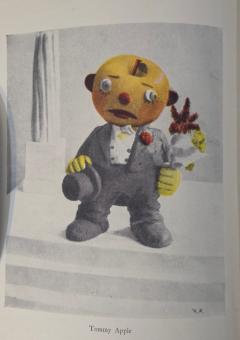
James Laver, Tommy Apple and His Adventures in Banana-Land, Jonathan Cape, London, 1935.
This image reproduced as the cover and frontispiece.
Condition
Very good vintage condition. Minor handling marks consistent with age. Verso with copyright stamp and estate stamp. -
More Information
Documentation: Signed Origin: England Period: 1920-1949 Materials: Silver Gelatin Print Condition: Good. Condition: Vintage condition with minor age-appropriate handling and light surface wear; strong tonal range and clarity. Creation Date: 1934/1940 Styles / Movements: Modernism, Other Incollect Reference #: 847233 -
Dimensions
W. 5 in; H. 6 in; W. 12.7 cm; H. 15.24 cm;
Shipping Information:
Ask about competitive S&H rates.
Message from Seller:
Established in 1984, Appleton offers a curated selection of 20th Century furniture, tables, chairs, and décor, featuring works by iconic designers like Frank Lloyd Wright and Edward Wormley. For inquiries, contact us at appletonarts@gmail.com.
More Listings from Appleton View all 224 listings
-
Tile on Sand Mosaic of a Navajo Sand Painting Yei Dancers Rainbow Guardians
-
Warren McArthur Hat Rack c. 1938
-
Signed Early Silas Seandel "Ortega" Brutalist Cut Metal Coffee Table, circa 1970
-
Paul Frankel 72" Cork Top Sideboard by Johnson Furniture Co. 1950s
-
Walnut Adjustable Lounge Chair Arden Riddle (1921-2011) pre-1965

-
Stadler-Neuwirth Adjustable Beech and Wrought Iron Floor Lamp, circa 1951
-
Monumental Leroy Setziol 1963 16 foot Architectural Douglas Fir Wall Sculpture
-
Profile of A Clown Georges Rouault Interpreted As A Ceramic Mosaic Panel C. 1955

-
Rare Studio Nest of Three Incan Influenced Tables by Toqapu Studio, circa 1985
-
Bowed Front Solid Cherry Desk With Suspended Drawers Maine Studio 1980s
-
Large 1970s Mixed-Metal Botanical Wall Sculpture with Butterflies, 59 Inches
-
Muller Onyx Top Arturo Pani Coffee Table, Mexico, circa 1960
-
!940s Bamboo Rattan Lounge Chair

-
1960s Adrian Pearsall Craft Associates Walnut & River Slate Side Table

