



Listings / Fine Art / Photographs / Abstract






Showrooms
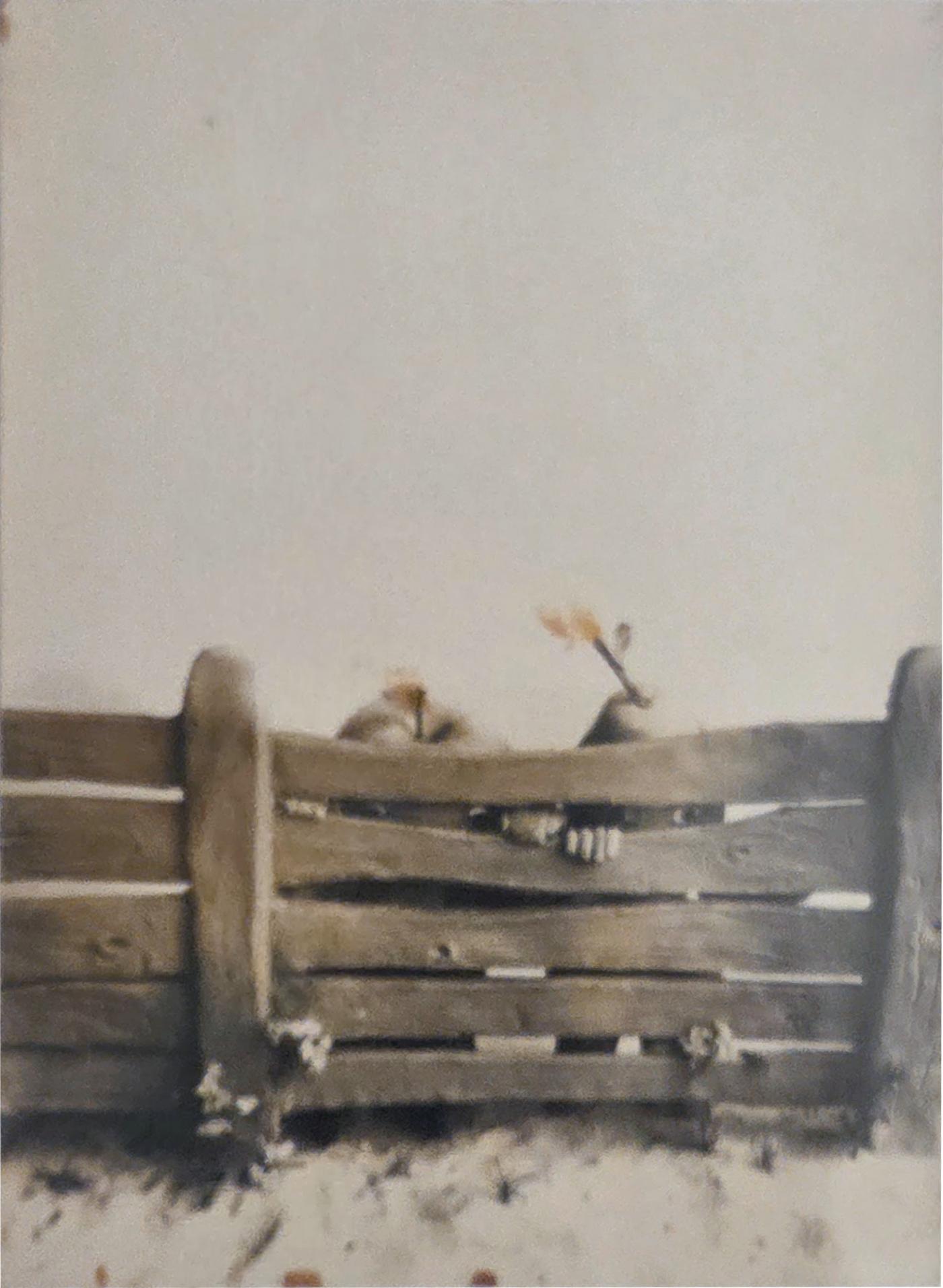
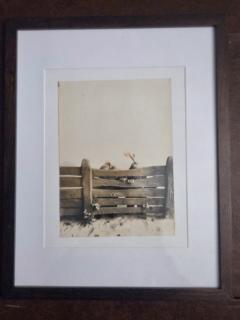
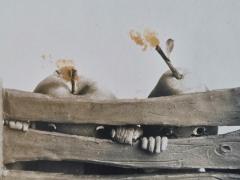
"Tommy Apple & Peggy Pear" Frontispiece Silver Gelatin Print1935/1940
-
Description
Henry Rox (1899–1967)
Frontispiece
Tommy Apple and Peggy Pear
by James Laver
Jonathan Cape, London, 1936
Negative 1935 (print c. 1940)
Vintage silver gelatin print
8.25 x 6 inches
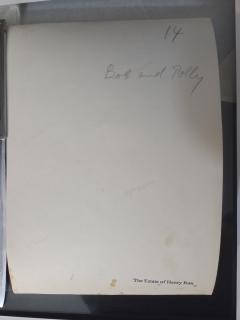
Verso copyright stamp:
“Copyright Henry Rox, 102 College Street, South Hadley, Mass.”
Estate stamp verso
No known negatives extant
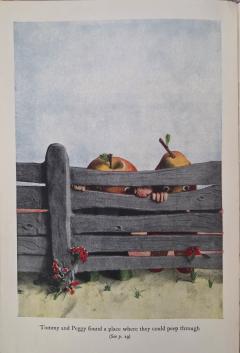
This vintage silver gelatin print is the original frontispiece composition created by Henry Rox for Tommy Apple and Peggy Pear, the second collaboration between Rox and author James Laver, published in London in 1936. Serving as the visual threshold to the book, the image establishes both tone and narrative structure for the sequence of photographic tableaux that follows.
Tommy Apple and Peggy Pear peer over a rustic wooden fence, their fruit-formed hands gripping the upper rail as they look out toward an unseen space beyond. The fence operates as both a physical barrier and a narrative device, marking a boundary between the known and the unknown. Their elevated posture suggests curiosity and hesitation—a moment of pause before entry—while the simplicity of the gesture carries the psychological weight of the scene.
The environment is entirely constructed. The fence, terrain, and surrounding elements are fabricated and arranged specifically for the camera, forming a controlled miniature space in which the figures operate. Rox’s lighting is even and deliberate, describing the texture of the wood, the soft modeling of the figures, and the shallow spatial field with clarity. The horizontal alignment of the fence stabilizes the composition, while the figures introduce a subtle vertical counterpoint.
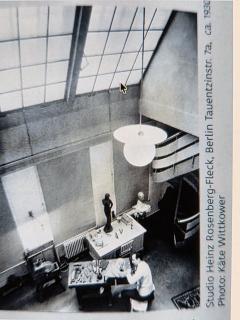
Rox’s photo-sculptural work is grounded in over a decade of formal training and professional practice in Europe. Between 1919 and 1933 he studied art history and sculpture in Berlin and Paris, including at the University of Berlin, the Charlottenburger Kunstgewerbeschule, and later at the Académie Julian and Académie Colarossi. By the late 1920s he was actively exhibiting and had established a fully functioning studio, documented in a 1930 photograph, equipped for large-scale sculptural production. His enrollment at the Berliner Fotoschule in 1933 was not a shift in medium but a technical refinement intended to better photograph his sculptural work. This trajectory was interrupted by the political conditions in Germany, forcing Rox to leave behind an established studio practice.
Following his arrival in London in 1934, Rox translated this sculptural background into what he termed “photo-sculpture”: carefully constructed three-dimensional tableaux made specifically for photographic realization. His collaborations with James Laver—Tommy Apple and His Adventures in Banana-Land (1935) and Tommy Apple and Peggy Pear (1936)—mark the first sustained expression of this method.
Rox’s photo-sculptures circulated widely within mid-twentieth-century illustrated publications. His work appeared in American magazines including Life, Coronet, Collier’s, The New York Times Magazine, and later Family Circle, participating in the visual culture shaped by publisher Henry Luce and the broader editorial world associated with Condé Nast and art director Alexander Liberman. British editorial connections established during Rox’s London years also continued to surface in later publications, including Picture Post and the Swiss journal Graphis.
Beginning in 1993, Rox’s photographs were reintroduced through a series of Modernism exhibitions in the United States, where they were engaged primarily as objects within a broader decorative and material context. This early phase of presentation differs from more recent European scholarship, which has increasingly situated Rox within a photographic and art-historical framework.
In recent years, Rox’s work has undergone renewed European institutional attention through the research of Wolfgang Vollmer (Cologne), including exhibition at Fotohof, Salzburg (2021), participation in the European Month of Photography in Berlin, presentations in Paris, and inclusion in an exhibition at the Bonartes Photo Institute, Vienna (December 2025 – February 2026).
Rox’s career bridges European avant-garde sculpture, émigré reinvention, British publishing culture, American commercial modernism, and postwar academic practice. His photo-sculptures stand as hybrid works—simultaneously sculptural, performative, and photographic—reflecting a practice shaped by displacement, adaptation, and sustained formal inquiry.
Provenance
Acquired by the present owner in 1992 as part of a group of approximately 500 Henry Rox photographs.
Private collection, Camden, Maine.
Literature
James Laver, Tommy Apple and Peggy Pear, Jonathan Cape, London, 1936.
This image reproduced as the frontispiece.
Condition
Very good vintage condition. Minor handling marks consistent with age. Verso with copyright stamp and estate stamp. -
More Information
Documentation: Ample Provenance Origin: United States, Massachusetts Period: 1920-1949 Materials: silver gelatin photograph Condition: Good. Vintage silver gelatin print with even tonal range. Minor age-appropriate surface wear, light corner softening, and slight edge handling consistent with period mounting. Estate stamp verso with pencil notations. Overall very good vintage condition. Creation Date: 1940 Styles / Movements: Modernism, Other Incollect Reference #: 847256 -
Dimensions
W. 6 in; H. 8.25 in; W. 15.24 cm; H. 20.96 cm;
Shipping Information:
Ask about competitive S&H rates.
Message from Seller:
Established in 1984, Appleton offers a curated selection of 20th Century furniture, tables, chairs, and décor, featuring works by iconic designers like Frank Lloyd Wright and Edward Wormley. For inquiries, contact us at appletonarts@gmail.com.
More Listings from Appleton View all 223 listings
-
1952 Tye of California "Aboriginal" Ceramic Table Lamp
-
Paul Frankl Six Drawer Sideboard Cork Johnson Furniture 1950s
-
1990s Achille and Pier Giacomo Castiglioni Taccia Lamp for Flos
-
Pair Mid-Century Brancusi Cerused Oak Lamps W/ Original Red Fiberglass Shades
-
1950s Mid-Century German Hala Zeeland Model 110 White & Polished Aluminum Lamp
-
Frank Lloyd Wright Mahogany Desk Heritage Henredon 1955/56

-
Streamlined Chinoiserie Twin-Column Temple Gate Table Lamp, c. 1950s
-
1950s California Mid-Century Sculptural Manzanita Floor Lamp
-
Italian Neoclassical Carved Alabaster & Marble Table Lamp, c. 1930s
-
Pair Vintage Gerald Thurston for Lightolier Brass & Lucite Lamps, Circa 1950s
-
1950s Eduardo Alvarado Mexican Mosaic Banderillero Rosewood Table Castillo Taxco
-
1960s California Brutalist Hand-Carved Interlocking Old-Growth Douglas Fir Totem
-
Vintage French Le Dauphin Style Glass Lamp with Hand Gilt Foliage c1950
-
MAgriTTA Chair