








Offered by:
Kristan Hauge Japanese Art
2-32 Saishoji-cho, Okazaki, Sakyo-ku,
Kyoto 606-8342 , Japan
Call Seller
81757515070
Showrooms
19th Century Japanese Paintings. Zenga Tiger and Dragon by Inoue Kanshu.
-
Description
Inoue Kanshu (1807-1880)
Zenga Tiger and Dragon
19th century
Pair of framed Japanese paintings. Ink on silk.
Dimensions (each): W. 114 cm x H. 115 cm (45” x 45”)
Price: USD 17,500
Presented here are a pair of tiger and dragon (calligraphic) paintings by Inoue Kanshu, a Zen monk who held the honorary title of Hogan at Shokokuji temple in Kyoto during the early Meiji period. The paintings were originally mounted as two sides of a Japanese standing screen (tsuitate). Painted on expensive silk and on a grand scale we can only imagine that the original screen stood in an important temple.
Zen paintings or Zenga represent one of the world’s most fascinating religious and artistic traditions. Created to spread the teachings of Zen Buddhism, monk-artists rejected the rigid and serious style of traditional religious paintings, which catered to an elite audience. Instead, they favored playful, bold, and relatively simple designs that would appeal to commoners. Zenga aim to communicate the vision of Zen masters and reveal the essence of Zen Buddhism.
Often depicted winding through billowing clouds, dragons are one of the four supernatural animals in Chinese lore, associated with the male principle yang. From this Taoist association, dragon imagery was adopted by painters in the Zen tradition. Kanshu, by writing the word “dragon,” leverages the pictographic origin of the Chinese character and the gestural quality of calligraphy to suggest a dragon floating dramatically through the composition. Kanshu prioritizes not the proper rendering of the character but its ability to rise above its two-dimensional form, conveying the strength and movement of his brush.
The pale, seemingly hazy outlines and detail of the monochrome ink tiger and waterfall painting might initially appear casually brushed, but closer examination reveals Kanshu’s expert brush control. He had a real talent for painting which transcends more typically amateurish Zen artists. In this painting he exclusively uses a technique where he holds two brushes simultaneously—one with ink and the other with only water. By alternating between the brushes, he first outlines the general structure with ink, then uses the water brush to blend the still-wet ink. This process smudges the ink into tones and washes, softening it and varying the dark and light until the final shaping is achieved.
Shokokuji is the head temple of the Rinzai sect and oversees many sub-temples including the famous Kinkakuji and Ginkakuji. As well as holding a high position there, Inoue Kanshu was a teacher at the Imperial Palace in Kyoto. He remained single his whole life, devoting himself to his training and painting and calligraphy. At the time, his way of life was so unconventional that it was difficult for the general public to understand, but his style of painting, which strove to capture the essence of things, is still innovative even to this day. -
More Information
Documentation: Documented elsewhere (similar item) Period: 19th Century Condition: Good. Styles / Movements: Asian Art Incollect Reference #: 755718 -
Dimensions
W. 44.88 in; H. 45.28 in; W. 114 cm; H. 115 cm;
Message from Seller:
Kristan Hauge Japanese Art, based in Kyoto's museum district since 1999, specializes in important Japanese screens and paintings for collectors, decorators, and museums worldwide. Contact us at khauge@mx.bw.dream.jp or +81 75-751-5070 for exceptional access to Japanese art and history.
More Listings from Kristan Hauge Japanese Art View all 64 listings
-
18th Century Japanese Screen Pair. One Hundred Flowers, Chrysanthemums

-
Japanese Screen. Early 20th Century. Furosaki Screen. Wagtail & Chrysanthemum

-
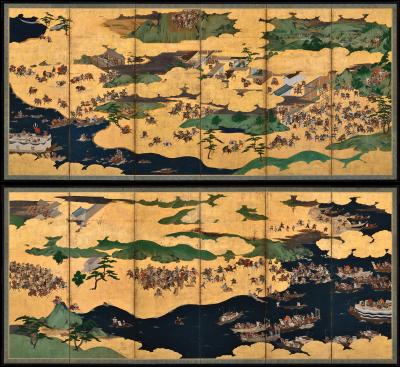
Late 17th Century Japanese Screen Pair. Battle of Ichi-no-tani and Yashima
-
17th Century Japanese Screen Pair. Flock of Cranes. Ink and color on gold leaf.

-
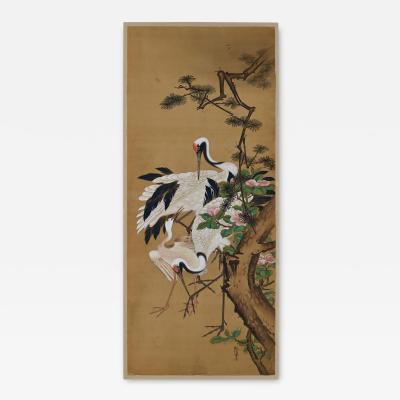
19th Century Japanese Silk Painting by Kano Chikanobu. Cranes, Pine & Camelia.
-
Early 20th Century Japanese Screen Pair – Ink Pine Trees on Gold

-
Sakai Hoitsu (1761-1828) | Autumn flowers | Japanese screen painting

-
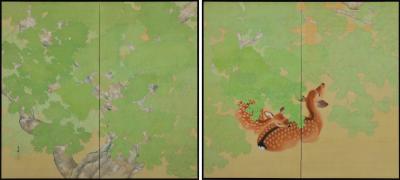
Early 20th Century Pair of Japanese Screens | Deer under Maple Trees
-
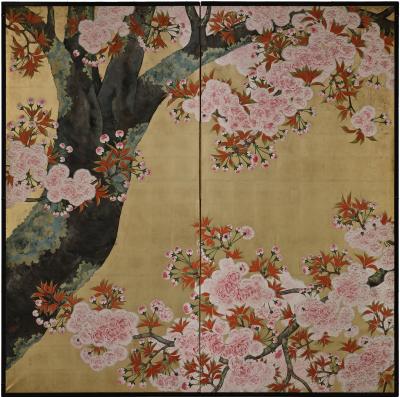
Early 20th Century Japanese Cherry Blossom Screen
-
1895 Meiji Japanese Screen Pair. Cherry Blossoms & Autumn Maples on Silver Leaf
-
Chaekgeori painting. 19th Century Joseon. Books & Scholars’ Accouterments.
-
19th Century Japanese Deer Screen by Okamoto Toyohiko. Maruyama Shijo School
-
17th Century Japanese Screen. Ink Plum Tree & Birds by Kano Naonobu

-
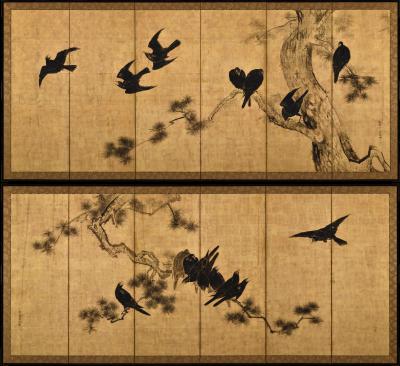
Mid 18th Century Japanese Screen Pair. Crows & Pines by Unkoku Toshuku