









Rethinking Tynell: The Real Story Behind His Adjustable Lighting Designs
 |
Rethinking
Paavo Tynell
The Real Story Behind His
Adjustable Lighting Designs
by Shadi Haddadin
The story begins with a single sentence.
In the 2005 monograph Paavo Tynell and Taito Oy, published by the Design Museum Helsinki to accompany the exhibition of the same year, Tuula Poutasuo writes on page 47:
“All lamps were made according to the United States electric appliances regulations. Because the ceiling lamp was not allowed to hang supported by the electrical cord, Paavo Tynell designed a counterweight-operated lift mechanism, which became one of his trademarks.” This was in reference to the iconic A1965 lamp.
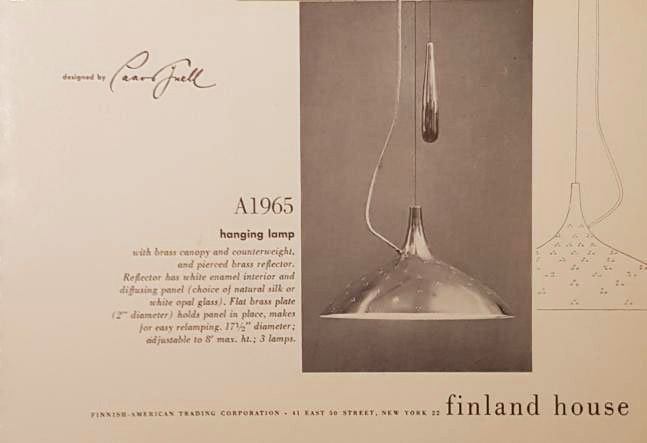 |
| The iconic A1965 adjustable lamp. |
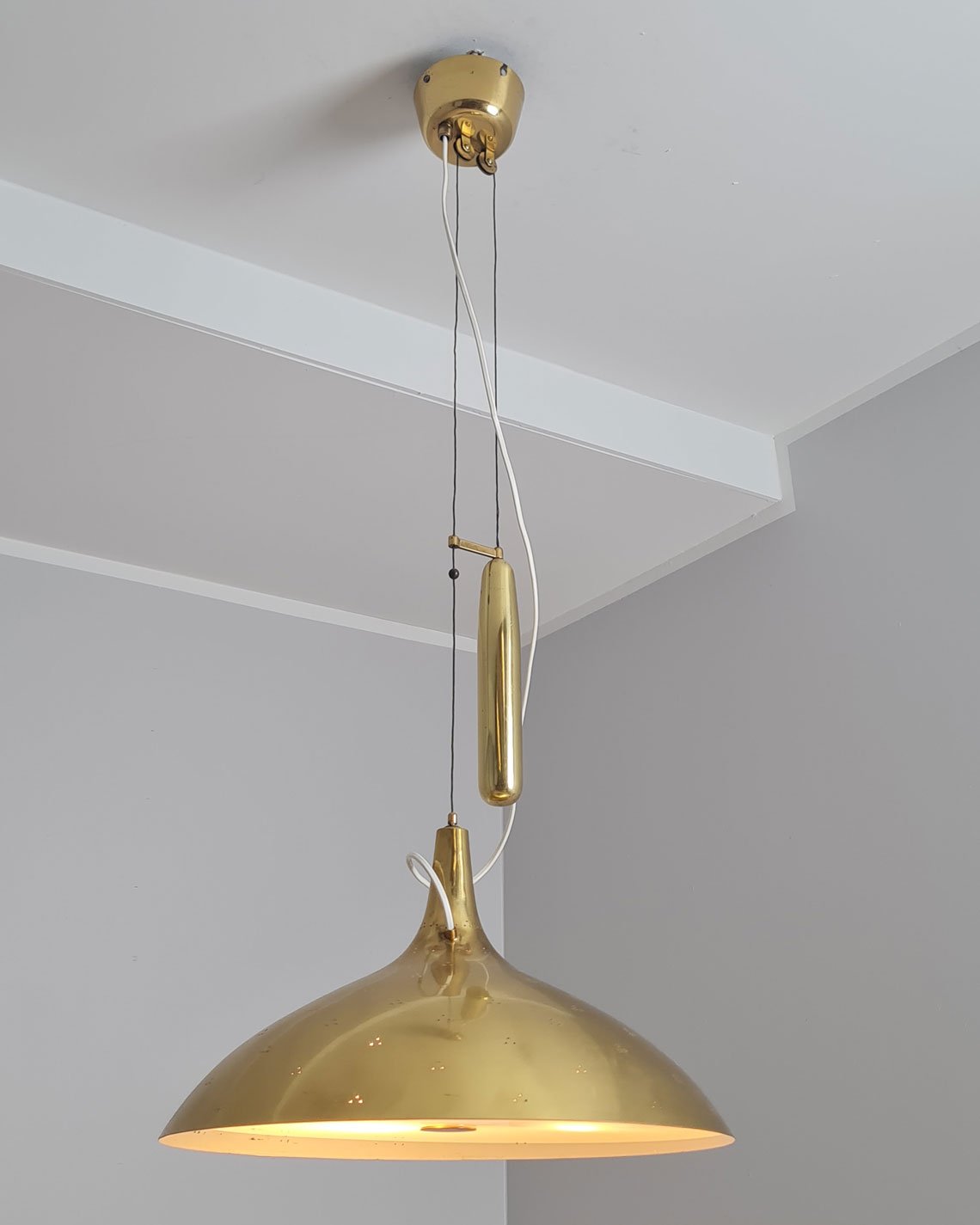 | 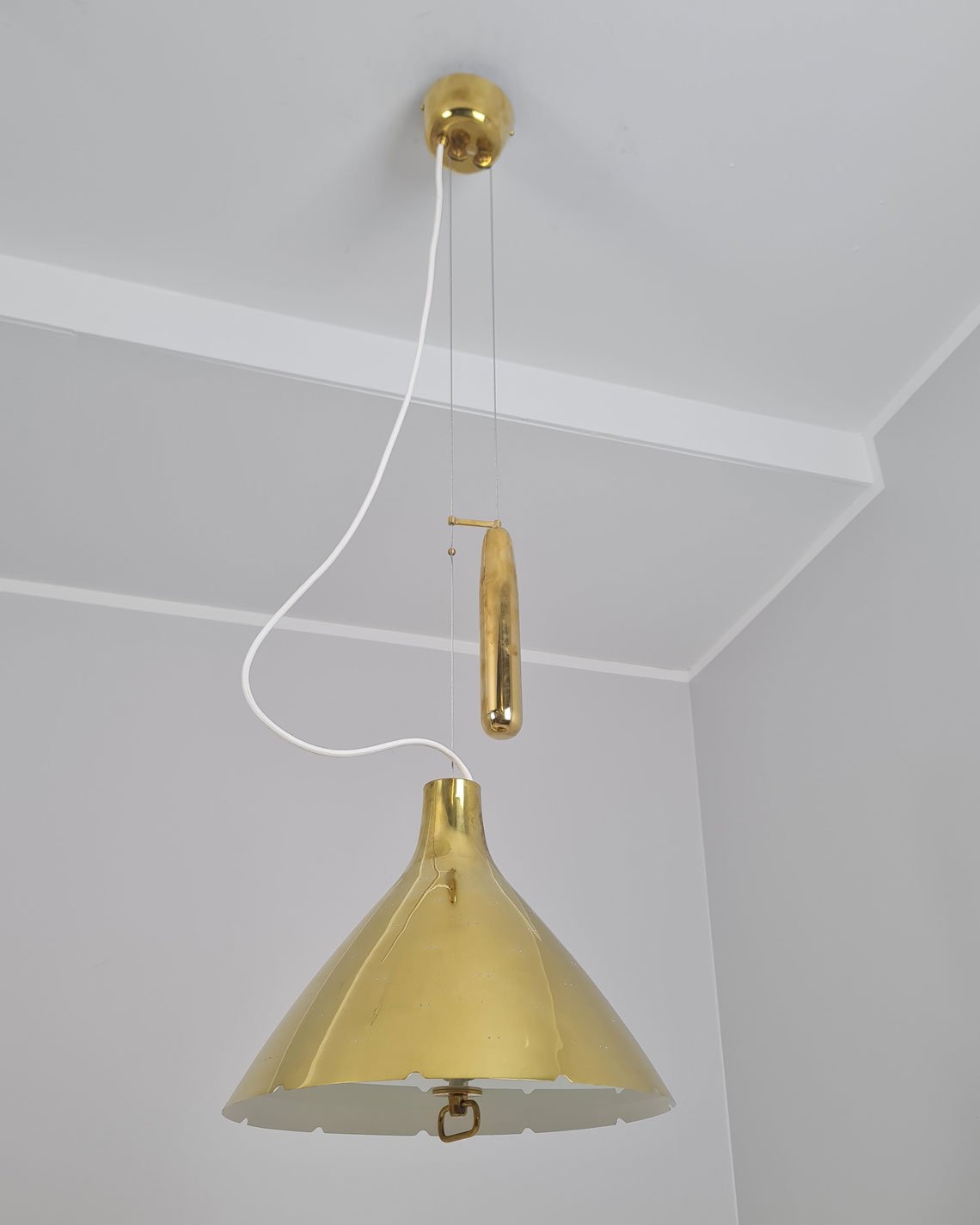 |
Left: Model A1965, polished brass with a triangular pattern of 3 pierced circles that emit pinpoints of light. A white silk diffuser softens the light. Right: Adjustable pendant lamp A1982MS. Polished brass with an overall pattern of pierced double dots and a delicately notched rim. Both are available from Haddadin Design on Incollect. |
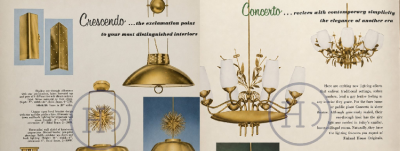
This statement, often repeated and rarely questioned, became the foundation of a widely accepted explanation for why Paavo Tynell developed his adjustable lighting mechanisms. And yet, something doesn’t quite add up. In the very same context, including the opening of Finland House and the associated catalogues, numerous lamps are clearly shown hanging freely by their cords, including models such as the 1994, 1995, 1996, 10157, 10138, 10129, and 10130. If such designs were not allowed, why do they appear so consistently?
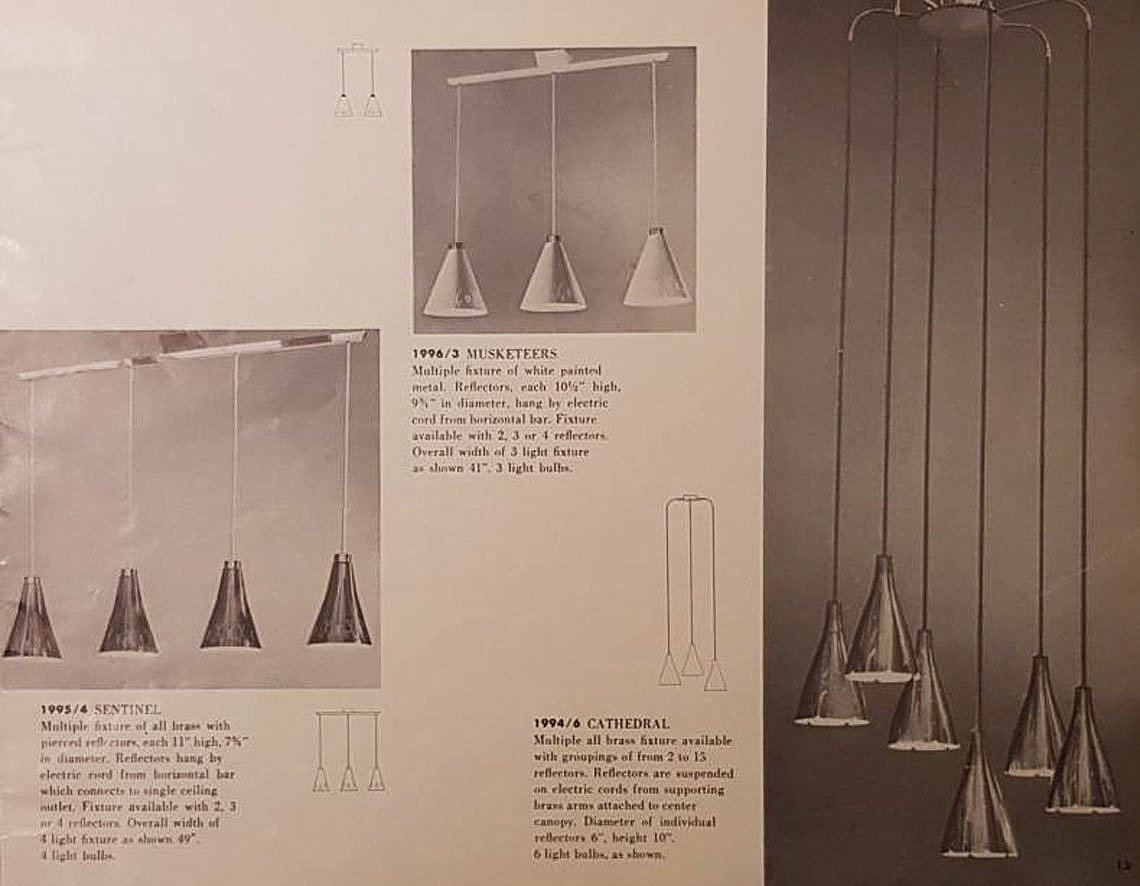 |
| Models 1994, 1995, 1995 with the text clearly describing them as hanging from electric cords. |
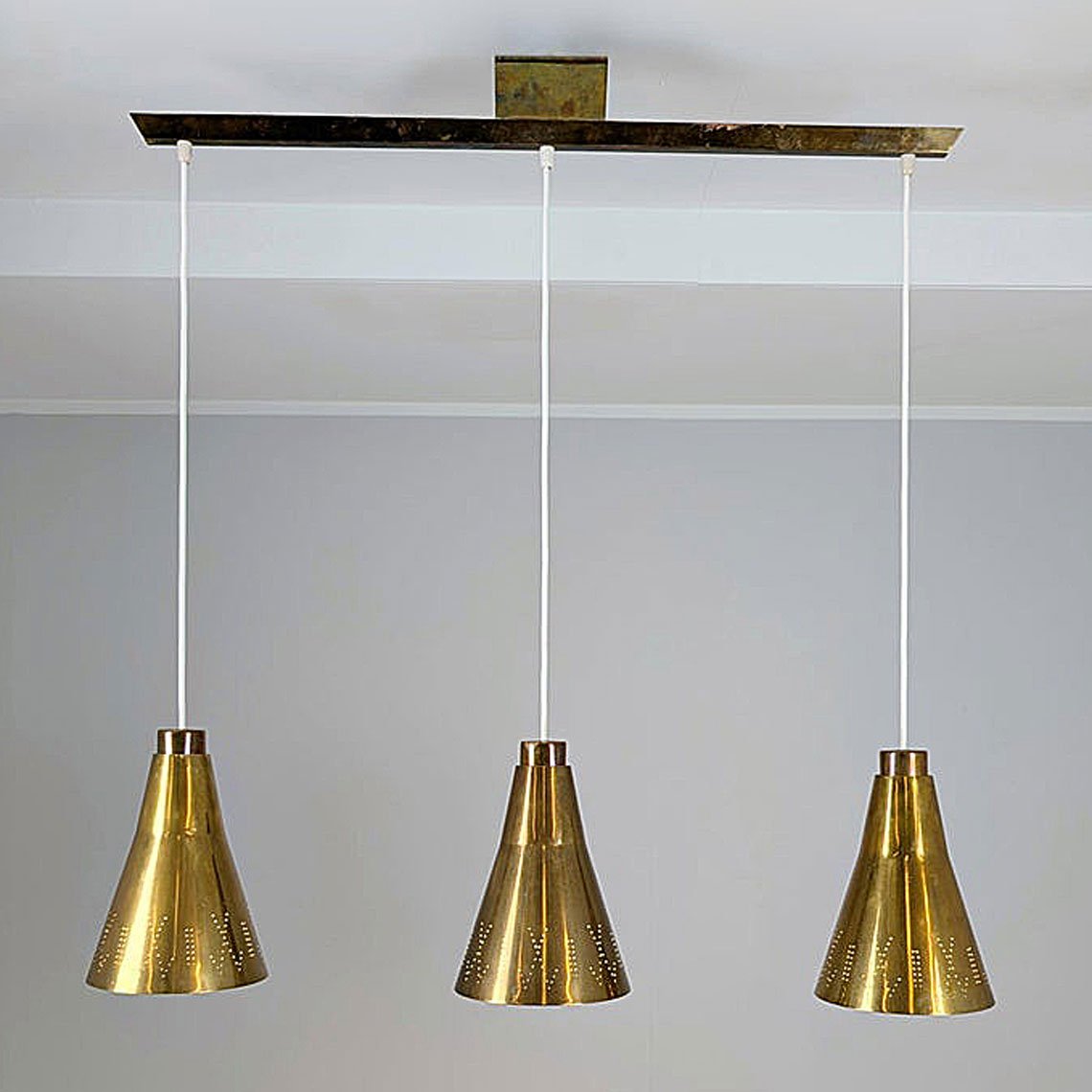 | 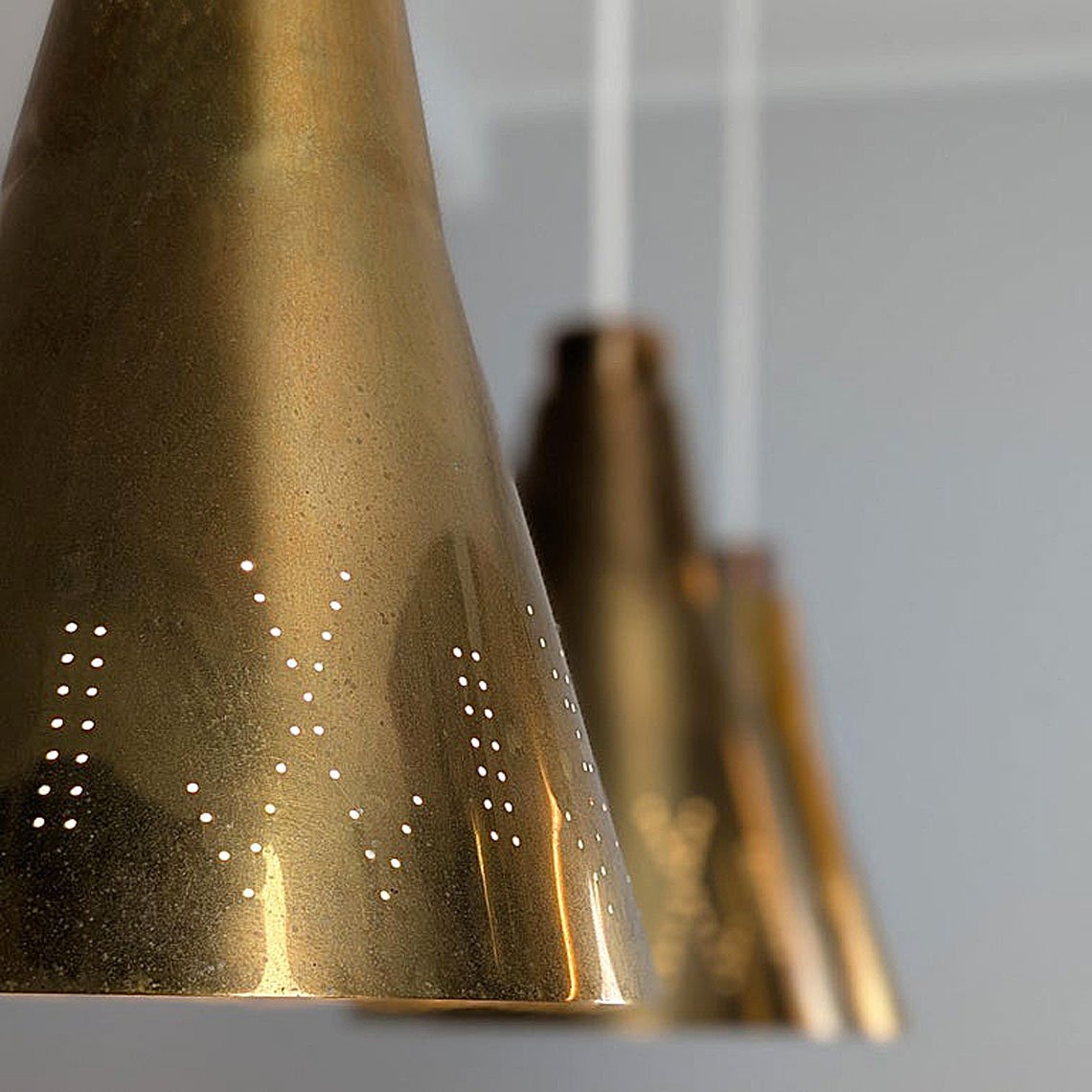 | |
| Model 1995/3 pendant light with 3 lights suspended from a horizontal polished brass bar. Polished brass shades are decorated with a wonderful pierced arrow border. Perfect over a dining table or kitchen island, this has an especially rich and glowing patina. Available from Haddadin Design on Incollect. | ||
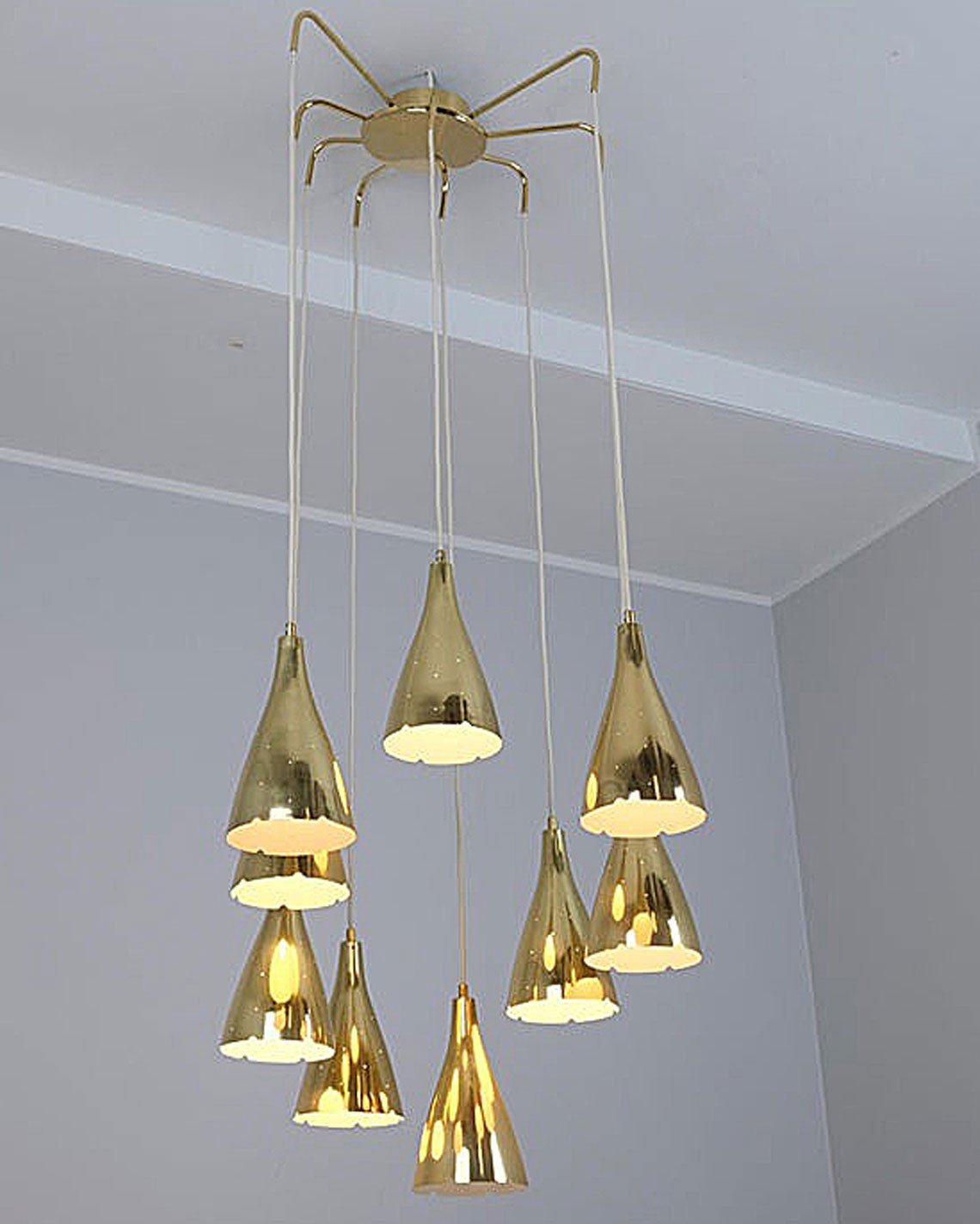 | 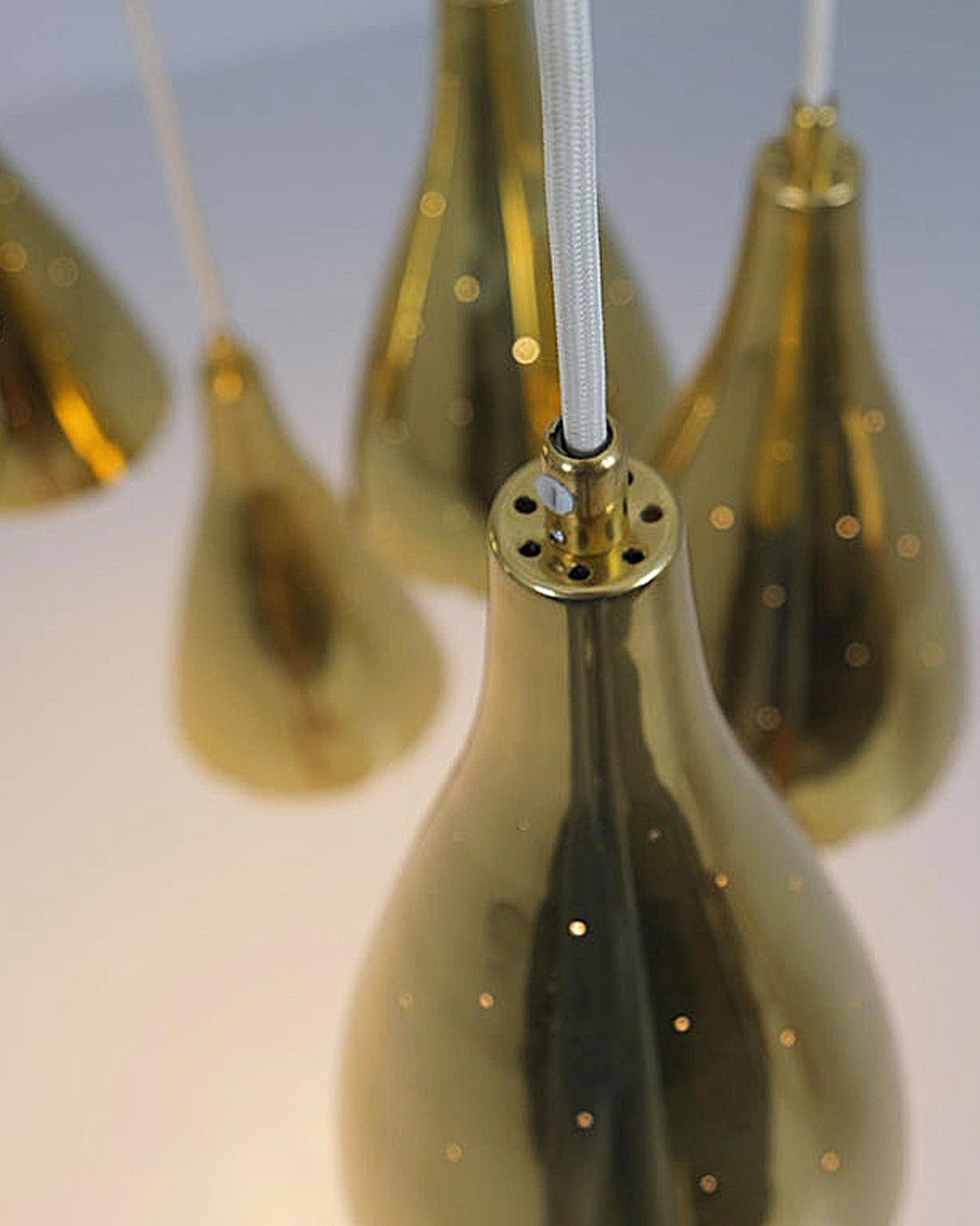 | |
Model 1994/9. Nine hanging perforated brass pendants connected at the top with a brass central piece. Each pendant hangs at a different level and drop can be adjusted through cord length. Individual perforations in an all-over pattern, subtle notches on the rim create a petal-like effect. This style was created in as few as 2 and as many as 12 pendants. Available from Haddadin Design on Incollect. | ||
So, what is the deal here? Why would certain models be permitted to hang from cords, while others seemingly were not?
The answer lies not in whether lamps could hang from cords, but in how those cords were used. The story, in fact, begins with the adjustable models themselves. Tynell and Taito had already developed adjustable lamps in Finland prior to their introduction to the American market, including models such as 1054, 1055, or 1077.
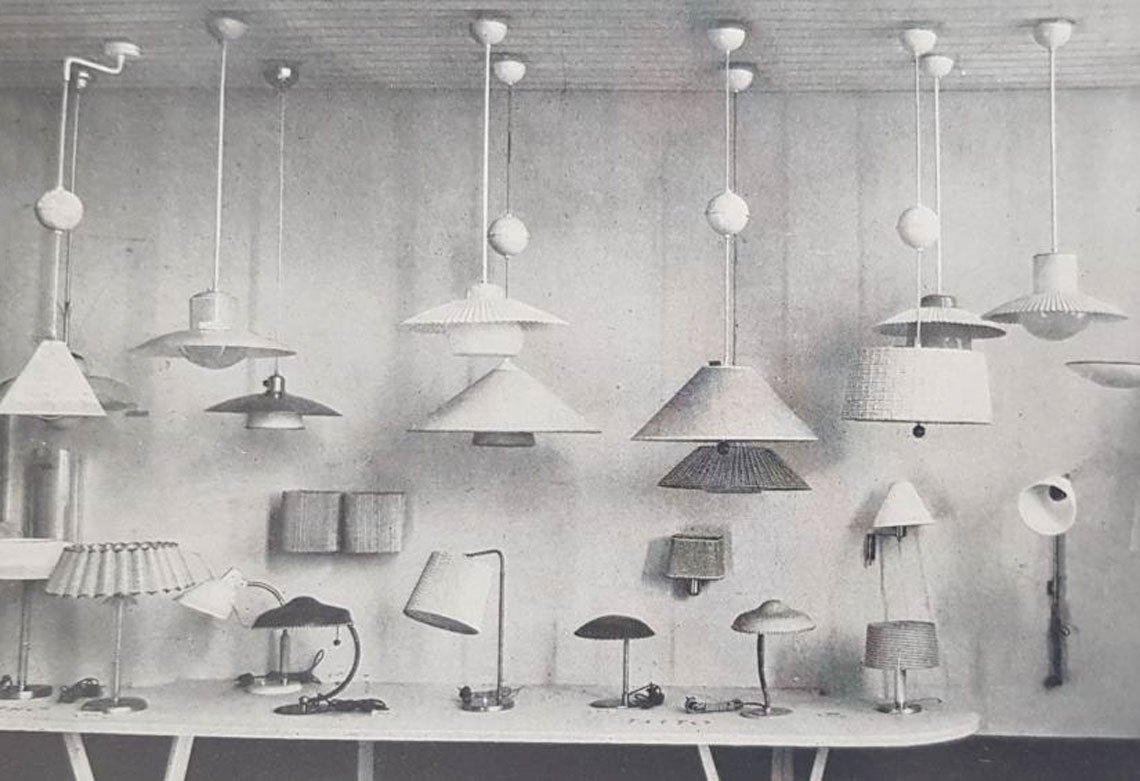 |
| Adjustable models pre the counterweight design, exhibited in Stockholm in 1941. |
These early designs often relied on a ball mechanism in which the electrical cord itself played an active role in the adjustment, which meant it was wrapped, tensioned, and subjected to friction. In some models, the counterweight was already used, but it also incorporated the cord itself in the mechanism. This was apparent in models like the A1998 and A1967, 1968, and 1969.
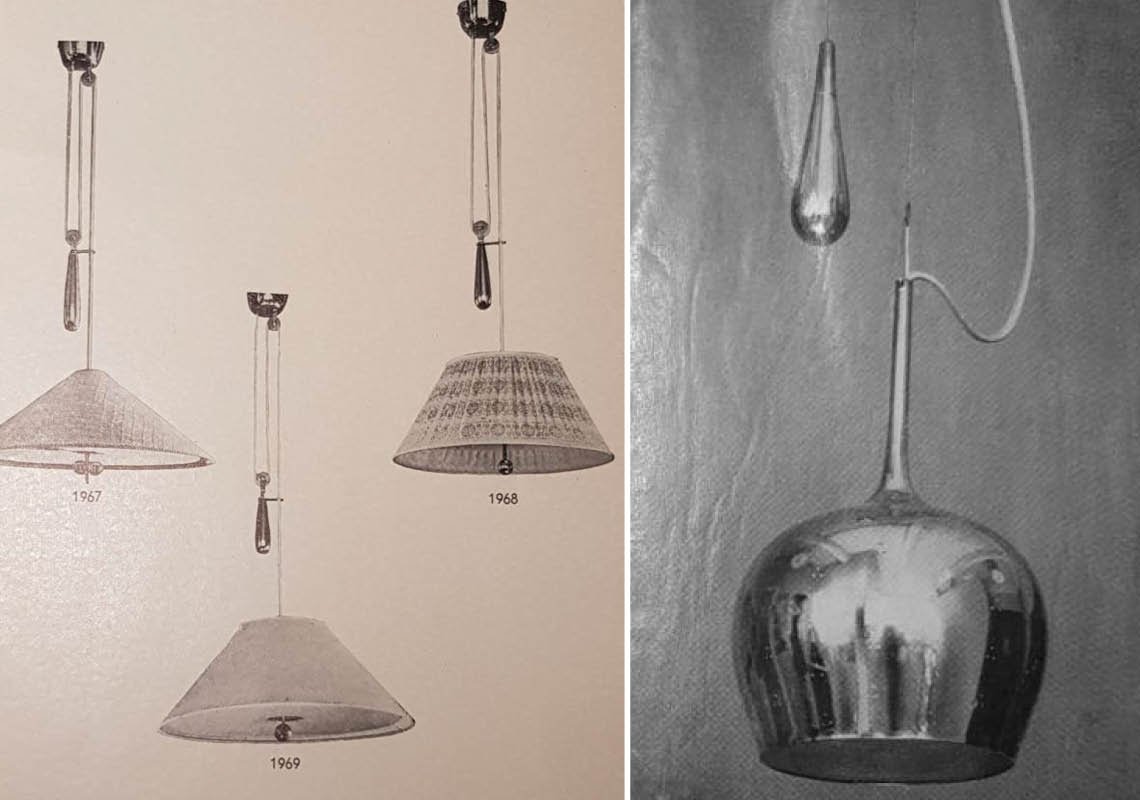 |
| Left: Adjustable models that incorporated the wire in the mechanism. Right: The model 1957 with the free hanging counterweight. |
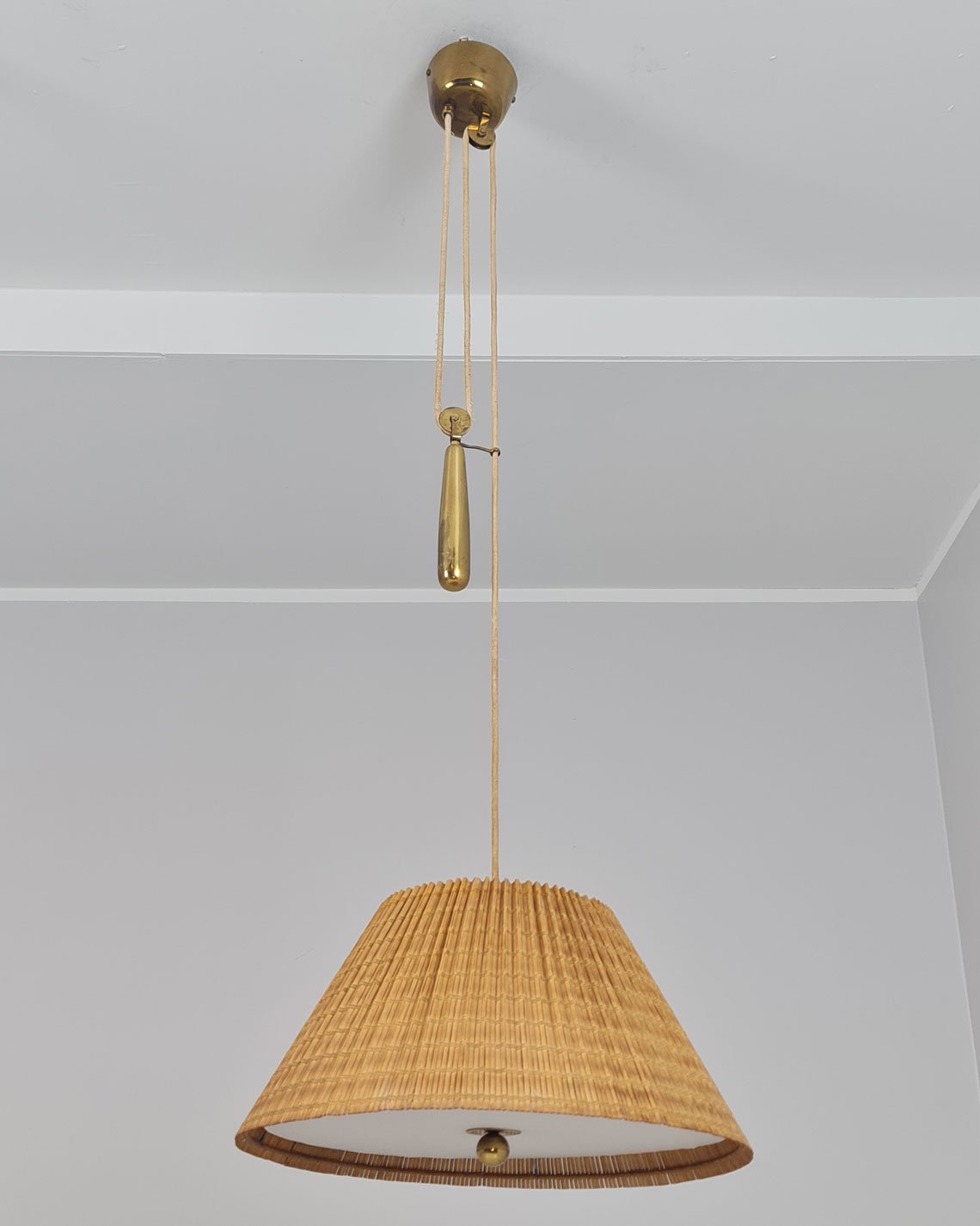 | 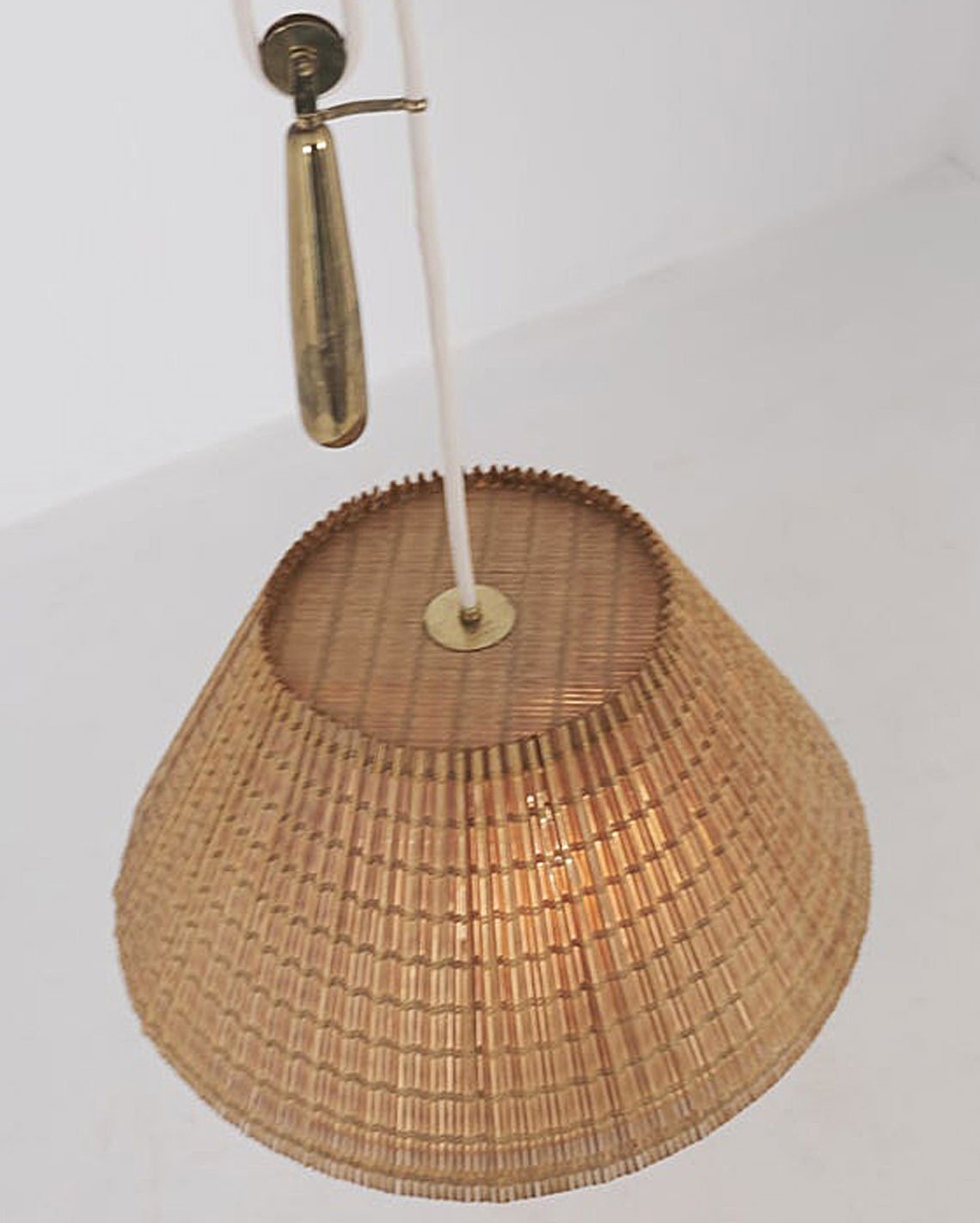 | |
Model 1968 Adjustable Ceiling Lamp with rattan shade that produces softly filtered, warm atmospheric light. Available from Haddadin Design on Incollect. | ||
And this is where the problem emerged. Mid-century American safety standards, shaped by Underwriters Laboratories and the National Fire Protection Association, did not prohibit lamps from hanging by cords. However, they imposed strict limitations on how flexible cords could be used. According to long-standing provisions of the National Electrical Code, flexible cords were permitted for use with luminaires, but with clear limitations:
“Flexible cords and cables shall not be used as a substitute for the fixed wiring of a structure.”
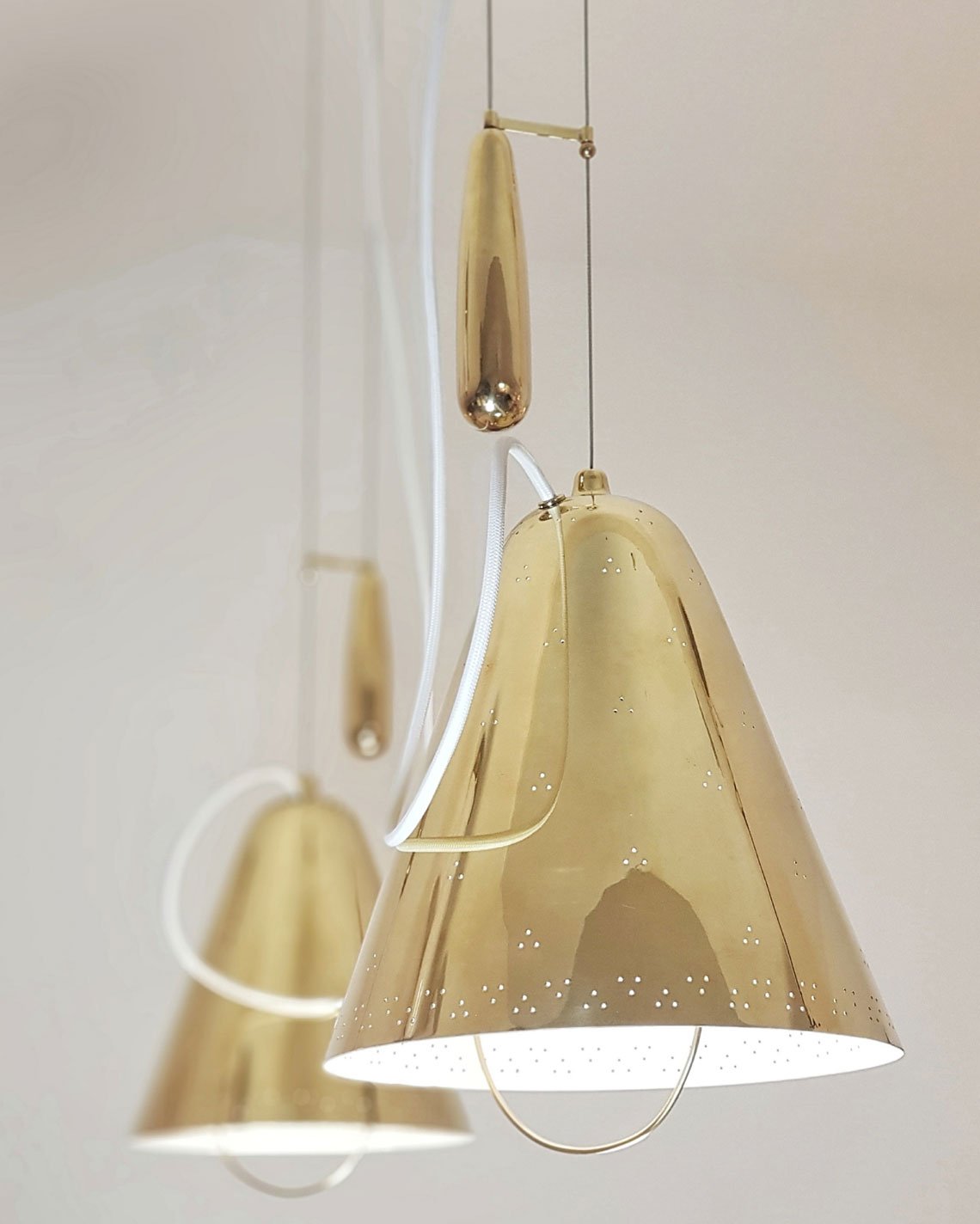 | 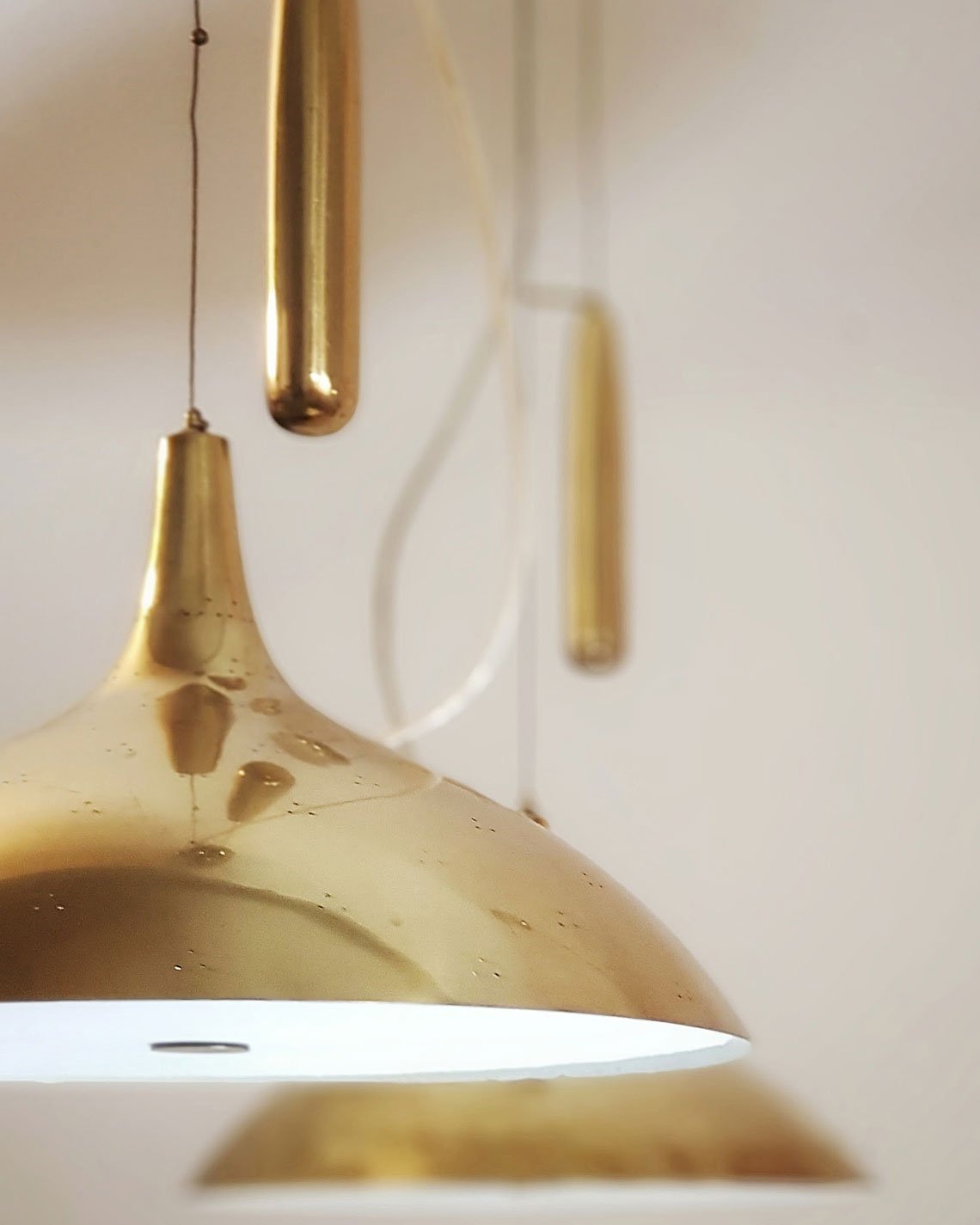 | |
Model A1942 (left) with curved handle and A1965 (right) | ||
They were also not permitted where subject to physical damage or mechanical strain and had to be installed so that tension was not transmitted to electrical connections. In practical terms, this meant that while a lamp could hang from a cord, the cord itself could not function as part of a mechanical adjustment system. Although similar designs existed in the United States with cords integrated into such mechanisms, the imported Taito lamps were apparently required to meet stricter limitations in order to obtain the UL seal of approval. A distinction that was noted in the Finland House catalogues.
Another important aspect was that all Finland House lighting fixtures were “Union Wired to insure compliance with high American standards.”* This meant they were “expertly wired by the skilled craftsmen of the International Brotherhood of Electrical Workers.”* If lamp fixtures were shipped to the United States without electrical cords, assembling them later, especially when incorporating adjustable systems, could prove highly challenging. Delivering the fixture body separately and adding the wiring afterward may have helped manage this complexity.
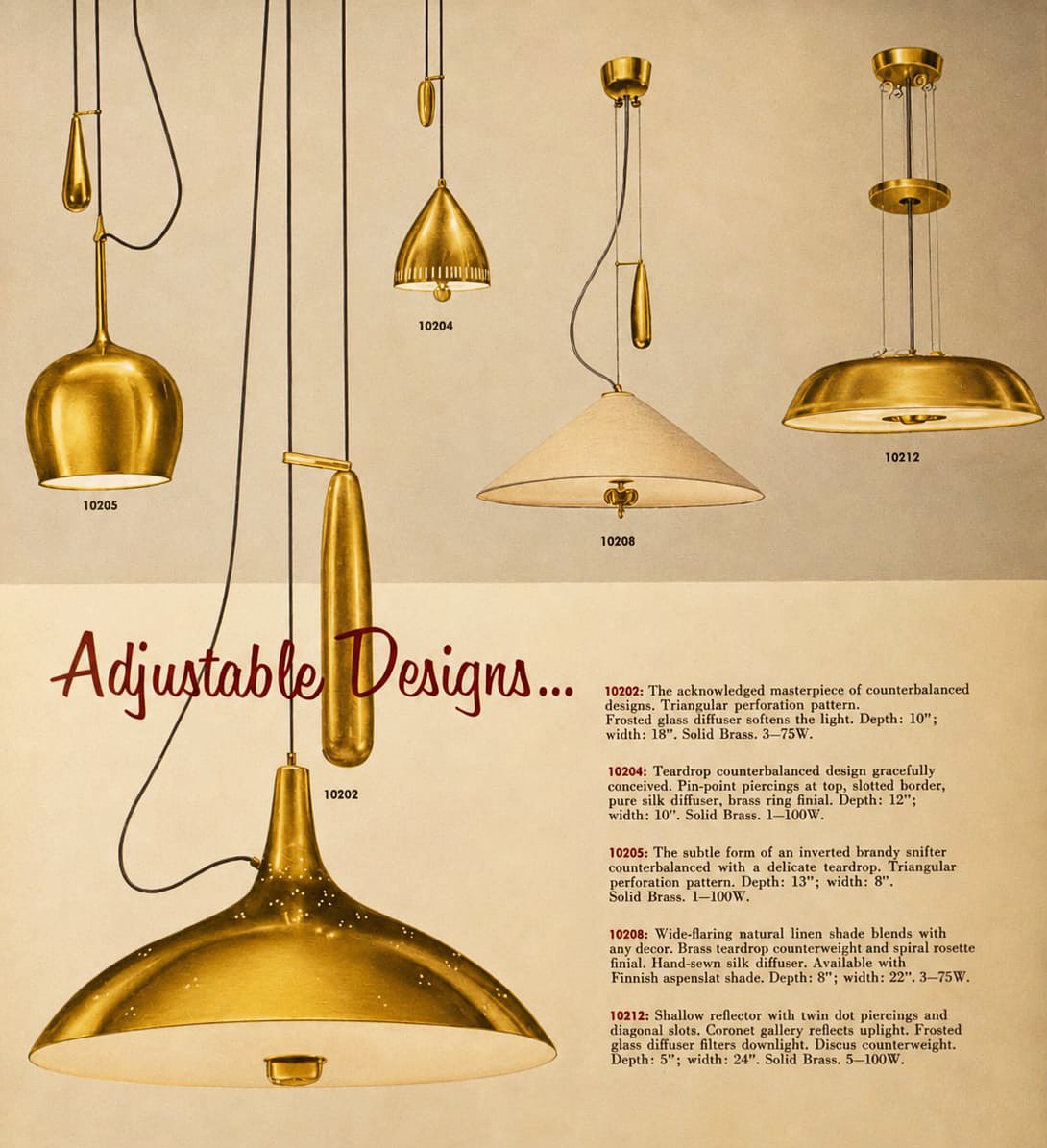
These constraints became the cornerstone for one of Tynell’s most significant innovations. Rather than relying on the cord, Tynell reimagined the entire adjustment system. The first models featured a counterweight mechanism that eliminated mechanical stress from the electrical cord entirely.
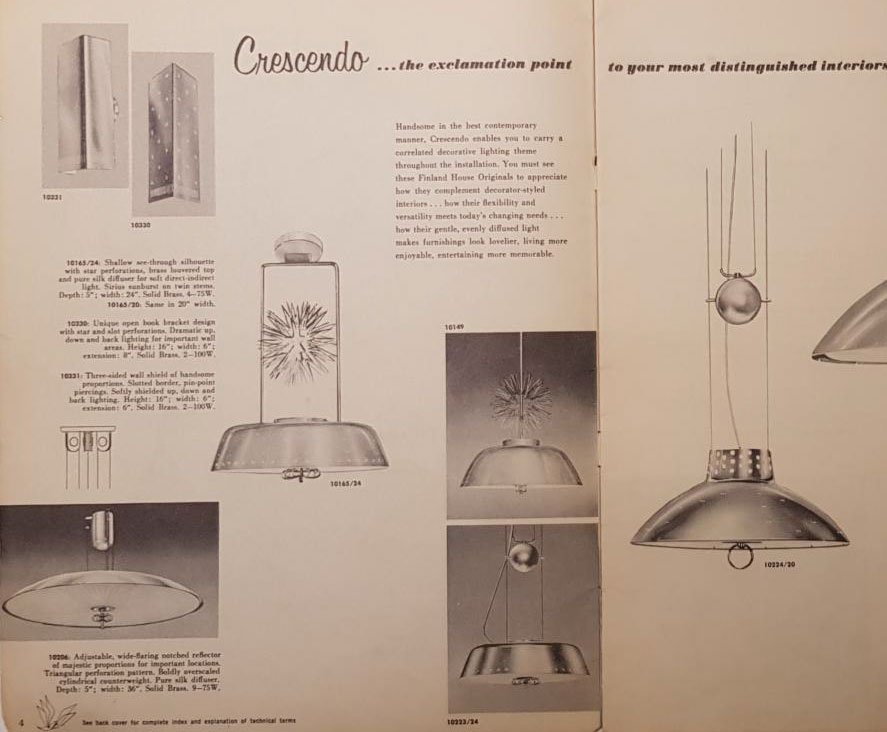 |
| Adjustable models 10206, 10223, 10224. |
Early versions featured a freely hanging counterweight suspended on a metal wire, which was later refined through the introduction of guiding rails and a pulley to stabilize movement and prevent contact with the cord. From this point onward, the development did not stop. Tynell went on to design a wide range of adjustable models like the 10206, 10223, and 10224, and many commissioned ones, each exploring new mechanical and aesthetic possibilities.
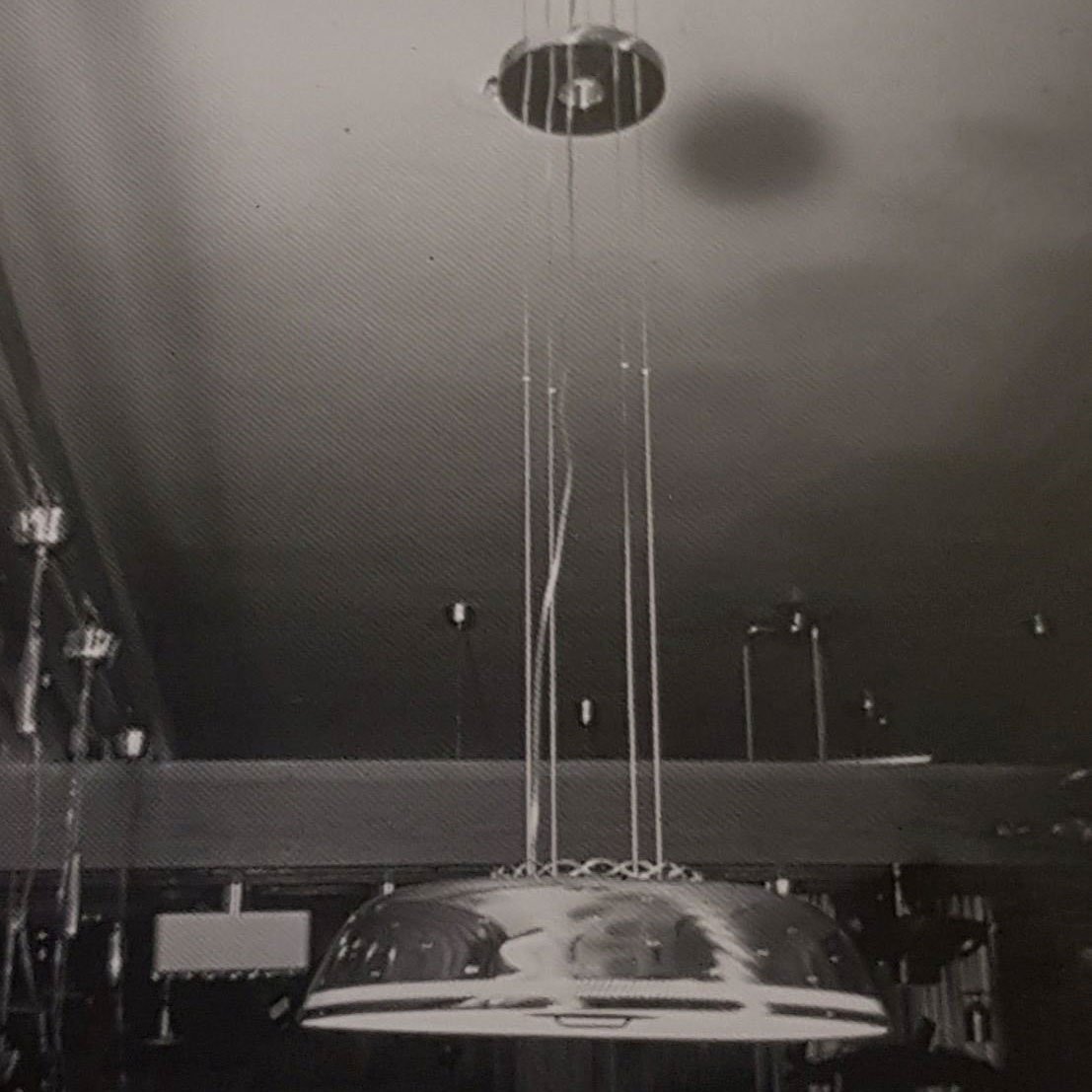 | |
| Adjustable lamp with disc-shaped counterweight. |
The counterweights themselves evolved into decorative elements: discs, barrels, and spring-integrated forms, transforming a technical necessity into a defining visual language.
One issue, however, remained when reviewing images from the Finland House exhibitions and catalogues. Some lamps still appeared to feature the very ball mechanism that seemed to be at the root of the problem.
At closer inspection, the answer becomes clear. The ball itself was not a counterweight and was no longer part of the adjustment mechanism. In these models, such as the 1942 or 10113, the ball was described as “a decorative brass sphere on stem” or “ornamental brass ball”.
This subtle but crucial shift resolves the apparent contradiction. The form remains, but the function has changed.** It is this final piece that brings the entire narrative together. A compelling example of how form follows function, or perhaps more precisely in this case, how form follows the need to comply with regulation for function to exist at all. Moreover, a decade after these first models appeared in the U.S., Tynell re-introduced the ball adjustable mechanism, which means there is much more to unravel.
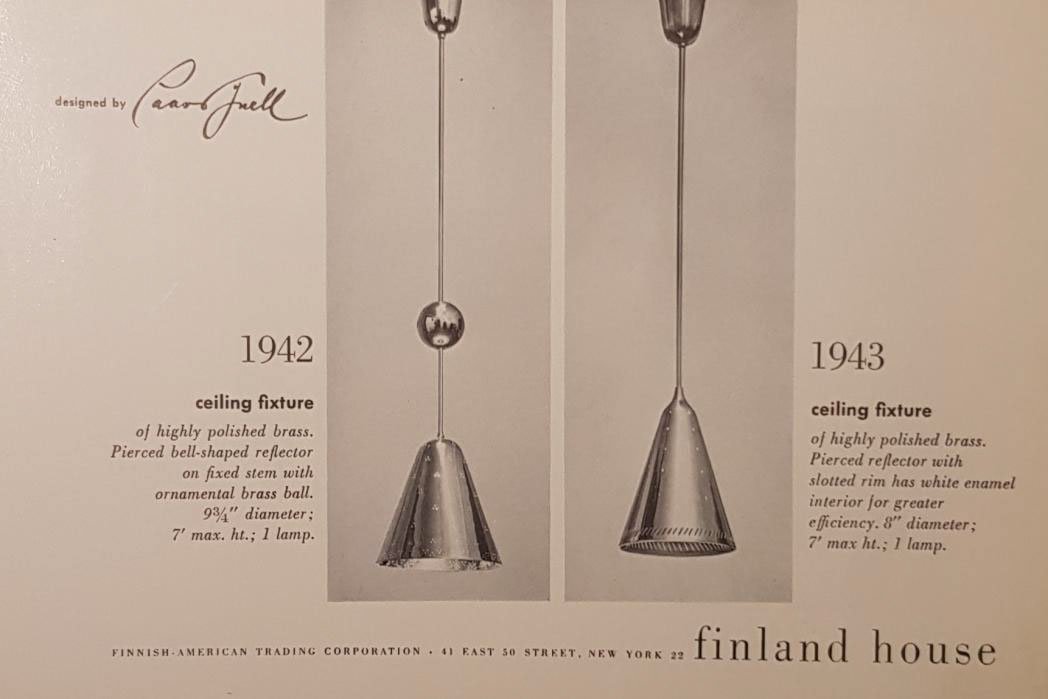 |
| The model 1942 featuring a “fixed stem with ornamental brass ball.” |
This research emerged as part of Haddadin Design's ongoing work in documenting Tynell’s designs. In the process, details begin to surface, insights, small inconsistencies, overlooked features, and technical decisions that reveal a much deeper story behind the designs. What initially appears straightforward often turns out to be far more complex. And it is within this process that many of these hidden aspects begin to unfold. There is still much to uncover in the fine details of these restrictions and “double standards” in regulations, but each step brings us closer to understanding not just the Tynell designs themselves, but the genius thinking behind them and the conditions that shaped them.
* Direct quotes from the sales catalogue: Finland House Lighting: Harmony in Lighting for Harmony in Living, Original Designs by Paavo Tynell, New York 1955.
** Years after the first models appeared in the U.S., Paavo Tynell reintroduced the adjustable ball mechanism. However, these later models appear to feature a mechanism different from the one Taito Oy used in the 1940s. This leaves an open question regarding the finer details of the regulations or the designs themselves that remains to be unraveled.
References:
Finland House lighting catalogues
Taito catalogues no. 16, Helsinki 1936
Idman Hankkija catalogue, Helsinki 1940s
Idman catalogue no. 136, Helsinki 1954
Markkinat Messut ja Näyttelyt, Harry Röneholm. Helsini Suomen messut 1945 Ornamo yearly book, 1952
Architecture and Design Museum Archives.
Paavo Tynell and Taito Oy. Marianne Aav, Eeva Viljanen, Poutasuo, Tuula, and others, Design Museum Helsinki, 2005.
National Electrical Code (NEC), Article 400 – Flexible Cords and Cables.
Underwriters Laboratories (UL) Standards for Portable Luminaires (mid-20th century principles).
 |
Discover More From Haddadin Design on Incollect
 |