









How Old Master Paintings Bring Elegance, Craft and Meaning to Interiors
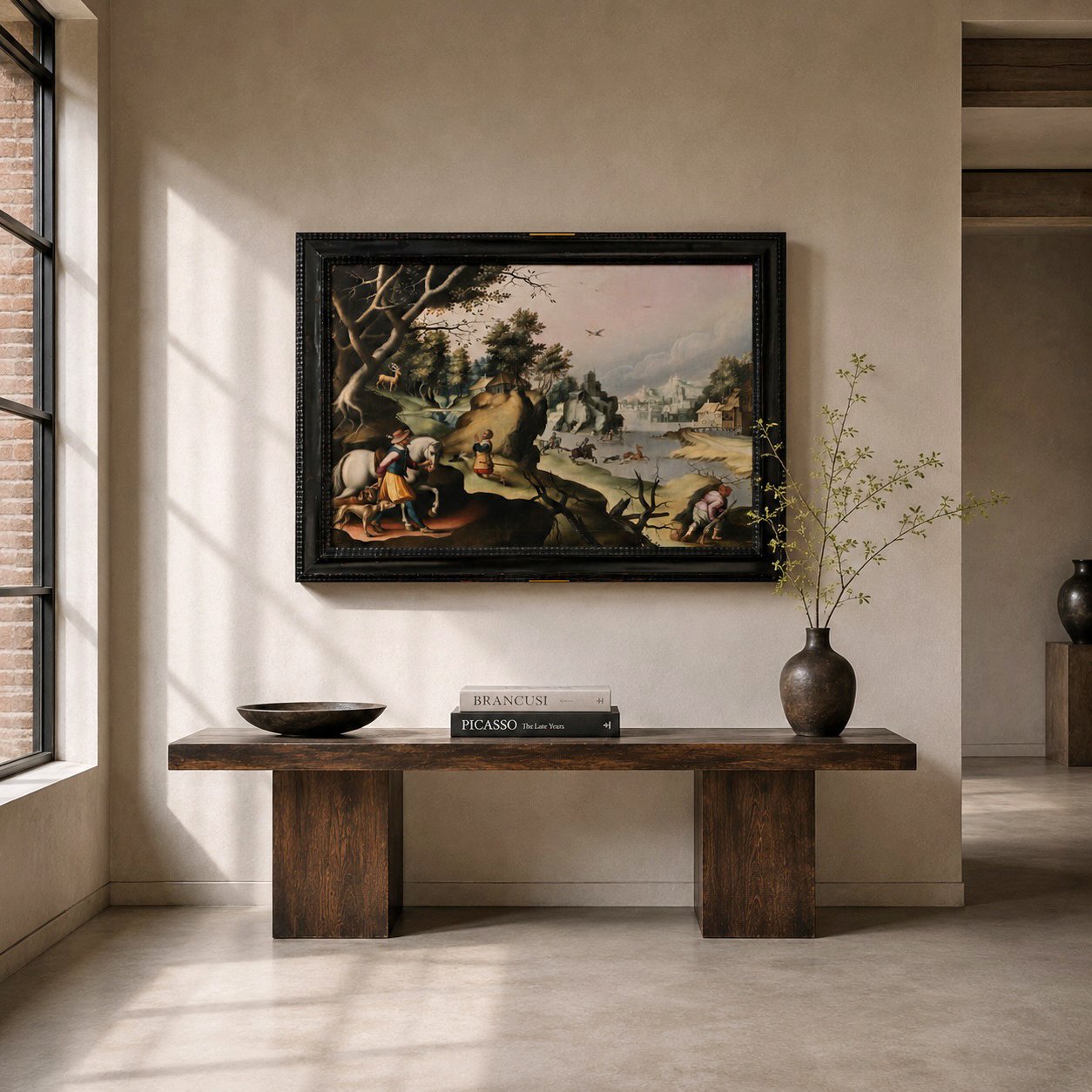 |
The Conversion of St. Hubert, Circle of Jan van der Straet (1523–1605). Oil on canvas, framed size approx. 44 x 57 inches. |
 |
The Legend of Saint Hubert was one of the most popular legends of the Middle Ages. Hubert was born in the mid-Seventh Century to a noble family in what is today Belgium. His passion was hunting, to which he devoted all of his free time. While out hunting a large stag one Good Friday (instead of being at church), the animal turned and Hubert saw a vision of a crucifix between its magnificent antlers: this was the conversion of Hubert, who renounced his titles and went into the priesthood. |
How Old Master Paintings Bring Elegance, Craft and Meaning to Interiors
by Benjamin Genocchio
 | |
William Avery, photo courtesy William Avery Fine Art |
William Avery studied history and art history at Princeton University, sparking a lifelong love for European Renaissance art. His expertise is in Northern Renaissance art, which forms the basis of his London-based gallery collection of Old Master paintings. He is a collector himself, and over the years has made notable art historical discoveries, including works by Frans Francken the Younger and the Spanish Renaissance master Juan de Borgoña. Incollect sat down with him to discuss the pleasure of having works of art historical significance in the home.
William Avery Fine Art has long championed work that exists at the intersection of art, religion, history and architecture. How do you define that overlap today, for those contemplating owning these masterpieces?
 |
Art, religion, and history were often synonymous in the Middle Ages. Art was religious art, and much of the history being recorded was drawn from the stories of the Bible. The paintings therefore captured the intersection of three things that were central to everyone’s life. To experience that intersection today is to bring the way people lived in the Renaissance into your home, and to be reminded of why religion mattered deeply: it provided instruction and guidance for daily life. It was the lens through which people understood the world, particularly before the scientific revolution and the Enlightenment.
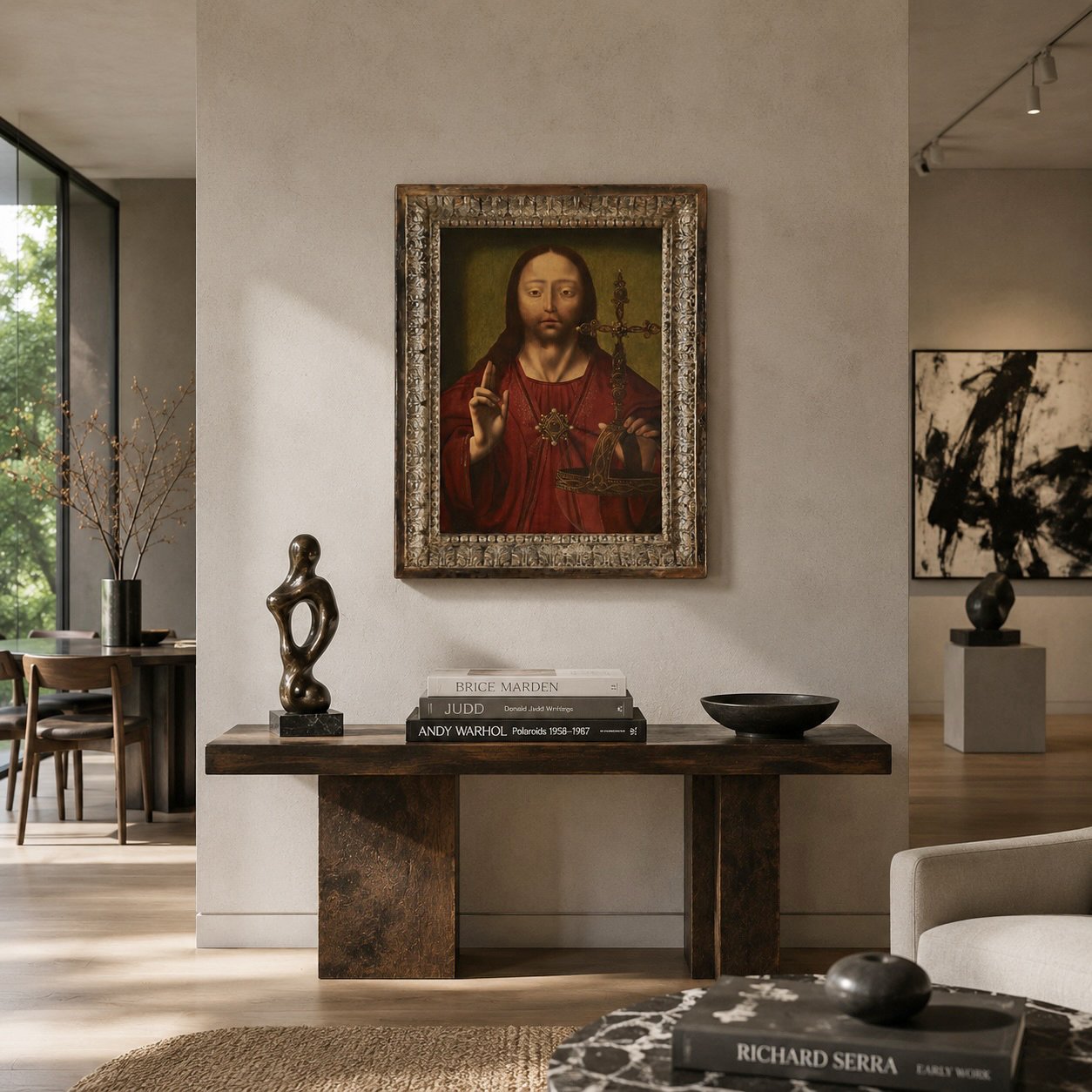 |
Christ as Salvator Mundi, Followers of Joos van Cleve (1511–1540/1). Oil on canvas, framed size 25 x 18 inches. |
What originally drew you to collecting and dealing in Old Master paintings?
|
It goes back to my university days. I took a course in Italian Renaissance art at Princeton, and it got me completely hooked. I began visiting cities with great Renaissance collections and took a student job at the University art museum, which gave me the chance to really be around the paintings, to understand what it is to live with them, and to appreciate the importance of public collections as a tool for communities to engage with works of art. Career and life took different directions for a while, but this was always a through line.
Your collection spans many centuries and European cultures. What tends to unite the works you are drawn to?
|
I'm particularly drawn to the 16th Century, the peak of the Renaissance. If you think about northern Europe at that time, there was enormous social upheaval: wars, political instability, turbulence of every kind. And yet these paintings survived, and gave their owners a degree of stability in deeply difficult times. They are, in that sense, relics and treasures from another world, one that was in many ways profoundly different from our own, and in other ways similar.
Has the definition of "Old Masters" shifted over recent decades, and if so, how?
 |
The category is fairly consistent; broadly, it’s paintings from the 18th century or earlier, and its usage has remained steady.
Many of the works in your collection celebrate labor-intensive processes and great formal skill. Why do you think collectors and designers are increasingly drawn to that kind of craftsmanship?
|
These painters were members of a profession, a protected trade, governed by guilds with genuine standards. To enter a guild, you needed to apprentice with a master, demonstrate a certain level of skill, and pass certain tests. The artistry was taken seriously because it was inseparable from the profession itself. You would never have thought of splashing paint on a canvas and calling it art. There was a close fusion between artistry and craft. Today’s art operates differently; it is, to a great extent, a market-driven phenomenon, where technique is secondary to the overall reception.
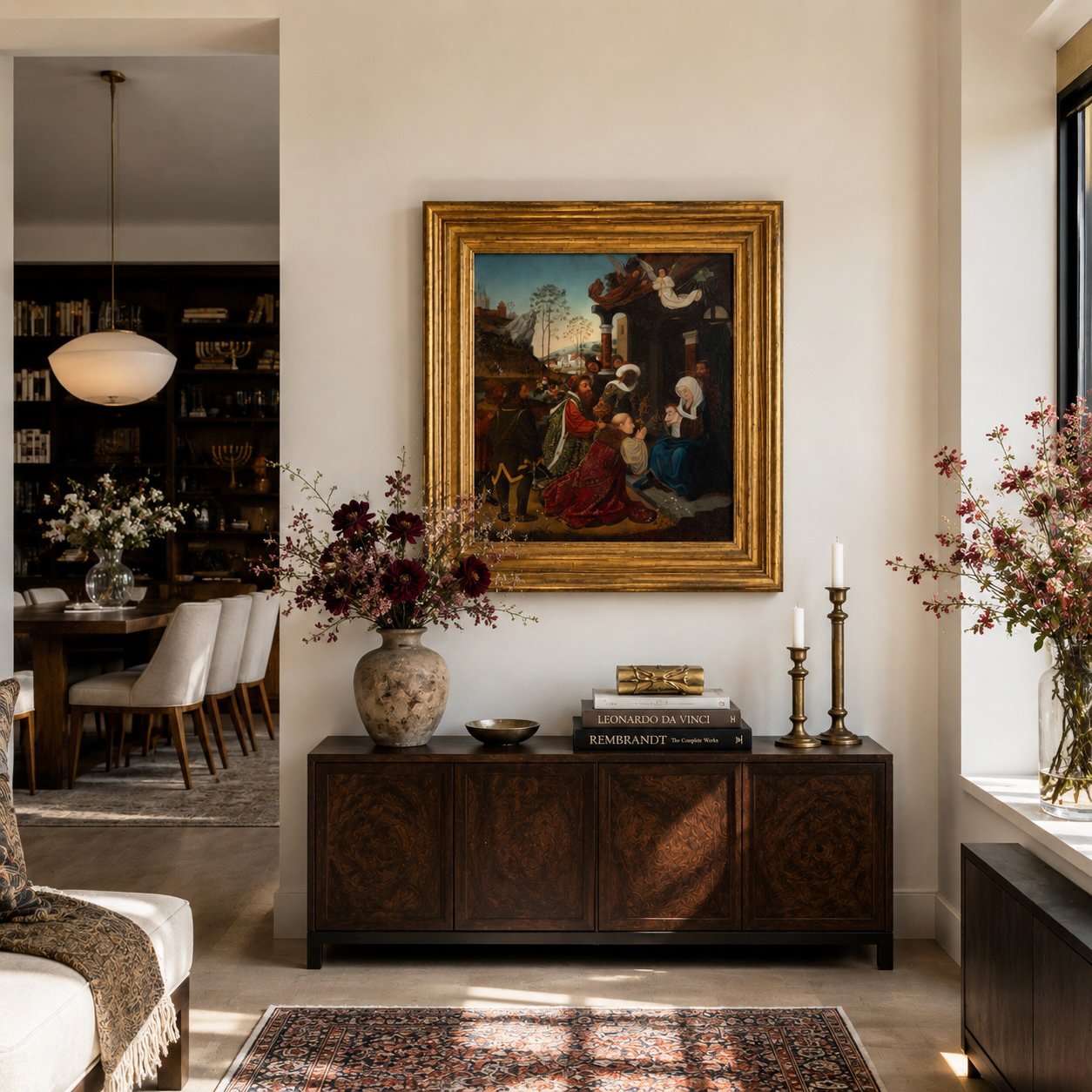 | |
The Adoration of the Magi, After Quinten Massijs (1466–1530). Oil on panel, framed size approx. 22.4 x 19.7 inches.
The Three Kings, resplendent in their royal robes, kneel before the Christ Child, symbolizing the rule of the divine over the earthly. The detail and color of the robes shows are expertly rendered, as are the solemn faces of the Kings. The Christ Child himself is almost smiling, as he leans toward the Kings from the safety of Mary’s sure hands. Behind the Kings two curious shepherds peer from behind a pillar, as angels hover above the manger beside the star that has guided the Magi to the Christ Child. The artist infuses the scene with holiness and humanity. |

Is this one of the reasons why people are still drawn to these paintings today?
|
I think collectors and designers are increasingly drawn to Old Masters precisely because of what that earlier world represents: a time when the profession of painter demanded rigorous training, when skill was not optional, when the making of something beautiful was considered both an art and a trade worth protecting.
How important is attribution in the artworks you collect?
|
It depends on the work. We have pieces with firm attributions,where the signature and the hand of the painter matter enormously. We have contemporary copies from the workshop or school of a known artist. And we have paintings by unknown hands who will probably remain unknown. Beautiful works that have survived the centuries without any recorded name attached to them. There are many such works in famous museums too, and I find something rather moving in that. It reminds me a little of the Tomb of the Unknown Soldier. All these artists toiled for centuries, contributing to a profession, leaving behind beautiful things, and we simply don't know who they were. When you have a firm attribution, that is a welcome addition to a painting. But when you don't, you are forced to engage with the work entirely on its own terms, without the frame of a known name, and that can actually allow you to see it more directly, more deeply.
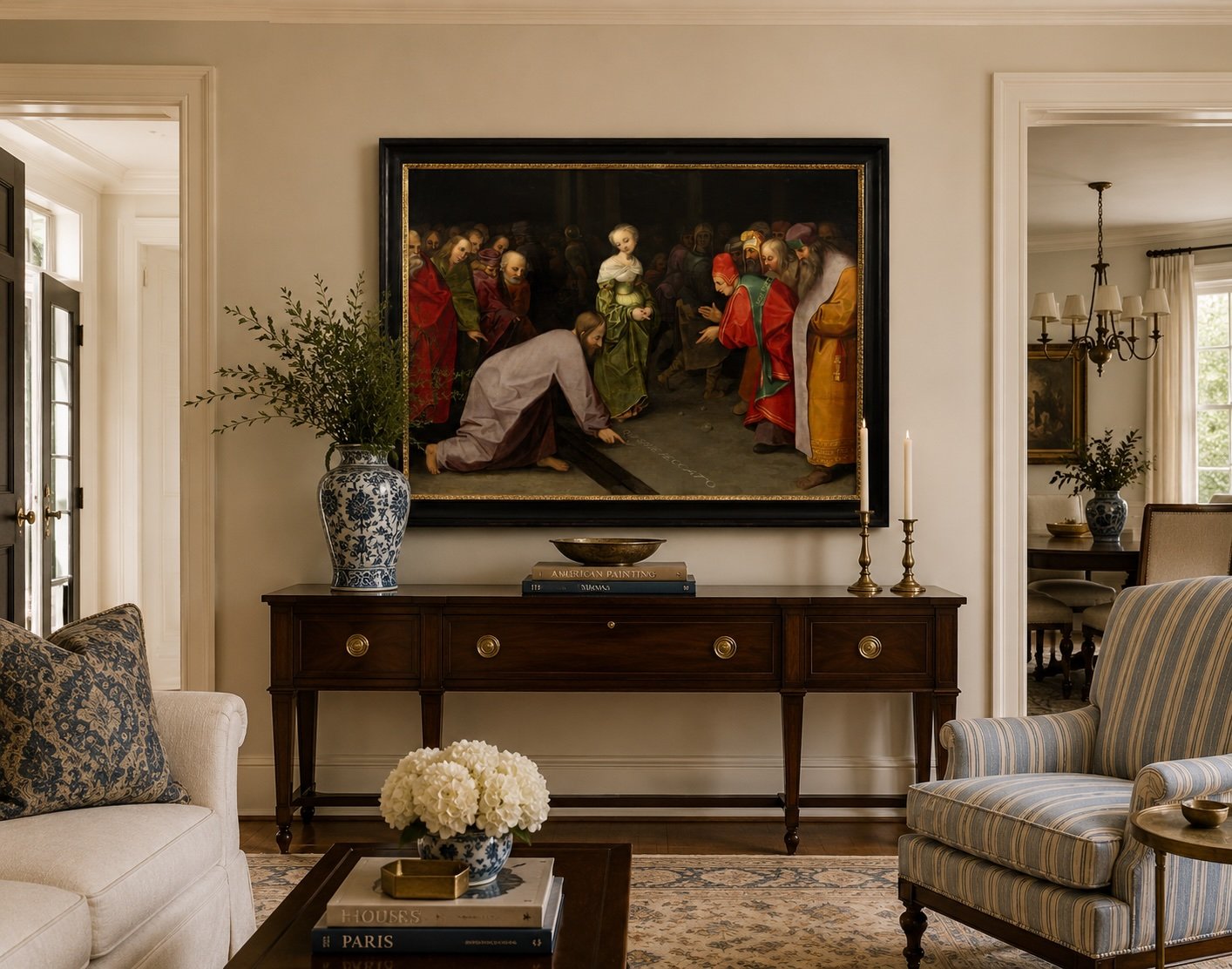 | |
Christ and the Woman Taken in Adultery, Follower of Pieter Brueghel the Elder (ca. 1525–1569). Oil on panel, framed size approx. 42 x 54 inches.
Our painting tells the story, from the Gospel of John (8:1-11), of Christ’s defense of a woman caught in adultery, who was brought to him by the Scribes and Pharisees. It is here that Christ utters his memorable challenge to her accusers, “He that is without sin among you, let him first cast a stone at her.” |
In an era shaped by AI and digital fabrication, do you think handcrafted work carries a different meaning now?
|
I certainly hope so! I think we're in serious trouble if we lose ourselves entirely to the digital world. The fact of the matter is that most of us have to be online to work, to earn a living, to stay in touch with family and friends. But we need balance. We need things that are real, that we can touch and feel, that have texture and brushwork, that carry emotion and were made by the hand of a human being. I find, personally, that if I have spent a day on screens of every size and then come home to one of these paintings, it grounds me. It brings me back. We are human beings, embodied in flesh and blood; we are born, we will die, just as everyone before us did, and these paintings help us hold onto that fact.
What conversations are you having with collectors today that perhaps you weren't having five or fifteen years ago?
|
There has been a real reawakening of interest in Old Masters, and particularly in works with religious themes. Some of those collectors are motivated by love of the art and the period, some by the subject matter itself. But what I find most interesting is a new kind of collector, someone who has never collected art before, who perhaps never thought of themselves as a collector, but who encounters these works and thinks: wouldn't it be wonderful to have something like that in my home? They see these paintings as family heirlooms, things they will own and pass on. There is a younger generation now, owning homes in the United States and in Europe, who are thinking about something that represents their values and makes a statement to their family and friends about who they are. A carefully chosen Old Master can do exactly that.
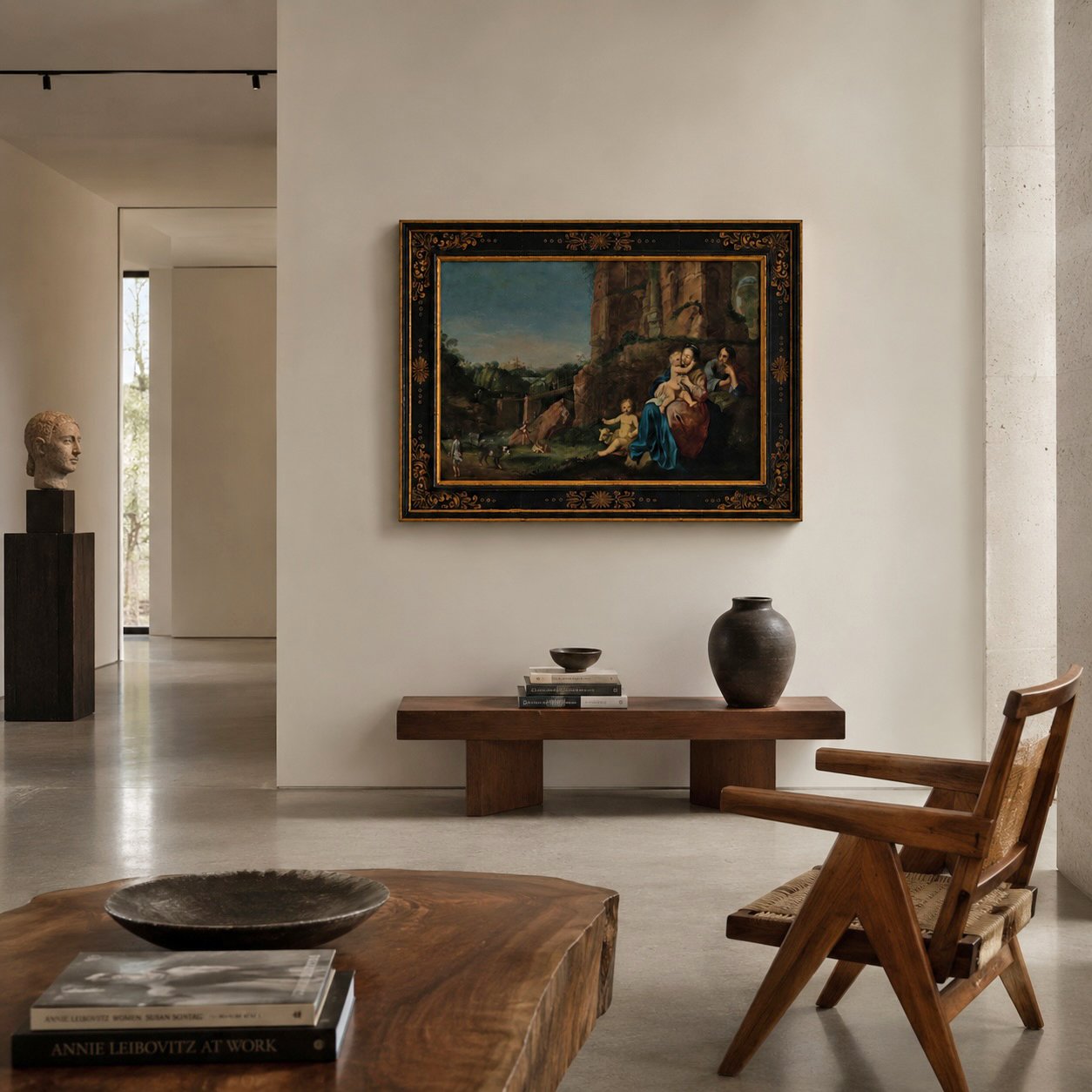 | |
Landscape with the Rest on the Flight to Egypt, Circle of Bartholomeus Breenbergh (1508–after 1657). Oil on copper, framed size 24 x 32 inches.
The subject depicted in our painting was a popular one during the Renaissance: the Holy Family resting during their Flight to Egypt, where they went to escape the murderous Herod. The Christ Child embraces Mary and presses his cheek to hers, as Joseph looks on. The Holy Family is shown with John the Baptist, a popular addition to the traditional Flight to Egypt iconography, the legend having grown, around Matthew’s minimal account, that the Holy Family met the infant John during their journey. John is holding a reed cross (partially obscured by Mary’s cloak) with a lamb lying at his feet, a reference to his saying about Christ: “Behold the Lamb of God, which taketh away the sin of the world”. The infant John is looking directly at us and gesturing to the lamb, as if to remind us of the sacrifice of Christ’s life that is to come. |
Do you work with interior designers, and how has that relationship evolved?
|
Yes, and it's a growing part of the market for Old Masters. What I find when speaking with interior designers is that they often come with a concept already agreed with a client, and they want to bring something unique to the equation. Something that will distinguish their work. They get to know their clients well over the course of a commission, and when they judge that a client would be receptive to an Old Master, it becomes a way of making the project truly singular. Particularly in contemporary interiors, the mix of old and new is working very well right now. Designers see Old Masters as a way to bring something irreplaceable into a space, and often the client hasn't thought of it at all, so the designer opens up an entirely new possibility. For the client moving into a new home or having a space refurbished, there will be many familiar elements, but something that genuinely refreshes a room, or lends a contemporary space a touch of elegance, history and depth, is always welcome.
What would you say to someone beginning to bring Old Master works into their home?
|
Start. And start small. Find one piece that fascinates you. My test is always: do you keep coming back to the image? If you find yourself drawn to something, whether in a gallery or online,if you return to it, if something pulls you back, then there is something about it that speaks to you, and you should listen to that. Buy one painting, put it somewhere in the house where you will see it often, and you will experience what every owner of Old Masters eventually discovers: the painting looks different at different times of day, it changes with the light in the room, you notice something new in it every time you walk past, and you have a different experience with it every time you stop to look. Then go from there.
How do you help clients think about placing Old Master paintings in contemporary living spaces?
|
A great deal of it comes down to contrast. You might have a very large, bright contemporary space where a painting with a serious subject, a crucifixion, a biblical scene, is placed, and the contrast itself is what makes it work. Interior designers are excellent at this: at thinking about how old and new speak to each other, about how to use a painting's colors in relation to the room around it. What I encourage collectors and designers to do is think creatively and not be afraid. Don't be afraid to mix old and new. Don't be afraid of contrast. Don't be afraid to put a serious subject in a bright space. Make sure larger works are given proper room to breathe. In larger American homes in particular, there is ample space in living rooms, hallways, and entranceways for some of the substantial Old Masters. Give the painting its due.
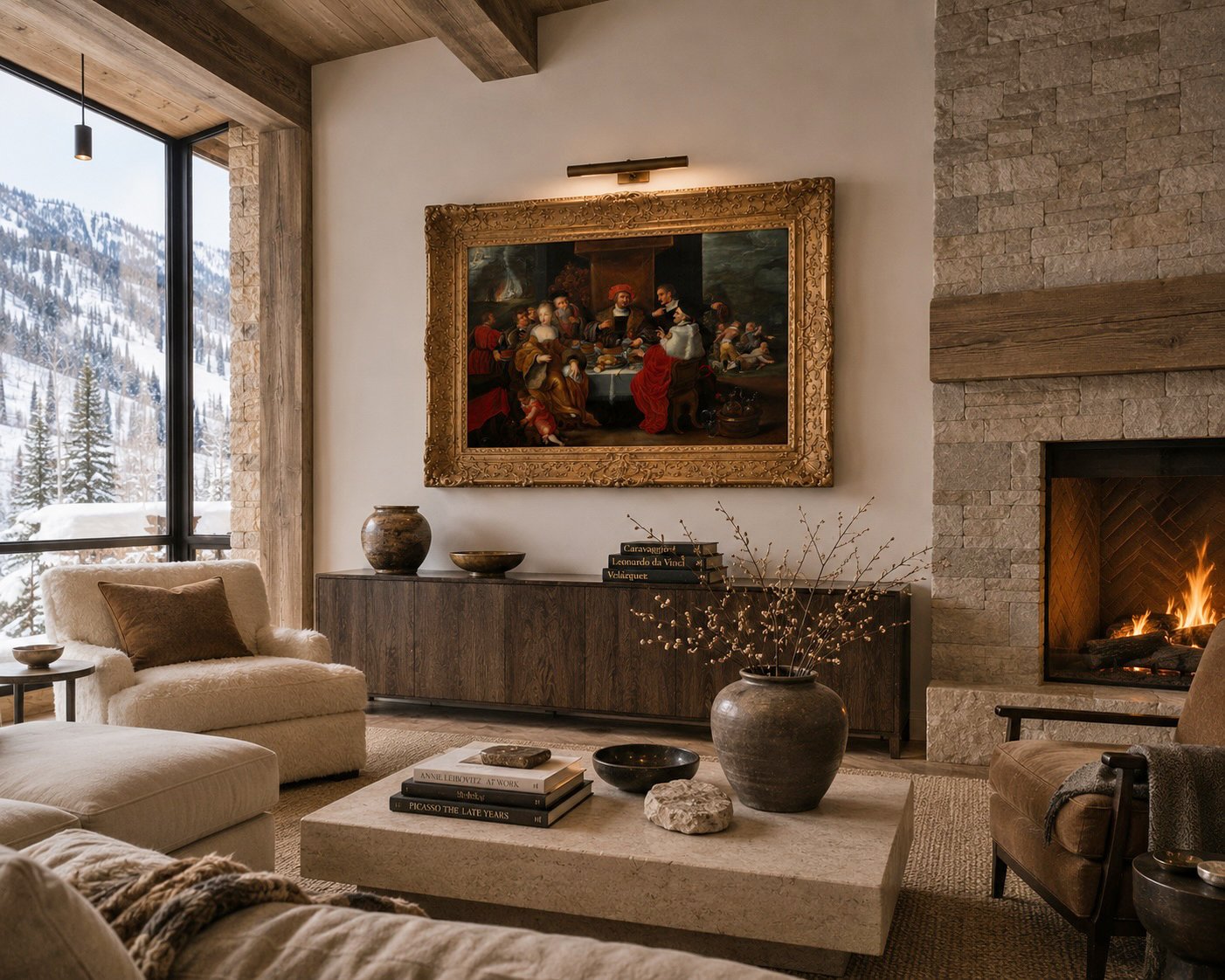 | |
The Parable of the Rich Man and Lazarus, Hieronymus Francken (1541–1610). Oil on panel, framed size approx. 28.7 x 40.2 inches.
This painting is distinguished by its narrative composition, telling a complex story whilst staying true to the details in the Gospel. Still today, it carries a timeless message about compassion for those less fortunate. |
Is there a growing appetite for Old Master work that carries narrative, cultural or social meaning beyond pure aesthetics?
|
That is actually a very good description of the category as a whole. These painters frequently worked with a lesson or message in mind, painting for an audience they were trying to reach. Even the still life, perhaps the one genre that appears to be purely aesthetic, often carries deeper meanings about mortality and beauty. What you get with an Old Master is rarely just a pretty picture. You get meaning. You get something to contemplate. You get depth. And I do think people are increasingly seeking that. Something more than an image that looks good on a wall.
How has digital discovery changed the way you work and how collectors find Old Master paintings?
|
It has opened the market enormously. There are people I engage with online who have questions about a particular painting and have been experiencing art digitally for some time before they considered themselves potential owners. The digital experience is not the same as standing in front of a work in the flesh, but it is a genuine experience nonetheless, and it brings in exponentially more people than would ever have engaged before. Many of those people ultimately become clients. As for my own sourcing, I have bought paintings from all over the world. In many cases I have gone to see them first, but in some cases I have bought sight unseen on the strength of digital images, and made excellent purchases that way. Everyone benefits from that expanded reach.
What distinguishes you from other dealers in your field?
|
Several things, beginning with many decades of knowledge and expertise in this area. We also invest seriously in how our works are presented online: every painting is photographed to the highest standard, and we use AI to generate imagery of the paintings in situ in home surroundings so that a collector in New York or Los Angeles or Singapore can engage with it properly, ask informed questions, and make a considered decision. I am always available for that conversation; that is very much part of how we work. For those who would like to see a work in person before committing, we have a space in London where viewings can be arranged by appointment. It is a quieter, more considered experience than a commercial gallery, and people seem to value that. And then, when a painting is purchased, the experience of receiving it matters enormously to us. Every work leaves us fully restored and ready to hang; conservation is part of what we do, not an afterthought. It is packaged with the care you would expect for something of this age and significance and dispatched by the finest specialist art couriers. From the moment someone decides to buy, to the moment the painting is on their wall, the process should feel seamless and be handled with complete professionalism. That is something I take real pride in.
 |
Discover More From William Avery Fine Art on Incollect
 |