



M. Mary Elizabeth Price
American, 1877 - 1965

Mary Elizabeth Price was born in 1877 to lawyer Reuben Moore and Caroline Cooper Paxson Price, Quakers who lived in Shenandoah, Virginia. When she was still a child, the family moved first to West Virginia, and then to Solebury Township, Bucks County, where her mother had been born. Price spent the rest of her childhood on the farm in Solebury Township, just north of New Hope.
A genetic disposition toward art seems to have run through the Price family. Her brother, F. Newlin Price, was the owner of the well-regarded Ferargil Gallery on West 57th Street in New York. From 1914 to 1943, many of the leading American painters, including the Pennsylvania impressionists, sold their work through this gallery. Another brother, R. Moore Price, was also an art dealer in addition to being an accomplished framemaker, and his wife, Elizabeth Freedley Price, was an impressionist painter. A sister, Alice Rachel Price, was married to Rae Sloan Bredin, a well-known New Hope artist. A third brother, Carroll Price, remained on the family farm in Solebury with his wife, Edith.
Price studied at the Pennsylvania Museum School of Industrial Art (now the University of the Arts) from about 1896 to 1904. She attended the Pennsylvania Academy of the Fine Arts, Philadelphia, from 1904 to 1907, where her teachers were Hugh Breckenridge and Daniel Garber. She also studied privately with William L. Lathrop.
In 1914 Price exhibited at the Corcoran Biennial in Washington, D.C., for the first of seven times. That same year also marked her first exhibition at the Pennsylvania Academy, where she showed again in 1917, 1918, 1923, 1926, and from then on every year until 1943. She exhibited her work at the National Academy of Design, New York, a total of sixteen times between 1921 and 1943, and it was there, in the 1927 exhibition, that Price received the women artists known as the Philadelphia Ten, she regularly exhibited with the group from 1921 until their last exhibition in 1945.
In 1917 she went to New York and conducted the "Baby Art School," an innovative program underwritten by Mrs. Harry Payne Whitney and previously known as the Neighborhood Art School of the Greenwich House. Children from nearby public schools were taught the fine arts of drawing, painting, sculpting, pottery, and wood carving. The idea was so successful that Carnegie Institute of Technology in Pittsburgh asked her to stage an exhibition of the children's work in the winter of 1919-1920, in conjunction with an art education campaign for teachers and supervisors in art.
Price was generous in helping others in her profession, often assembling exhibits of works by women artists, which traveled around the country. "There's nothing like creating your own competition," she said. From 1920 to 1927 Price was chairman of exhibits for the National Association of Women Painters and Sculptors. In this capacity, she arranged exhibits of women artists across the United States, in South America, and in Hawaii.
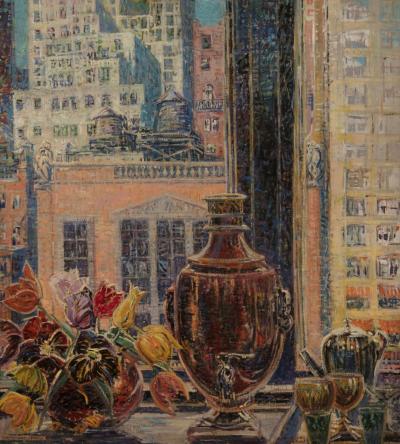
Best known for her floral panels and screens, she revived and employed the methods of the Italian Renaissance painters of Florence and Siena, using gesso and red clay, gold and silver leaf, and a full palette of oil color. On a glistening background of precious metal leaf, bright oil paint was applied, producing dazzling panels of unusually colorful flowers. A critic for the New York Times wrote, "Her work combines a Sienese delicacy of line with a modern freedom in the use of color."
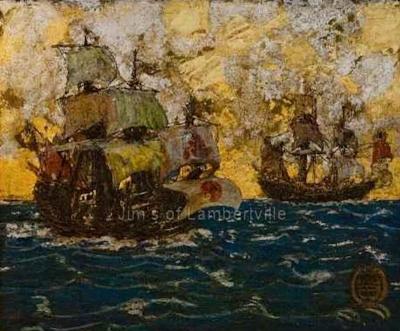
In addition to her well-known floral works, Price also produced landscapes, scenes of village and farm life, and a series of sixteenth-century Spanish galleons, one of which won the Carnegie Prize mentioned earlier. In 1931 she collaborated with another member of the Philadelphia Ten, studio-mate Lucille Howard, on a series of murals for the American Woman's Association clubhouse at 353 West 57th Street in New York. The murals depicted images drawn from traditional needlework samplers stitched by anonymous eighteenth- and nineteenth-century American women and girls.
In the late 1920s Price returned permanently to Bucks County, purchasing the cottage that she and her brother, F. Newlin Price, had been renting for a number of years. She named it Pumpkin Seed, and spent the rest of her life there. "When I first saw the original cottage it was painted such a vivid yellow that I instinctively thought of a pumpkin; and it was so small that I named it 'Pumpkin Seed' more in derision than anything else. But the quaintness of the name grew on us so that we've learned to love it. The lilies, delphiniums, hollyhocks, mallows, irises, peonies, gladioli, and poppies that she grew in her cottage garden became frequent subjects for her floral paintings.
Price died on February 19, 1965, at Mercer Hospital in Trenton, New Jersey. She was eighty-seven.
Biography courtesy of Roughton Galleries, www.antiquesandfineart.com/roughton
A genetic disposition toward art seems to have run through the Price family. Her brother, F. Newlin Price, was the owner of the well-regarded Ferargil Gallery on West 57th Street in New York. From 1914 to 1943, many of the leading American painters, including the Pennsylvania impressionists, sold their work through this gallery. Another brother, R. Moore Price, was also an art dealer in addition to being an accomplished framemaker, and his wife, Elizabeth Freedley Price, was an impressionist painter. A sister, Alice Rachel Price, was married to Rae Sloan Bredin, a well-known New Hope artist. A third brother, Carroll Price, remained on the family farm in Solebury with his wife, Edith.
Price studied at the Pennsylvania Museum School of Industrial Art (now the University of the Arts) from about 1896 to 1904. She attended the Pennsylvania Academy of the Fine Arts, Philadelphia, from 1904 to 1907, where her teachers were Hugh Breckenridge and Daniel Garber. She also studied privately with William L. Lathrop.
In 1914 Price exhibited at the Corcoran Biennial in Washington, D.C., for the first of seven times. That same year also marked her first exhibition at the Pennsylvania Academy, where she showed again in 1917, 1918, 1923, 1926, and from then on every year until 1943. She exhibited her work at the National Academy of Design, New York, a total of sixteen times between 1921 and 1943, and it was there, in the 1927 exhibition, that Price received the women artists known as the Philadelphia Ten, she regularly exhibited with the group from 1921 until their last exhibition in 1945.
In 1917 she went to New York and conducted the "Baby Art School," an innovative program underwritten by Mrs. Harry Payne Whitney and previously known as the Neighborhood Art School of the Greenwich House. Children from nearby public schools were taught the fine arts of drawing, painting, sculpting, pottery, and wood carving. The idea was so successful that Carnegie Institute of Technology in Pittsburgh asked her to stage an exhibition of the children's work in the winter of 1919-1920, in conjunction with an art education campaign for teachers and supervisors in art.
Price was generous in helping others in her profession, often assembling exhibits of works by women artists, which traveled around the country. "There's nothing like creating your own competition," she said. From 1920 to 1927 Price was chairman of exhibits for the National Association of Women Painters and Sculptors. In this capacity, she arranged exhibits of women artists across the United States, in South America, and in Hawaii.
Best known for her floral panels and screens, she revived and employed the methods of the Italian Renaissance painters of Florence and Siena, using gesso and red clay, gold and silver leaf, and a full palette of oil color. On a glistening background of precious metal leaf, bright oil paint was applied, producing dazzling panels of unusually colorful flowers. A critic for the New York Times wrote, "Her work combines a Sienese delicacy of line with a modern freedom in the use of color."
In addition to her well-known floral works, Price also produced landscapes, scenes of village and farm life, and a series of sixteenth-century Spanish galleons, one of which won the Carnegie Prize mentioned earlier. In 1931 she collaborated with another member of the Philadelphia Ten, studio-mate Lucille Howard, on a series of murals for the American Woman's Association clubhouse at 353 West 57th Street in New York. The murals depicted images drawn from traditional needlework samplers stitched by anonymous eighteenth- and nineteenth-century American women and girls.
In the late 1920s Price returned permanently to Bucks County, purchasing the cottage that she and her brother, F. Newlin Price, had been renting for a number of years. She named it Pumpkin Seed, and spent the rest of her life there. "When I first saw the original cottage it was painted such a vivid yellow that I instinctively thought of a pumpkin; and it was so small that I named it 'Pumpkin Seed' more in derision than anything else. But the quaintness of the name grew on us so that we've learned to love it. The lilies, delphiniums, hollyhocks, mallows, irises, peonies, gladioli, and poppies that she grew in her cottage garden became frequent subjects for her floral paintings.
Price died on February 19, 1965, at Mercer Hospital in Trenton, New Jersey. She was eighty-seven.
Biography courtesy of Roughton Galleries, www.antiquesandfineart.com/roughton
 Loading...
