













Offered by:
Jeff R. Bridgman Antiques, Inc.
Historic York County
York, PA , United States
Call Seller
717.502.1281
Showrooms
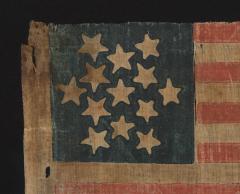
13 Stars Arranged in 6-Pointed Great Star/ Star of David Pattern
-
Description
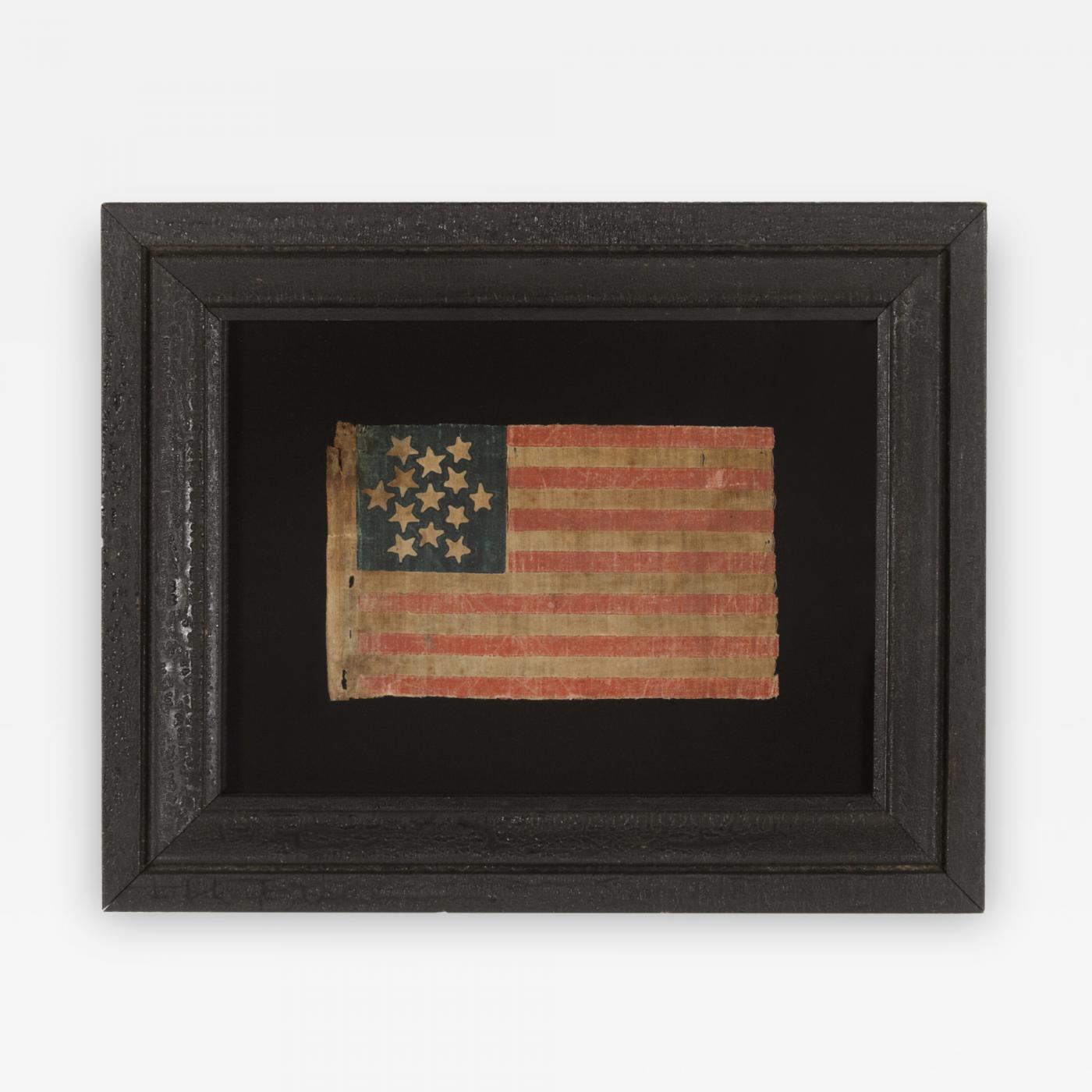
13 STARS ARRANGED IN 6-POINTED GREAT STAR / STAR OF DAVID PATTERN, A RARE AND PARTICULARLY EARLY EXAMPLE AMONG PARADE FLAGS IN THIS STAR COUNT, PROBABLY MADE FOR POLITICAL CAMPAIGNING, CA 1848-1860:
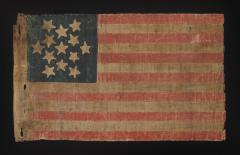
Printed on coarse, glazed cotton, this 13 star American parade flag is one of just four known examples in this approximate size and in this rare style. Its stars are arranged in a six-pointed version of what is known as the "Great Star" or "Great Luminary" pattern, distinguished by one large star made out of smaller ones.
Though the reason behind the decision to select this particular design is not known, several explanations are plausible. One is that it mimics the arrangement of stars found on the Great Seal of the United States, which appears within the cloud-like formation above the American eagle. This can be most ready viewed on the flag of the President of the United States or the back of the U.S. one dollar bill.
In present times, one might identify the design as the Star of David, though this symbol, also known as the Shield of David, was not in widespread use by members of the Jewish faith until the 20th century. It could be that the star configuration draws a connection between this particular flag and a historical example of the Revolutionary War era. No 18th century flags are presently known to have survived with this pattern, however, and I know of none that are illustrated in period paintings or drawings. It may be that the source was simply lost to time, but whatever the case may be, one may note that it does represent the most logical manner by which 13 stars may be arranged in a star-shaped pattern.
All surviving 19th century flags with this star design are extremely scarce, but this one is particularly rare. Other 13 star parade flags are known with the same six-pointed Great Star, but they are significantly smaller size post-date this example, which was probably made sometime between the late 1840's and 1860, the latter date coinciding with Abraham Lincoln’s first campaign. One other parade flag known that is similar in design and scale was found in Elmira New York and is overprinted with black text that reads "Lincoln & Hamlin.” Two others are presently known in the same size, which, like this flag, have no overprinted text.
Prior to the Civil War there was very little private use of the American flag. Most pre-war examples seem to have been employed in political rallies. That is the most likely purpose of this particular flag. One of the others survives on its original wooden staff, which has a square shape instead of the round dowels most typically encountered. Square and otherwise crude staffs are an early trait and, in addition to the manner of printing, fabric and colors, help to date this particular variety.
13 star flags have been flown throughout our nation's history for a variety of purposes. They were hoisted at patriotic events, including Lafayette's visit in 1825-26, the celebration of the nation's centennial in 1876, and the sesquicentennial in 1926. They were displayed during the Civil War, to reference past struggles for American liberty and victory over oppression, and were used by 19th century politicians in political campaigning for the same reason. The U.S. Navy used the 13 star count on small boats until 1916, because it was easier to discern fewer stars at a distance on a small flag. Commercial flag-makers mirrored this practice and some private ships flew 13 star flags during the same period as the Navy. The use of yachting ensigns with a wreath of 13 stars, surrounding a fouled anchor, which allowed pleasure boats to bypass customs between 1848 and 1980, persists today without an official purpose.
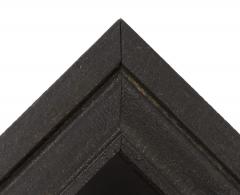
Mounting: The black-painted American molding dates between 1830 and 1860. This is a pressure mount between U.V. protective acrylic and 100% cotton, black in color, which was been washed to reduce excess dye. An acid-free agent was added to the wash to further set the dye and the fabric was heat-treated for the same purpose.
Condition: There is significant soiling throughout. There is moderate fading of the red-orange stripes and there is minor fabric breakdown and loss. Many of my clients prefer early flags to show their age and history of use. The flag presents beautifully and the extreme rarity of this example well-warrants its condition.
Frame Size (H x L): 12.75" x 16"
Flag Size (H x L): 5" x 8.25" -
More Information
Origin: United States Period: 19th Century Materials: Glazed cotton Condition: Good. There is significant soiling throughout. There is moderate fading of the red-orange stripes and there is minor fabric breakdown and loss. Many of my clients prefer early flags to show their age and history of use. Creation Date: 1848-1860 Styles / Movements: Folk Art, Americana Dealer Reference #: 13j-1417 Incollect Reference #: 253196 -
Dimensions
W. 12.75 in; H. 16 in; D. 2 in; W. 32.39 cm; H. 40.64 cm; D. 5.08 cm;
Sold
