

Karl Springer and the Art of Modern Luxury
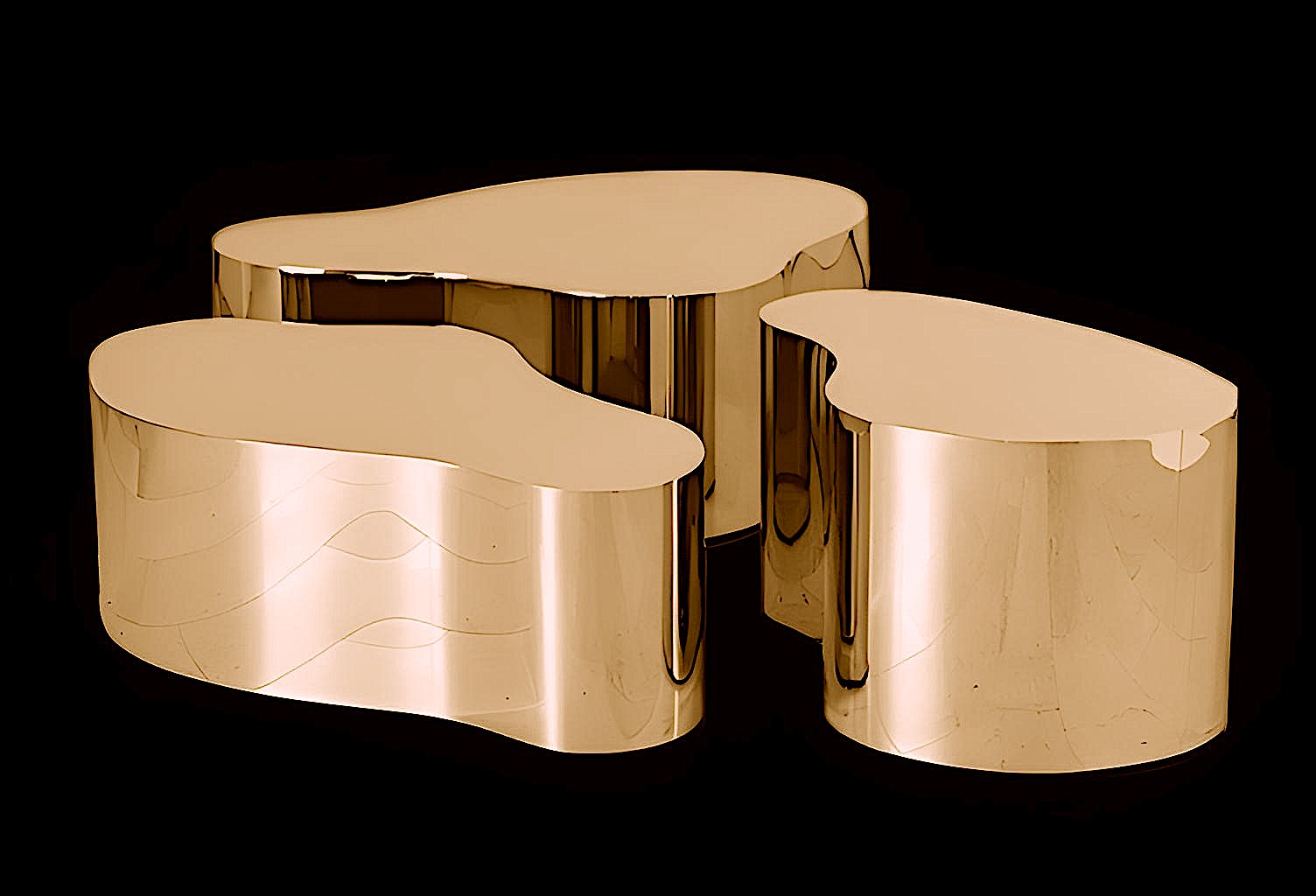 |
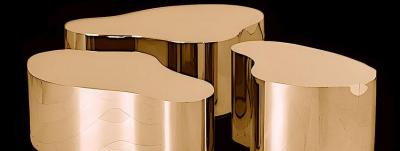
| Perhaps his most admired, coveted, and imitated design, Springer’s mastery of proportion and scale is at its apex in his Free Form Low Tables. The amorphic shapes can be combined into a unit, arranged as an artful cluster, or placed around a room. Recessed casters allow easy movement. |
Karl Springer
and the Art of
Modern Luxury
by Benjamin Genocchio
Photos courtesy Karl Springer LTD
 | |
Karl Springer |
More than three decades after designer Karl Springer’s death, Mark Eckman continues to make his furniture much as it was made during his lifetime: slowly, individually and by hand. Along with his wife and business partner Marcella Gelb, he oversees an unusually personal design business built on craftsmanship, rare materials and the enduring appeal of Springer’s brand of maximalist minimalism.
There is something improbable about the current headquarters of Karl Springer Ltd. The company, whose furniture once epitomized the glitz and glamour of New York interiors in the 1970s and 1980s—lacquered goatskin tables, polished metal consoles, monumental Lucite forms—is today run by Eckman and Gelb from a bucolic estate in Stamford, Connecticut. “It is my calling and my passion,” Eckman says. Everything is made individually, to specification, through a network of specialized American craftspeople whom Eckman has spent decades discovering, cultivating and supporting. This decidedly old-fashioned business model may be one reason why Karl Springer Ltd. has survived. Another is that Springer’s furniture, with its combination of clean forms and luxurious materials, looks remarkably contemporary.
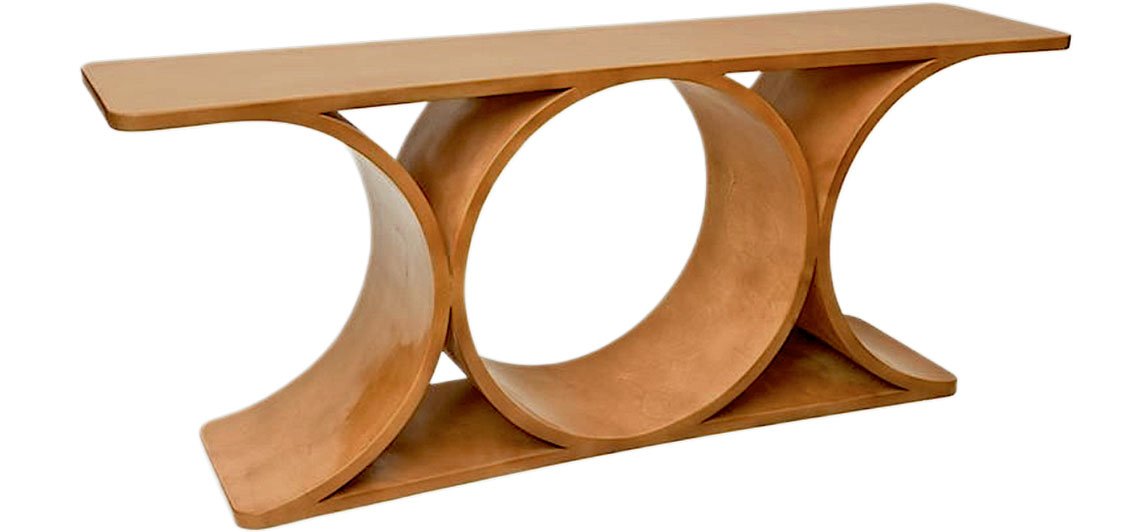 |
The JMF Double C Console is part of Springer’s JMF Series, honoring the legacy of French interior designer Jean Michel Frank. Frank was influenced by Ashanti stools to create his Diablo table, which in turn inspired Springer’s design for this console. |
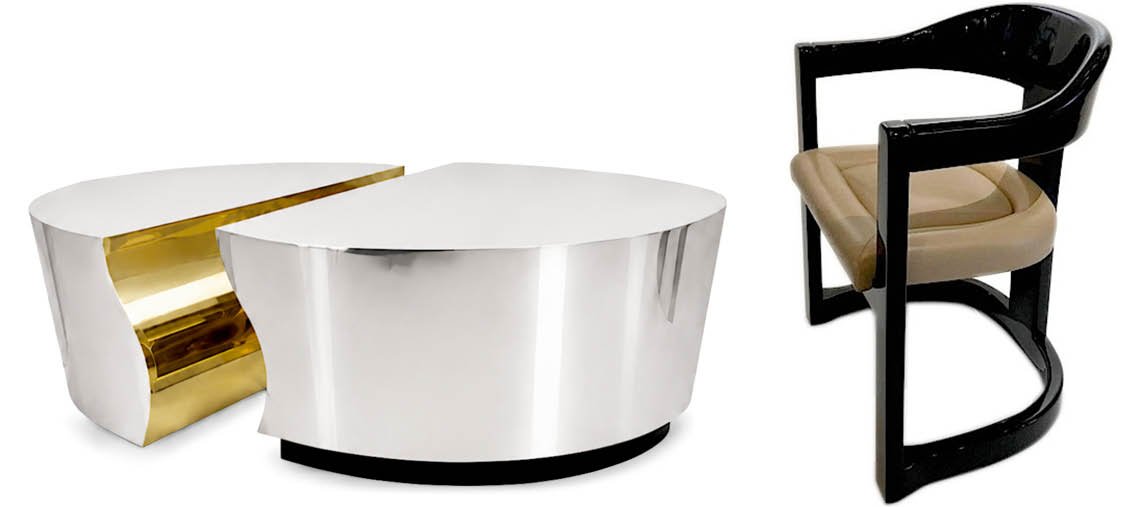 |
| Left: Springer’s Mark V Coffee Table has a modular two-piece interlocking layout. It features highly polished mirror-finished stainless steel exteriors paired with a contrasting bronze or gold-tinted brass interior surface. Right: The iconic Onassis Dining Chair, shown here in glossy black lacquer, is also available as a barstool or counter stool. Jacqueline Kennedy Onassis ordered dining chairs for the Onassis home on the Greek mainland and matching barstools for their yacht, the Christina O. |
Karl Springer Ltd. was founded in New York in 1965 by the German-born designer Karl Springer. His career was an unconventional one. Springer began as a bookbinder and later worked as a window dresser before developing decorative objects and furniture. As commissions became larger, he assembled a network of specialist artisans capable of executing increasingly ambitious designs and finishes. Eventually the business grew into a substantial international operation; at its height, Springer occupied a 20,000-square-foot penthouse showroom on East 61st Street, and counted among his many celebrity clients the Duchess of Windsor, Jackie and Ari Onassis, Diana Ross, and Frank Sinatra.
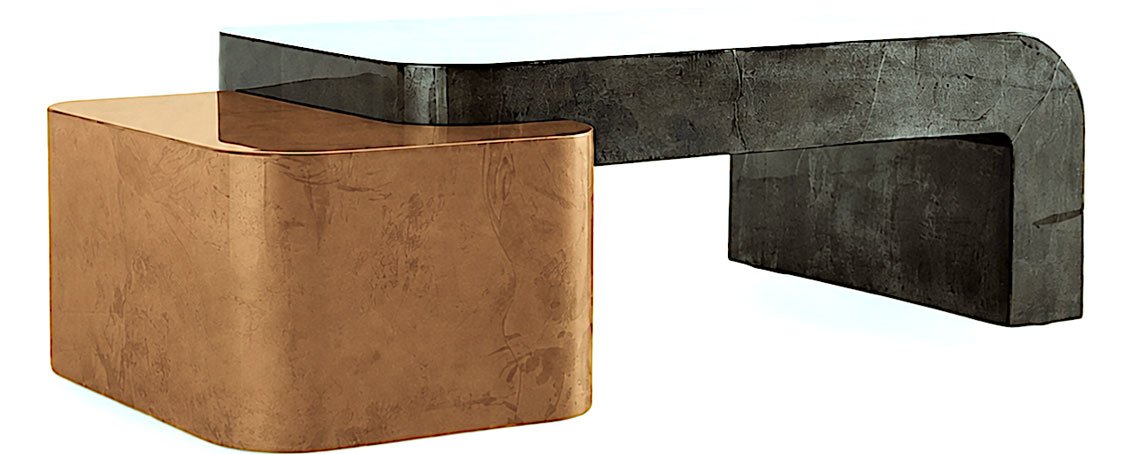 |
The bold, sculptural Atlas Coffee Table features a striking interlocking design wrapped in two contrasting tones of free-form goatskin parchment. |
Eckman entered the story in 1972. An industrial designer, he was then working with a company fabricating Lucite furniture and lighting. The two began collaborating on Lucite and subsequently on other materials, establishing a professional relationship that continued until Springer died in 1991. Three years later, Eckman and Gelb acquired Karl Springer Ltd. and all rights to the name, the designs, the photographs and the archives. What followed was not an attempt to reinvent Springer for a new generation. Quite the opposite: Eckman became the custodian of a design language and, just as importantly, a method of making things. “The unproduced designs in the archives are a treasure trove for us.” They continue to issue unrealized designs in the manner Karl meant them to be.
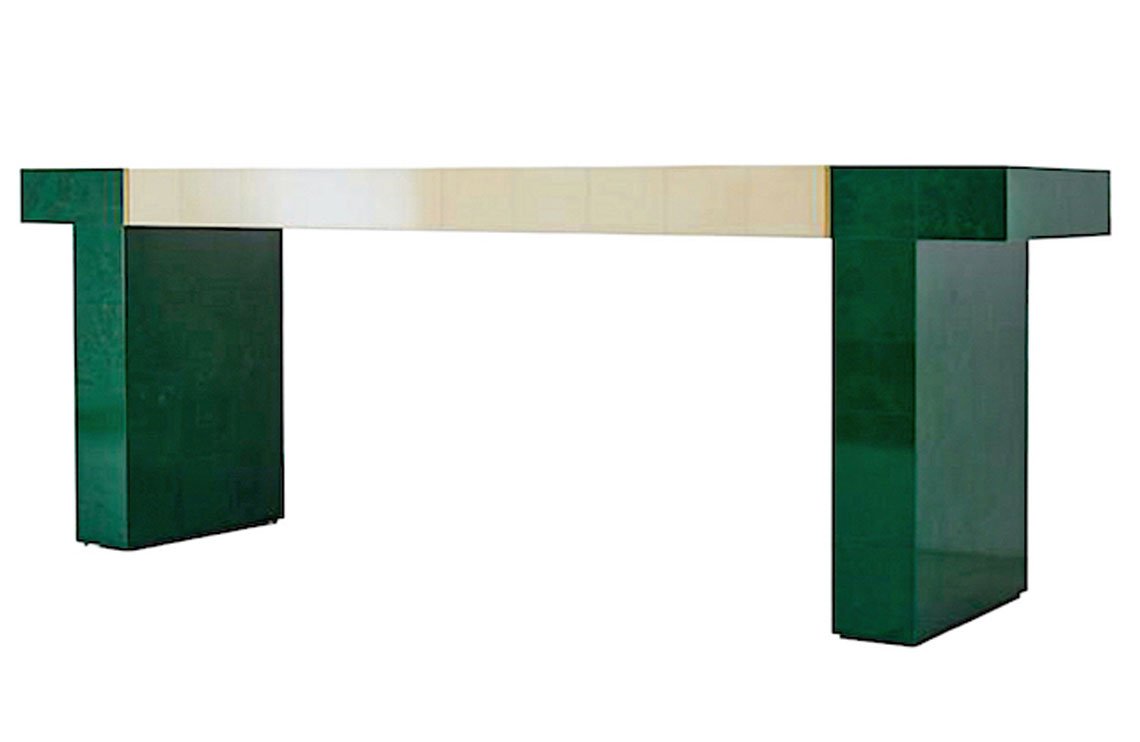 | 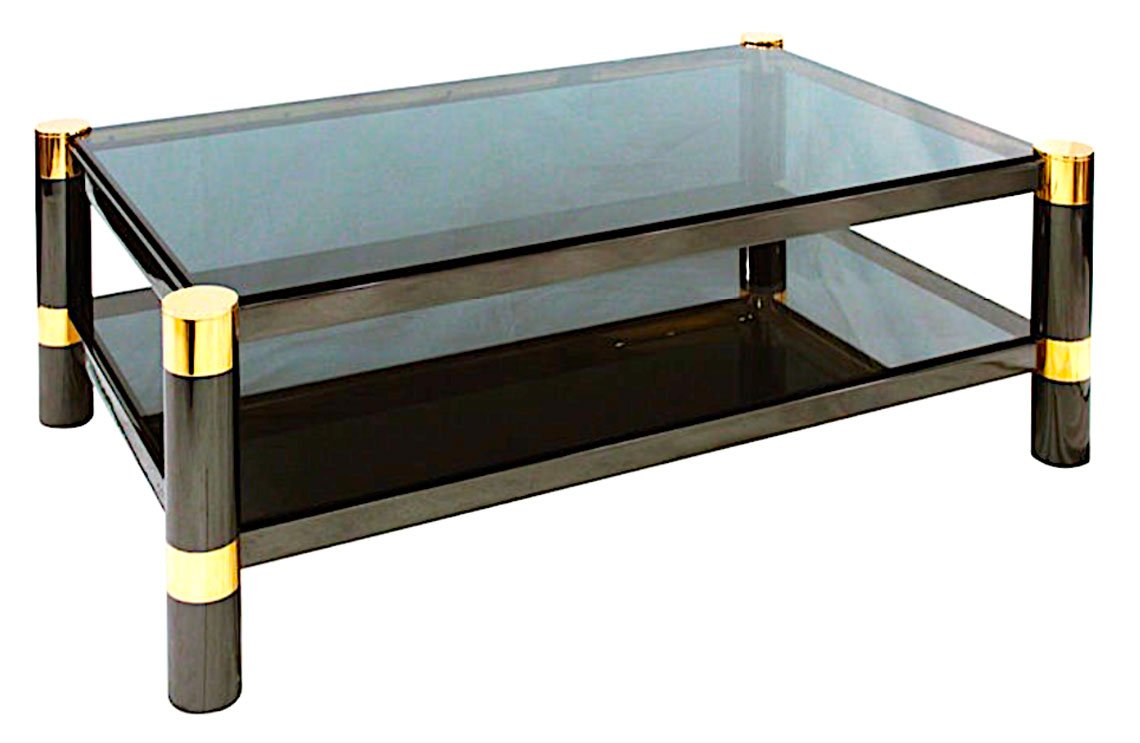 | |
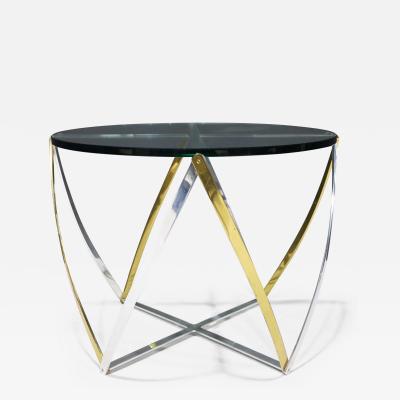
Left: The T-2 Console was originally designed in 1985. The perfect proportions of the design are enhanced by a color-blocking finish with two shades of goatskin parchment and brass inlays. Right: Round Leg Coffee Table, with a bronze frame, brass accents, and smoked glass, was originally designed and produced in the 1970s. | ||
Springer’s principles, Eckman says, could be summarized in three ideas: “purity of form, richness of materials, excellence of craftsmanship.” The forms themselves are mostly elementary—a cylinder, a Parsons table, a column, a rounded rectangle—but their surfaces are anything but ordinary. Springer worked in lacquered goatskin, parchment, shagreen, lucite, bronze, brass, stainless steel, and other materials requiring painstaking hand finishing. He could take a severe geometric object and make it sumptuous. Paige Rense, former longtime editor of Architectural Digest, was quoted as saying, “Anything by Karl Springer is classic and good.”
“Let the material and workmanship do the talking,” Eckman says, summarizing Springer’s approach. “Keep the forms simple, he advised me. He used to accuse me of making my designs too complicated.” That simplicity helps explain why the furniture has aged so well. Springer belongs to a later generation of modernists than the prewar pioneers, and he was less interested in industrial austerity than in transforming modernism into luxury. His furniture was clean and bold but also tactile, glamorous and oversized—for visual effect.
Springer’s Free Form Low Tables are his most recognizable design. They are unusual insofar as they dispense almost entirely with conventional furniture geometry. Instead of circles, squares or rectangles, the three tables are shaped as irregular, biomorphic volumes whose contours nest against one another like pieces of an abstract puzzle. Used together, they create a sculptural composition; separated around a room, each becomes an independent object. Originally produced in polished stainless steel with black glass tops, they are now available in brass, bronze, goatskin and exotic veneers. Clients can also commission them individually or in sets of two or three. The design is available exclusively from Todd Merrill Studio in New York. The Free Form Low Tables also demonstrate why his work remains compatible with interiors far removed from the period in which it was conceived. There is little historical ornament to date them. Instead, Springer relies on silhouette, proportion and material—turning three tables into an abstract composition that can continually be rearranged and rediscovered.
Eckman operates the business extremely efficiently. “We don’t stock anything,” he says. “Everything is made by commission.” A client can take a Springer design and request a special dimension, material, or finish. Eckman also undertakes custom fabrication for designers creating something of their own design, although he makes a distinction: such commissions are not necessarily Karl Springer branded designs, but are produced to the same standards. The company also produces unrealized designs found in the archives, like the perfectly proportioned T-2 Console, available in single or double goatskin colors with brass or stainless steel inlay.
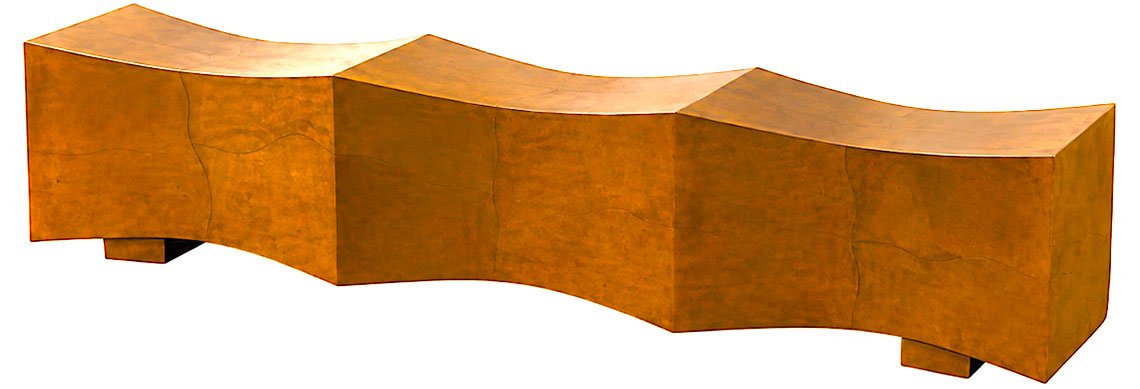 |
Springer’s Cameo Bench is characterized by its distinctive modular wave-like contours and refined minimalist form. Shown here in freeform lacquered goatskin parchment, It can also be produced in a two-seat style and a range of finishes. |
The Cameo Bench is another design that Eckman discovered in the Springer archives. “It was inspired by Karl’s fascination with Chinese finger pulls,” Eckman says. It is among the most sculptural of his many furniture designs, transforming the familiar idea of a bench into a rhythmic composition. The bench’s three seats are defined by a sequence of concave curves, producing an undulating silhouette. A cognac-colored surface gives the curves warmth and richness, catching light differently across each section while revealing the subtle irregularities and depth of the finish. It has also been produced in a two-seat version.
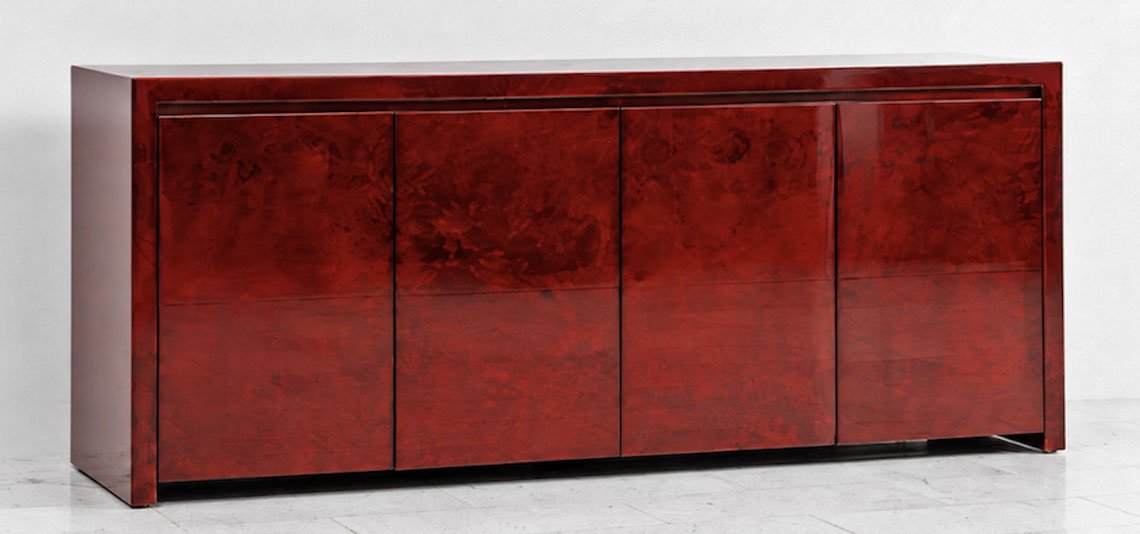 |
The Royal Palm Cabinet with four push-to-open doors has a minimalist, monolithic form and opulent texture wrapped in a richly variegated, glossy red-lacquered goatskin parchment. |
Springer understood luxury less as ornament added to an object than as the marriage of an unusual, fluid form with exceptionally rich materials. That principle is particularly evident in the Atlas Coffee Table, initially created by Springer as a custom commission. It consists of two interlocking forms—one warm and luminous, the other darker and more subdued—that together turn what might otherwise be a straightforward table into an exercise in geometry, material, and balance. The broad vertical planes give the piece an architectural solidity, while the generously rounded corners prevent it from feeling severe. Most striking is the way the two elements appear to pass through or embrace one another, making negative space as important as mass. The contrasting finishes heighten this effect, emphasizing both the independence and interdependence of the forms.
Eckman works principally with leading decorators, designers, architects, and private collectors. “My business is based on my reputation,” he says. “There are some galleries where people can walk in and see our furniture, but basically I’m in business by reputation.” That reputation also extends backward. Karl Springer Ltd. restores vintage Springer furniture and provides appraisals and authentication services—an increasingly important function as the designer’s secondary market has grown. Original Springer pieces are now actively sought by major auction houses and twentieth-century design dealers. Dealers like Todd Merrill and Evan Lobel played an important role in maintaining Springer’s legacy. “I think of them as brand ambassadors that kept the interest alive through the early 2000s and later introduced Springer to a new generation of designers and collectors,” Eckman says.
The business has grown steadily as the awareness of Springer has expanded. Yet Eckman is wary of growth for its own sake. “The business needs to be personal,” he says. “This way of production is not easily scaled up while preserving the quality.” Springer furniture depends on artisanal skills that cannot simply be scaled. Finding craftspeople capable of lacquered linen, goatskin work, or fine metal fabrication is difficult. “I have spent a lot of time finding new craftsmen,” he says. “Finding people with the skills to do what I want is half my job.”
Everything is made in America, insulating the company from tariff and international shipping complications confronting other luxury and collectible furniture businesses. More importantly, domestic production allows Eckman to closely supervise quality. “I’m proud of what we make and how we do it,” he says. That pride is personal. Eckman has Springer furniture in his home, including a set of three Free Form Low Tables in his living room and numerous vintage pieces collected over the years. More than thirty years after acquiring the company, he remains less a corporate executive than a craftsman, archivist, production manager, and steward of the designer’s vision.
 |
Discover More From Karl Springer LTD on Incollect
 |