











Maynard Dixon
American, 1875 - 1946
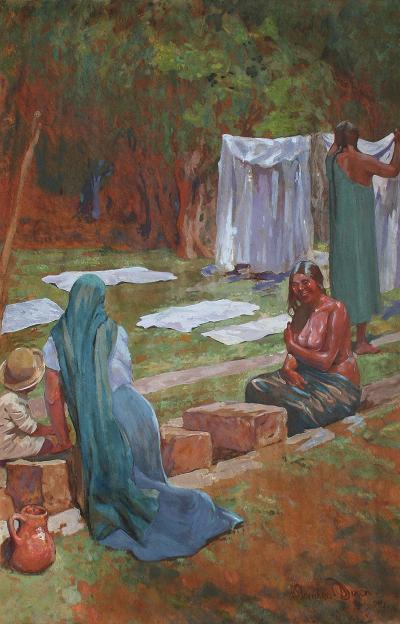
No artist captured the vast, sweeping landscape of the American west as dramatically as Maynard Dixon. As one of America's most accomplished illustrators, Dixon's work became known through the widespread exposure of his magazine and newspaper illustrations. Like many American artists of the early twentieth century, Dixon found a career as an illustrator as a way to satisfy his artistic compulsion while managing to earn a living.
Born in 1875, in Fresno, California, Maynard Dixon spent the vast majority of his life exploring and documenting the alluring American West. "A shy, sensitive youth, Maynard Dixon listened, looked and remembered, absorbing impressions of simplicity, low-land masses of land, and the farflung decorative sweeps of sky. Such shapes dominate and give signature to the art of his later years. 'No doubt,' he once reflected, 'these flat scenes have influenced my work. I don't like to psycho-analyze myself, but I have always felt my boyhood impressions are responsible for my 'weakness' for horizontal lines." (DJ. Hagerty, Desert Dreams: The Art and Life of Maynard Dixon, Layton, Utah, 1993, p. 5)
After a number of years as a successful illustrator, 1912 marked a year of tremendous success for Dixon as a painter. The National Academy of Design accepted three of his works into their winter and summer exhibitions, and early in the year he moved back to San Francisco, where his creative development blossomed. Living as an illustrator on the East Coast did not agree with Dixon who complained, "I am getting paid to lie about the West. I'm going back home to where I can do honest work." (as quoted in W. Burnside, Maynard Dixon, Artist of the West, Provo, Utah, 1974, p. 55).
Unlike many of the other illustrators living in New York and selling their work to national magazines, Dixon had firsthand experience of the American West. He "knew that the West was not always in conflict, as eastern myths had too often dictatedthe cowboy was not always on a bucking horse nor was the Indian always on the warpath. Even though in New York he had been able to compete with some of the best illustrators America had produced, Dixon wanted to realistically portray the more ordinary pursuits of people he knew and admired and with whom he had developed an affinity, people who actually inhabited the West." (Maynard Dixon, Artist of the West, p. 55) As he remarked himself: "My return from New York to the old studio on Montgomery Street marked the beginning of my real development. I was getting a new development rather than a new manner, and beginning to find myself I saw and had always seen something wonderful here in America. As a painter, then, I date from 1912." (as quoted in Maynard Dixon, Artist of the West, p. 59)
Apart from being a talented illustrator and artist, Maynard Dixon left behind a more enduring legacy, a true record of the American West. It seems that he took to heart the early advice of Frederic Remington who encouraged him to "be always true to yourself to the way and the things you see in nature... See much and observe the things in nature which captivate your fancy and above all-draw, draw, draw, and always from nature." (as quoted in Maynard Dixon: Artist of the West, p. 215)
Biography courtesy of Roughton Galleries, www.antiquesandfineart.com/roughton
Born in 1875, in Fresno, California, Maynard Dixon spent the vast majority of his life exploring and documenting the alluring American West. "A shy, sensitive youth, Maynard Dixon listened, looked and remembered, absorbing impressions of simplicity, low-land masses of land, and the farflung decorative sweeps of sky. Such shapes dominate and give signature to the art of his later years. 'No doubt,' he once reflected, 'these flat scenes have influenced my work. I don't like to psycho-analyze myself, but I have always felt my boyhood impressions are responsible for my 'weakness' for horizontal lines." (DJ. Hagerty, Desert Dreams: The Art and Life of Maynard Dixon, Layton, Utah, 1993, p. 5)
After a number of years as a successful illustrator, 1912 marked a year of tremendous success for Dixon as a painter. The National Academy of Design accepted three of his works into their winter and summer exhibitions, and early in the year he moved back to San Francisco, where his creative development blossomed. Living as an illustrator on the East Coast did not agree with Dixon who complained, "I am getting paid to lie about the West. I'm going back home to where I can do honest work." (as quoted in W. Burnside, Maynard Dixon, Artist of the West, Provo, Utah, 1974, p. 55).
Unlike many of the other illustrators living in New York and selling their work to national magazines, Dixon had firsthand experience of the American West. He "knew that the West was not always in conflict, as eastern myths had too often dictatedthe cowboy was not always on a bucking horse nor was the Indian always on the warpath. Even though in New York he had been able to compete with some of the best illustrators America had produced, Dixon wanted to realistically portray the more ordinary pursuits of people he knew and admired and with whom he had developed an affinity, people who actually inhabited the West." (Maynard Dixon, Artist of the West, p. 55) As he remarked himself: "My return from New York to the old studio on Montgomery Street marked the beginning of my real development. I was getting a new development rather than a new manner, and beginning to find myself I saw and had always seen something wonderful here in America. As a painter, then, I date from 1912." (as quoted in Maynard Dixon, Artist of the West, p. 59)
Apart from being a talented illustrator and artist, Maynard Dixon left behind a more enduring legacy, a true record of the American West. It seems that he took to heart the early advice of Frederic Remington who encouraged him to "be always true to yourself to the way and the things you see in nature... See much and observe the things in nature which captivate your fancy and above all-draw, draw, draw, and always from nature." (as quoted in Maynard Dixon: Artist of the West, p. 215)
Biography courtesy of Roughton Galleries, www.antiquesandfineart.com/roughton
Maynard Dixon, born in 1875, was a largely self-taught artist. He spent three months studying at Mark Hopkins Institute. Dixon decided to send his sketchbook to an artist he highly admired, Fredrick Remington, who encouraged Dixon to pursue his artistic talent. Dixon's first illustration was published in 1893 in "Overland Monthly". He began to work full time in 1895 for the "San Francisco Morning Call" and later the "San Francisco Examiner". Unfortunately, a fire in 1906 destroyed Dixon's body of work. Dixon gained international fame for his western subjects with the sky colors that became his distinctive trademark. An Indian thunderbird was used often as a logo in his work. By the 1920s, Dixon's work turned more to architectural structures and bold masses painted with a dynamic palette. He began to develop a Cubist-Realist style with angular forms and abstract color. However, Dixon painted a series of scenes concentrated on the tragic victims of the Depression during the 1930s that were quite different than his usual style. Dixon died soon after completing a mural of the Grand Canyon in 1946.
Biography courtesy of The Caldwell Gallery, www.antiquesandfineart.com/caldwell
Biography courtesy of The Caldwell Gallery, www.antiquesandfineart.com/caldwell

 Loading...
