





Listings / Fine Art / Photographs / Abstract



Showrooms
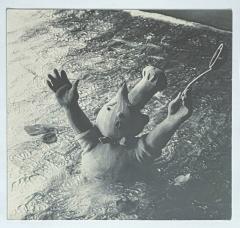
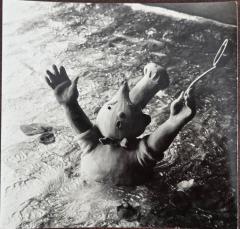
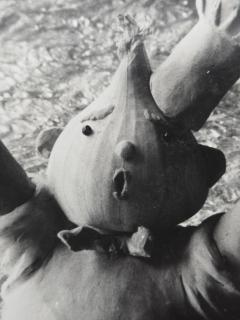
Henry Rox "Mr. Onion Shouting for Help" 1936 Vintage Print
-
Description
"Mr. Onion Shouting for Help" Opp. P. 34
From Tommy Apple and Peggy Pear by James Laver
Jonathan Cape, London, 1936
Vintage silver gelatin print
Image: 5.25 x 5.25 inches
Estate stamped verso
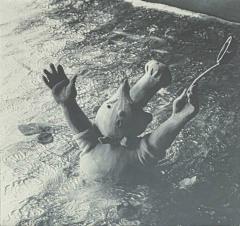
This vintage silver gelatin print forms part of Henry Rox’s London publication work created in 1936 for Tommy Apple and Peggy Pear. The image presents a constructed figure derived from an onion, animated through gesture and expression within a carefully staged narrative setting.
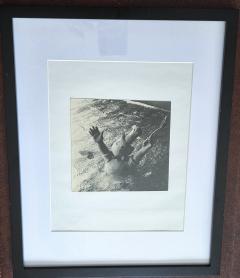
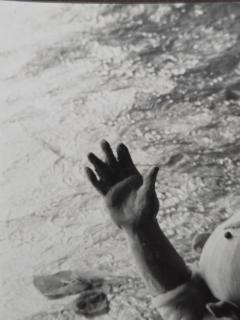
The figure is conceived as a fully constructed three-dimensional character. The onion provides the central mass and form, while applied elements articulate facial features and expression. Here, Rox places the figure in a moment of urgency: partially submerged in water, arms raised, mouth open, and body tilted backward as if losing footing. The surface is worked to suggest rippling water, with small floating elements punctuating the scene and reinforcing the sense of movement.
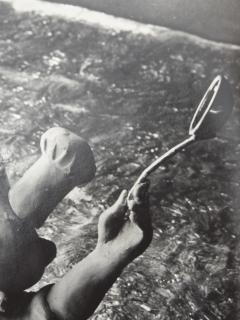
The composition is direct and contained. Rox isolates the figure within a shallow spatial field, allowing the rounded form and raised gesture to dominate the image. At the upper right, the edge of the constructed water surface becomes visible, where the light shifts into a brighter, slightly washed area. Rather than breaking the illusion, this detail underscores how tightly controlled the staging is. Within a very small tabletop space, Rox calibrates light, texture, and depth so that the surface reads convincingly as water, moving from brighter highlights into deeper tonal passages that give the scene weight and instability.
Rox builds the entire environment from everyday materials—vegetable forms, soil, and fabricated elements—then stages and lights the construction before photographing it. The photograph is the final work, not documentation of a sculpture. The materials remain visible, but they resolve into a complete and readable image.
Created in collaboration with James Laver—then a prominent writer and critic—these photographs represent one of the earliest sustained explorations of Rox’s “photo-sculpture” method. The images were conceived not as conventional illustrations but as constructed visual narratives in which sculptural form and photographic realization are inseparable.
Executed shortly after Rox’s departure from Germany, these London works mark the transition from his established sculptural practice in Berlin to a new form shaped by both necessity and invention. Within a remarkably short period, Rox developed a fully articulated visual language in which everyday materials—fruits, vegetables, and fabricated elements—are transformed into animated characters and staged environments.
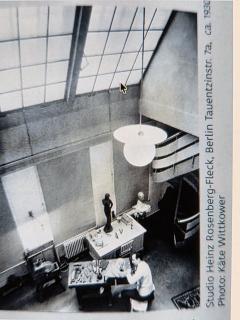
Rox’s photo-sculptural work is grounded in over a decade of formal training and professional practice in Europe. Between 1919 and 1933 he studied art history and sculpture in Berlin and Paris, including at the University of Berlin, the Charlottenburger Kunstgewerbeschule, and later at the Académie Julian and Académie Colarossi. By the late 1920s he was actively exhibiting and had established a fully functioning studio, documented in a 1930 photograph, equipped for large-scale sculptural production. His enrollment at the Berliner Fotoschule in 1933 was not a shift in medium but a technical refinement—intended to better photograph his own sculptural work. This trajectory was abruptly interrupted by the political conditions in Germany, forcing Rox to leave behind an established studio practice. The photo-sculptures developed in London shortly thereafter should be understood as a continuation of this sculptural training, translated into a photographic form under the pressures of exile.
Rox referred to these works as “photo-sculptures.” Rather than photographing existing subjects, he constructed miniature sculptural environments from organic and fabricated materials, staging them specifically for photographic realization. The resulting images synthesize sculpture, theatrical staging, and photography into a single resolved composition.
Rox’s photo-sculptures circulated widely within mid-twentieth-century illustrated magazine culture. His constructed images appeared in publications including Life, Vogue, Town & Country, Harper’s Bazaar, Mademoiselle, Seventeen, Coronet, Collier’s, and The New York Times Magazine, participating in the editorial environment associated with Time Inc. and Condé Nast.
Context and Development
Rox’s constructed photographs emerge from the late Weimar photographic environment in which experimental approaches to lighting, object study, and staged imagery were actively developing. His photographic training in 1933 at the Berliner Fotoschule placed him within this context shortly before leaving Germany. Following his arrival in London in May 1934, he translated this foundation and his sculptural training into what he termed “photo-sculpture”: carefully constructed three-dimensional tableaux created specifically for photographic realization.
A documented 1930 photograph of Rox’s Berlin studio confirms the scale and sophistication of his sculptural practice prior to exile, underscoring the professional context from which these London works emerged.
General Overview
Henry Rox (born Heinz Rosenberg, Berlin, 1899) was trained as a sculptor in Berlin and Paris before exile in 1934 necessitated a transformation in his working method. Operating first in London and later in the United States, he developed a hybrid practice in which sculptural construction, theatrical staging, and photography were fully integrated. His images appeared widely in mid-20th century publications associated with Condé Nast and Time Inc., while his sculpture continued to be exhibited in American museum contexts, including the Whitney Annual exhibitions.
Beginning in 1993, Rox’s photographs were reintroduced through a series of Modernism exhibitions in the United States, where they were presented within a broader design and material culture context rather than as a defined photographic corpus. These exhibitions, while not academic in structure, were instrumental in reintroducing Rox’s work to collectors and establishing an initial market presence in the United States.
In recent years, Rox’s work has undergone renewed European institutional reassessment through the research of Wolfgang Vollmer (Cologne). This includes exhibition at Fotohof, Salzburg (2021); participation in the European Month of Photography; presentations in Paris; and inclusion in the exhibition at Bonartes Photo Institute, Vienna (December 2025 – February 2026). These presentations have begun to situate Rox more fully within the history of 20th-century constructed and staged photography.
Rox’s career bridges European avant-garde sculpture, émigré reinvention, British publishing culture, American commercial modernism, and postwar academic practice. His photo-sculptures stand as hybrid works—simultaneously sculptural, performative, and photographic—reflecting a practice shaped by displacement, adaptation, and sustained formal inquiry.
Rox illustrated three books: Tommy Apple and His Adventures in Banana-Land (1935), Tommy Apple and Peggy Pear (1936), and Banana Circus (1940).
No known negatives survive, and Rox’s photographs do not appear to have been produced in formal editions. Individual images exist in varying and often limited numbers, with some examples appearing to be unique or known in only a small number of prints. As a result, each photograph functions less as part of an editioned corpus and more as an individual artifact within the artist’s working process.
Provenance and Survival
This print originates from a larger group of photographs preserved from Henry Rox’s final residence in South Hadley, Massachusetts, where a substantial body of material remained following the deaths of the artist and his wife. The material was preserved in situ until the eventual dispersal of the property, after which it entered private hands. No known negatives are extant, and these prints constitute a primary material record of the artist’s photographic practice.
Condition
Very good vintage condition. Minor handling marks consistent with age. Verso with later collection stamp. -
More Information
Documentation: Signed Origin: England Period: 1920-1949 Materials: silver gelatin print Condition: Good. see description Creation Date: 1935 Styles / Movements: Modernism, Other , Black & White Incollect Reference #: 848126 -
Dimensions
W. 5.25 in; H. 5.25 in; W. 13.34 cm; H. 13.34 cm;
Shipping Information:
Ask about competitive S&H rates.
Message from Seller:
Established in 1984, Appleton offers a curated selection of 20th Century furniture, tables, chairs, and décor, featuring works by iconic designers like Frank Lloyd Wright and Edward Wormley. For inquiries, contact us at appletonarts@gmail.com.
More Listings from Appleton View all 222 listings
-
Enrique Garcel Greek Key Mirror Tessellated Bone 1970s Studio Crafted Columbia
-
Stadler-Neuwirth Adjustable Beech and Wrought Iron Floor Lamp, circa 1951
-
Arden Riddle Studio Craft Unique Storage Cabinet Solid Cherry 1966
-
Studio Crafted Spider Leg Oval Writing Desk, 1970s
-
Pia Manu 1960s Brutalist Cast Resin and Steel Sled Base Coffee Table, Belgium
-
Mexican Carved Hand Chair in the Style of Pedro Friedeberg, circa 1960
-
Signed Early Silas Seandel "Ortega" Brutalist Cut Metal Coffee Table, circa 1970
-
Set of 3 John Hutton Lounge Chairs for Donghia Merbau Coastal Collection1995

-
Pair of Chased Brass and Mirrored Glass End Tables from Semon Bache, 1959

-
Large 1970s Mixed-Metal Botanical Wall Sculpture with Butterflies, 59 Inches
-
Stilnovo Floor Lamp Red and White Plexiglass and Marble, Italy, 1960

-
Paul Puccio Giallo Siena Marble Dining Table/ Console 1976 New York
-
Liteline Glass Cane Table Lamp in the Style Gaetano Scolari, circa 1970

-
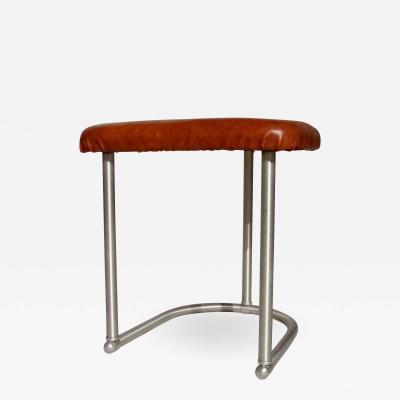
Warren McArthur Vanity Stool Style No. 1131 circa !936