









Offered by:
Kristan Hauge Japanese Art
2-32 Saishoji-cho, Okazaki, Sakyo-ku,
Kyoto 606-8342 , Japan
Call Seller
81757515070
Showrooms
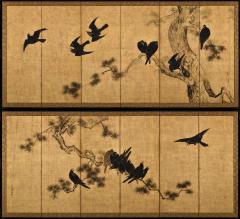
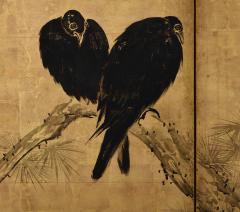
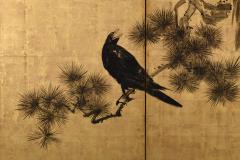
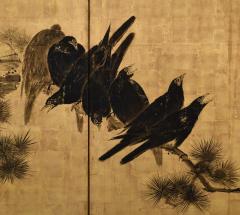
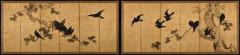
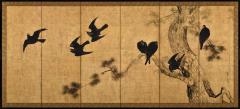
Mid 18th Century Japanese Screen Pair. Crows & Pines by Unkoku Toshuku
-
Description
Unkoku Toshuku (1722-1779)
Crows and Pines
Mid 18th Century
A pair of six-panel Japanese Screens. Ink and gold leaf on paper.
Dimensions: Each Screen: H. 170.5 cm x W. 375 cm (67” x 147.5”)
Haha-cho or mynah birds, whose forms resemble crows in artwork, were commonly depicted in Japanese art. These types of paintings were originally modeled on paintings attributed to the 13th century Chinese painter Muqi (Mokkei), whose art was enormously influential in Japan. Crows only became a theme among Japanese artists from the later 1500s onward. They likely were inspired by these imported Chinese paintings of myna birds, which are not native to Japan, substituting the native species of crow instead.
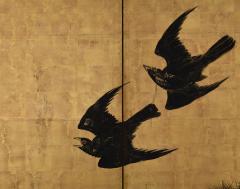
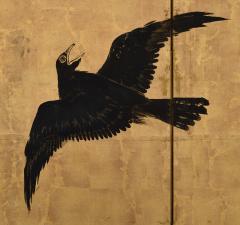
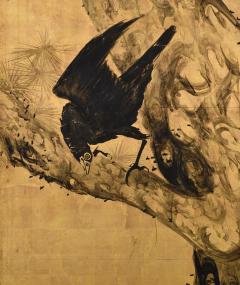
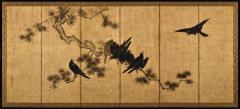
The best known early examples of the depiction of Japanese crows are two Momoyama screen paintings by Hasegawa Tohaku (Crows and Herons, Crows on Pine and Egrets on Willow) and a set of sliding doors attributed to Unkoku Togan (Ravens and Plum Tree). Both artists were strongly influenced by the work of Sesshu. The two artists eventually entered into a famous legal contest over succession to the line of Sesshu. The case was won by Unkoku Tōgan, who gained the right to call himself the ‘third generation of Sesshu.’ Another famous painting of crows is by Unkoku Toeki, the first son of Togan. This series of paintings mounted on screens is held in Konchi-in Temple in Higashiyama Kyoto. Large scale artworks depicting crows from the Momoyama and Edo periods are rare. Both the brushwork and the modeling of the crows in this pair of screens by Unkoku Toshuku are clearly indebted to the work of these founding Unkoku masters. Somewhere in the 17th century, the compositional model used here by Toshuku appears to have become somewhat standardized. Another screen utilizing the same model (left screen) was painted by Kano Chikanobu (1660-1728). Even so there are clear differences in brushwork of the birds and the pine and the overall atmosphere of the screens. In this work by Toshuku the jet black crows are the focus of the painting while the scratchy pines barely seem able to hold their weight. In the Kano school work more attention has been paid to the solidity of the pine with the crows blending in to their surroundings.
In Japanese art and culture, crows are captivating symbols, carrying layers of meaning that have evolved over centuries. In Shinto beliefs, crows are often viewed as messengers bridging the human world with the spiritual realm. Acting as intermediaries for deities, they can convey blessings or serve as omens, giving them a complex role in Japanese art and folklore. Within Japanese Buddhist art, crows symbolize the cycle of death and rebirth, reflecting life’s impermanence and the journey of the soul. As creatures that both survive and scavenge, they highlight life’s fragile balance and serve as reminders of mindfulness and the transient nature of existence.
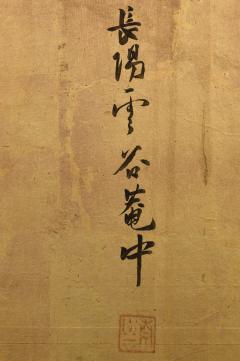
Unkoku Toshuku (1722-1779) was a native of western Japan and a retainer for the Mori family, who lived in Nagato city in what is now Yamaguchi prefecture. He is part of a long line of Unkoku school artists who were descendent from Unkoku Touoku (1582-1615). After Togan (the schools founder) the lineage of the Unkoku school split in to two familial lines; Touoko and Toeki. Touoku was Togan’s eldest son, and his lineage is less well known. He died before his father so another son, Toeki, took the official reigns of the school and the title of ‘fourth generation of Sesshu’. -
More Information
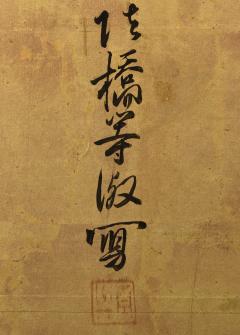
Documentation: Signed Period: 18th Century Creation Date: Mid 18th Century Styles / Movements: Asian Art Incollect Reference #: 764099 -
Dimensions
W. 147.64 in; H. 67.13 in; W. 375 cm; H. 170.5 cm;
Message from Seller:
Kristan Hauge Japanese Art, based in Kyoto's museum district since 1999, specializes in important Japanese screens and paintings for collectors, decorators, and museums worldwide. Contact us at khauge@mx.bw.dream.jp or +81 75-751-5070 for exceptional access to Japanese art and history.
More Listings from Kristan Hauge Japanese Art View all 60 listings
-
Japanese Screen Pair. Showa era. Nihonga Riverside landscape. Late Summer
-
Early 20th Century Japanese Screen Pair – Ink Pine Trees on Gold

-
Early 20th Century Japanese Cherry Blossom Screen
-
17th Century Japanese Screen Pair. Grapevines. Attributed to Kano Tsunenobu
-
Chaekgeori painting. 19th Century Joseon. Books & Scholars’ Accouterments.
-
Mitani Toshuku Unkoku School, 17th century. Japanese falcon painting.

-
Japanese Screen. Early 20th Century. Furosaki Screen. Wagtail & Chrysanthemum

-
1895 Meiji Japanese Screen Pair. Cherry Blossoms & Autumn Maples on Silver Leaf
-
19th Century Japanese Silk Painting by Kano Chikanobu. Cranes, Pine & Camelia.
-
17th Century Japanese Screen Pair. Flock of Cranes. Ink and color on gold leaf.

-
17th Century Japanese Screen. Ink Plum Tree & Birds by Kano Naonobu

-
Early 20th Century Pair of Japanese Screens | Deer under Maple Trees
-
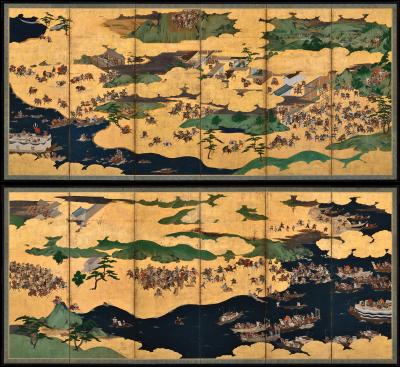
Late 17th Century Japanese Screen Pair. Battle of Ichi-no-tani and Yashima
-
Sakai Hoitsu (1761-1828) | Autumn flowers | Japanese screen painting

