














Offered by:
Kristan Hauge Japanese Art
2-32 Saishoji-cho, Okazaki, Sakyo-ku,
Kyoto 606-8342 , Japan
Call Seller
81757515070
Showrooms
Meiji era Japanese Screen Pair, Two-panel. Spring & Autumn Birds & Flowers
-
Description
Spring and Autumn Birds & Flowers
Hasegawa Gyokujun (1863-1921)
Meiji period, circa 1900.
Ink, color and gofun on silk.
Dimensions of each screen:
H. 172 cm x W. 188 cm (68’’ x 74”)
Price: USD 38,000
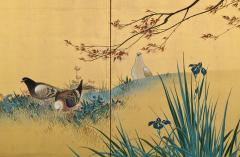
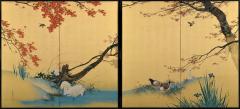
This elegant pair of two-panel Japanese screens, painted around 1900 by Hasegawa Gyokujun, presents a richly symbolic kacho-ga (bird-and-flower painting). Executed in mineral pigments and gold leaf on paper, the work orchestrates a seasonal journey that unfolds from right to left, moving from spring into autumn.
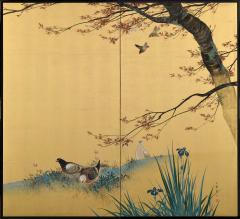
On the right screen, a cherry tree extends across both panels, its trunk rendered in bold brushstrokes with patches of mossy blue-green. Delicate cherry blossoms flutter at the far right, emblematic of spring’s fleeting beauty. At the base, tall irises bloom in sharp, elegant clusters, their leaves painted in vivid blue-green. Nearby, a pair of doves forage in the grass while other birds take flight, animating the scene with a sense of vitality.
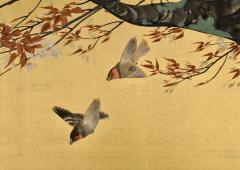
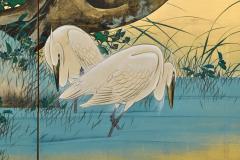
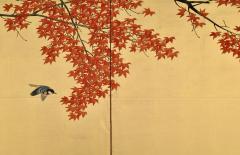
As the viewer’s eye moves leftward, the seasons shift. The tree’s branches now blaze with autumnal red maple leaves, their crisp forms contrasting against the glowing expanse of gold leaf background. Hibiscus flowers bloom beside the moss-covered tree stump, their white petals adding an understated accent to the fiery foliage above. Below, two graceful egrets stand at the water’s edge, their pale feathers carefully detailed with soft gofun, creating a serene, reflective counterpart to the vibrant foliage.
The composition is carefully balanced: the diagonal thrust of the maple trunk unites the two panels, while the scattering of birds—from those perched on the ground to those soaring mid-air—guides the viewer’s gaze across the space. The use of gold leaf provides both a luminous backdrop and a timeless atmosphere, evoking the transience of nature and the cyclical passage of time.
Historically, this screen reflects a pivotal moment in Japanese art. After the stability of the Edo period, there was a dramatic shift from the Meiji to the Taishō periods, a time of negotiation between tradition and modernity. Hasegawa Gyokujun was among the artists who bridged this gap, carrying forward the refinement of early modern painting while opening pathways to new approaches that paved the way for the present day.
Hasegawa Gyokujun (1863–1921) was born in Kyoto as the eldest son of Hasegawa Gyokuho, a Shijō school painter and pupil of Matsumura Keibun. Trained initially by his father, Gyokujun displayed exceptional talent from an early age and quickly established himself within Kyoto’s vibrant painting circles. He made his formal debut in the art world in his mid-twenties, gaining immediate recognition when his work Dawn Clouds at the Imperial Garden was purchased for the emperor’s personal collection after being shown at the Shinkō Bijutsukai in 1887.
In 1891, Gyokujun co-founded the “Young Painters Social Club” (Shōgakai) together with Takeuchi Seihō, Miyake Gogyō, and Taniguchi Kōkyō, marking his position among the rising generation of Kyoto painters. That same year, he was appointed as a judge for the Great Private Paintings Exhibition alongside Takeuchi Seihō, Yamamoto Shunkyō, and Kikuchi Hōbun, a testament to his standing in the art world.
His career was further distinguished by numerous awards at both national and international venues, including the Chicago Columbian World’s Fair (1893), the Fourth National Industrial Exhibition (1895), and the inaugural exhibition of the Nihon Kaiga Kyōkai (Japan Painting Association).
Although widely respected as one of Kyoto’s most promising artists, Gyokujun eventually stepped away from the city’s competitive art world. In his later years, he devoted himself to teaching, serving as an elementary school art instructor in Ōtsu, leaving behind both a legacy of elegant paintings and a significant role in the transition of Japanese painting into the modern era. -
More Information
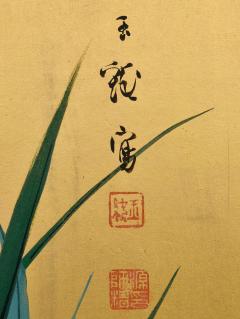
Documentation: Signed Period: 1900-1919 Creation Date: 1900 Styles / Movements: Asian Art Incollect Reference #: 833495 -
Dimensions
W. 74.02 in; H. 67.72 in; W. 188 cm; H. 172 cm;
Message from Seller:
Kristan Hauge Japanese Art, based in Kyoto's museum district since 1999, specializes in important Japanese screens and paintings for collectors, decorators, and museums worldwide. Contact us at khauge@mx.bw.dream.jp or +81 75-751-5070 for exceptional access to Japanese art and history.
More Listings from Kristan Hauge Japanese Art View all 61 listings
-
Sakai Hoitsu (1761-1828) | Autumn flowers | Japanese screen painting

-
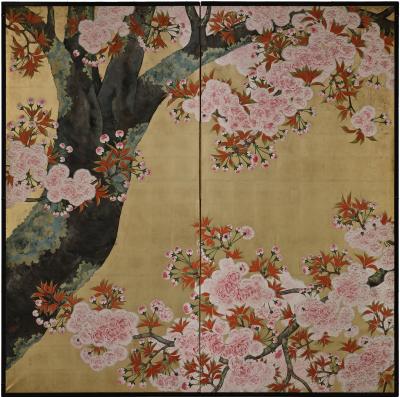
Early 20th Century Japanese Cherry Blossom Screen
-
Japanese Screen. Early 20th Century. Furosaki Screen. Wagtail & Chrysanthemum

-
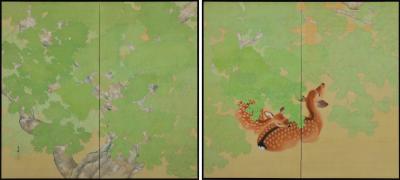
Early 20th Century Pair of Japanese Screens | Deer under Maple Trees
-
Early 20th Century Japanese Screen Pair – Ink Pine Trees on Gold

-
17th Century Japanese Screen Pair. Flock of Cranes. Ink and color on gold leaf.

-
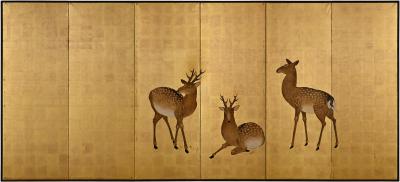
19th Century Japanese Deer Screen by Okamoto Toyohiko. Maruyama Shijo School
-
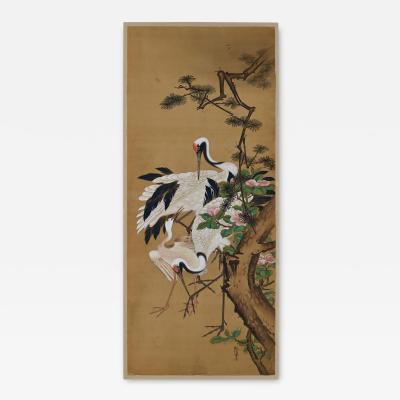
19th Century Japanese Silk Painting by Kano Chikanobu. Cranes, Pine & Camelia.
-
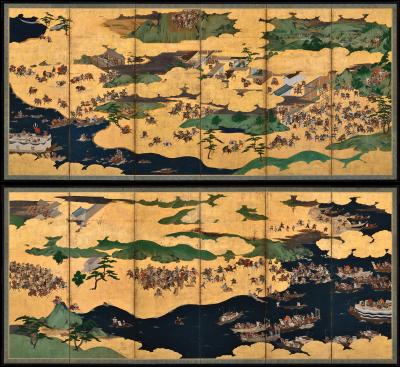
Late 17th Century Japanese Screen Pair. Battle of Ichi-no-tani and Yashima
-
17th Century Japanese Screen. Ink Plum Tree & Birds by Kano Naonobu

-
1895 Meiji Japanese Screen Pair. Cherry Blossoms & Autumn Maples on Silver Leaf
-
Chaekgeori painting. 19th Century Joseon. Books & Scholars’ Accouterments.
-
Mid 18th Century Japanese Screen Pair. Crows & Pines by Unkoku Toshuku
-
Mitani Toshuku Unkoku School, 17th century. Japanese falcon painting.

