





Listings / Fine Art / Paintings / Still Life



Offered by:
Kristan Hauge Japanese Art
2-32 Saishoji-cho, Okazaki, Sakyo-ku,
Kyoto 606-8342 , Japan
Call Seller
81757515070
Showrooms
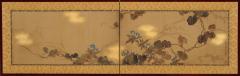
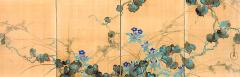
Sakai Hoitsu (1761-1828) | Autumn flowers | Japanese screen painting
-
Description
A two-fold Japanese screen by Sakai Hōitsu (1761-1828). Japan 19th century, Edo period.
Color on silk.
Dimensions:
Image – H. 13” x W. 51” (32 cm x 129 cm)
Screen – H. 18” x W. 56” (46 cm x 144 cm)
Price: USD 34,500
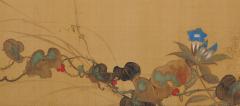
This small Japanese folding screen painted by Sakai Hoitsu was originally designed as a pair of sliding doors for an alcove or tokonoma. The scene depicts an autumn vine weaving rhythmically through bellflowers (kikyo) and pampass grass (susuki). Kikyo and susuki are two of the celebrated seven grasses of autumn (aki no nanakusa) which were often mentioned in verses of the Manyoshu, the earliest collection of Japanese poetry and song. More than flowers of any other season, autumn grasses washed by rain and bent in the wind are thought to attain a beauty unsurpassed; many feel the same way regarding Hoitsu’s exquisite brushwork and graceful compositions.
A four-fold screen by Hoitsu utilising the almost identical composition is held in the collection of the Miho Museum, Shiga.
Born into the family of the feudal lords of Himeji castle, Sakai Hōitsu had a privileged and cultivated upbringing providing him the opportunity to study Noh drama, haiku poetry, tea-ceremony, music and painting. As was common during the Edo period, Hoitsu began his study of painting with the officially sanctioned Kano school, later receiving influence from and instruction in the contemporary Ukiyo-e, Maruyama-Shijo and Nagasaki styles. Taking tonsure as a monk in 1797 Hoitsu freed himself of his significant familial obligations and immersed himself in the study of the life and art of Ogata Korin (1658-1716). His attraction to Korin was inspired by the fact that a century earlier Hoitsu’s family had been among Korin’s chief patrons, and numerous masterpieces by Korin were preserved in their collection.
In 1815, 100 years after Korin’s death, Hoitsu published Korin Hyakuzu (One Hundred Paintings by Korin), woodblock print reproductions of paintings by the master. Besides honouring Korin in this way, he clearly traced the lineage of what would come to be known in a later age as the Rinpa (Rimpa) school. Hoitsu, while taking Korin’s works as his model, went on to create highly affecting works reflective of the refined tastes of his day.
In recent times the Rinpa (Rimpa) school, which Hoitsu played a pivotal role in developing, has become Japan’s most admired and celebrated school of art.
In 1972 an exhibition entitled ‘Rinpa’ was held to celebrate the 100th anniversary of the Tokyo National Museum.
Commenting on that exhibition the noted scholar James Cahill states “The world of Rinpa is not far from our everyday life. It simply transforms the everydayness into a thoroughly beautiful image. Of all the arts in the world, if one were to cite a decorative style that transcends the ‘simply decorative’ limit, it would be Rinpa. The delicacy, boldness, and impressiveness of Rinpa is a perfect match for works of religious or humanistic content demonstrating highly refined artistry.”
In 2008 the Tokyo National Museum held an exhibition titled ‘Treasures by Rinpa Masters – Inheritance and Innovation’ in which many works by Hoitsu were featured.
In 2011 to celebrate the 250th anniversary of Hoitsu’s birth a broad and scholarly exhibition titled ‘Sakai Hoitsu and Edo Rinpa’ was held at the Himeji City Museum of Art and the Chiba City Museum of Art.
In 2012 the Japan Society held the exhibition ‘Silver Wind: the Arts of Sakai Hoitsu’ in New York. The exhibited works were sourced predominantly from American collections.
In 2015 the Kyoto National Museum held the blockbuster exhibition ‘Rinpa – The Aesthetics of the Capital’. Works by Hoitsu formed a significant part of the exhibition.
Works by the artist can be found in the collections of: Asia Society, New York; Cleveland Museum of Art, Ohio; Etsuko and Joe Price Collection, USA; Feinberg Collection, USA; Gitter-Yellen Collection, USA; Hosomi Museum, Kyoto; Idemitsu Museum of Arts, Tokyo; Indianapolis Museum of Art, Indiana; Kyoto National Museum; Los Angeles County Museum of Art, California; Metropolitan Museum of Art, New York; Minneapolis Institute of Art, Minnesota; Mitsui Memorial Museum, Tokyo; MOA Museum of Art, Shizuoka; Museum of Fine Arts, Boston; Museum of Imperial Collections, Sannomaru Shozokan; Museum Yamato Bunkakan, Nara; National Gallery of Victoria, Australia; Nelson-Atkins Museum of Art, Missouri; New Orleans Museum of Art, Louisiana; Philadelphia Museum of Art, Pennsylvania; Seikado Bunko Art Museum, Tokyo; Smithsonian Museum of Art, Washington D.C.; Tokyo National Museum; Victoria and Albert Museum of Art, London; Worcester Art Museum, Massachusetts; Yamatane Museum of Art, Tokyo. -
More Information
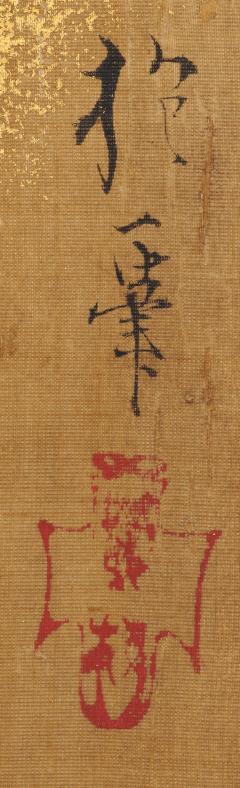
Documentation: Signed Period: 19th Century Condition: Good. Styles / Movements: Asian Art Incollect Reference #: 757954 -
Dimensions
W. 56 in; H. 18 in; W. 142.24 cm; H. 45.72 cm;
Message from Seller:
Kristan Hauge Japanese Art, based in Kyoto's museum district since 1999, specializes in important Japanese screens and paintings for collectors, decorators, and museums worldwide. Contact us at khauge@mx.bw.dream.jp or +81 75-751-5070 for exceptional access to Japanese art and history.
More Listings from Kristan Hauge Japanese Art View all 64 listings
-
Japanese Screen. Early 20th Century. Furosaki Screen. Wagtail & Chrysanthemum

-
17th Century Japanese Screen Pair. Flock of Cranes. Ink and color on gold leaf.

-
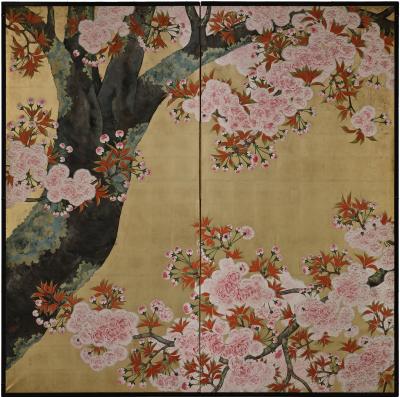
Early 20th Century Japanese Cherry Blossom Screen
-
Mitani Toshuku Unkoku School, 17th century. Japanese falcon painting.

-
Early 20th Century Japanese Screen Pair – Ink Pine Trees on Gold

-
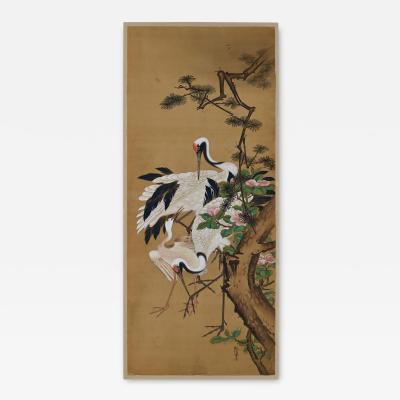
19th Century Japanese Silk Painting by Kano Chikanobu. Cranes, Pine & Camelia.
-
Late 17th Century Japanese Screen. Puppy and Kittens on Gold Leaf.
-
18th Century Japanese Screen Pair. One Hundred Flowers, Chrysanthemums

-
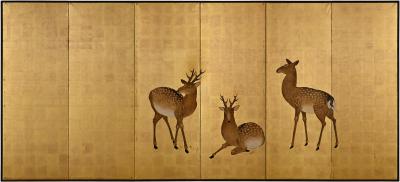
19th Century Japanese Deer Screen by Okamoto Toyohiko. Maruyama Shijo School
-
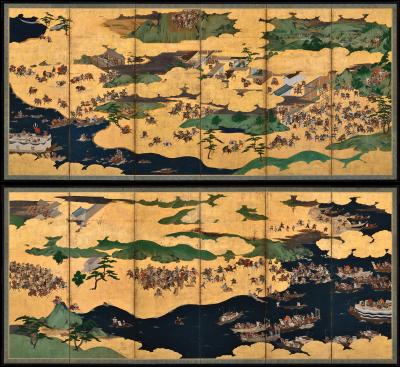
Late 17th Century Japanese Screen Pair. Battle of Ichi-no-tani and Yashima
-
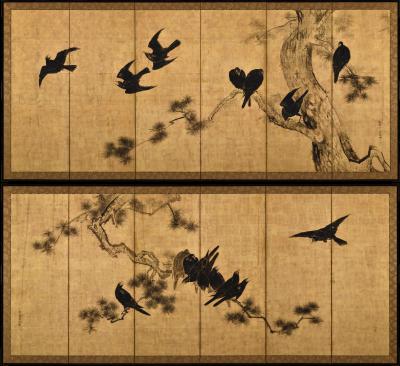
Mid 18th Century Japanese Screen Pair. Crows & Pines by Unkoku Toshuku
-
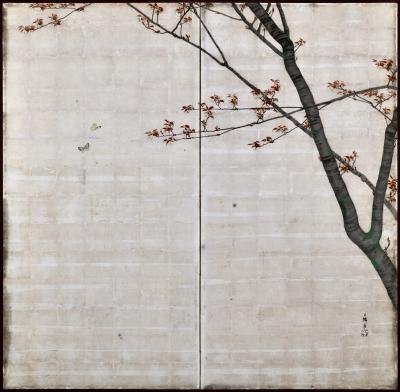
1895 Meiji Japanese Screen Pair. Cherry Blossoms & Autumn Maples on Silver Leaf
-
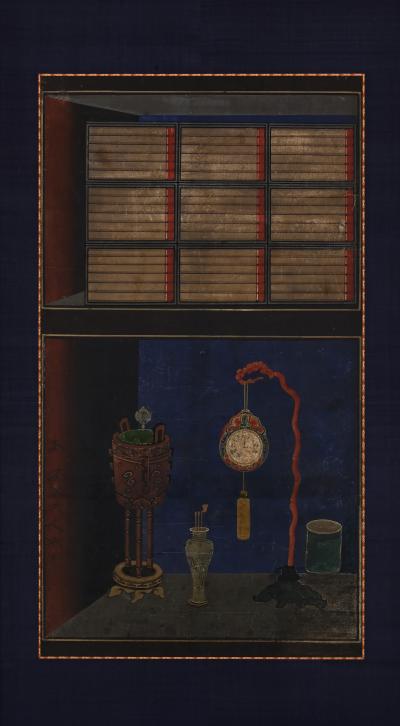
Chaekgeori painting. 19th Century Joseon. Books & Scholars’ Accouterments.
-
17th Century Japanese Screen. Ink Plum Tree & Birds by Kano Naonobu

