





Offered by:
Kristan Hauge Japanese Art
2-32 Saishoji-cho, Okazaki, Sakyo-ku,
Kyoto 606-8342 , Japan
Call Seller
81757515070
Showrooms
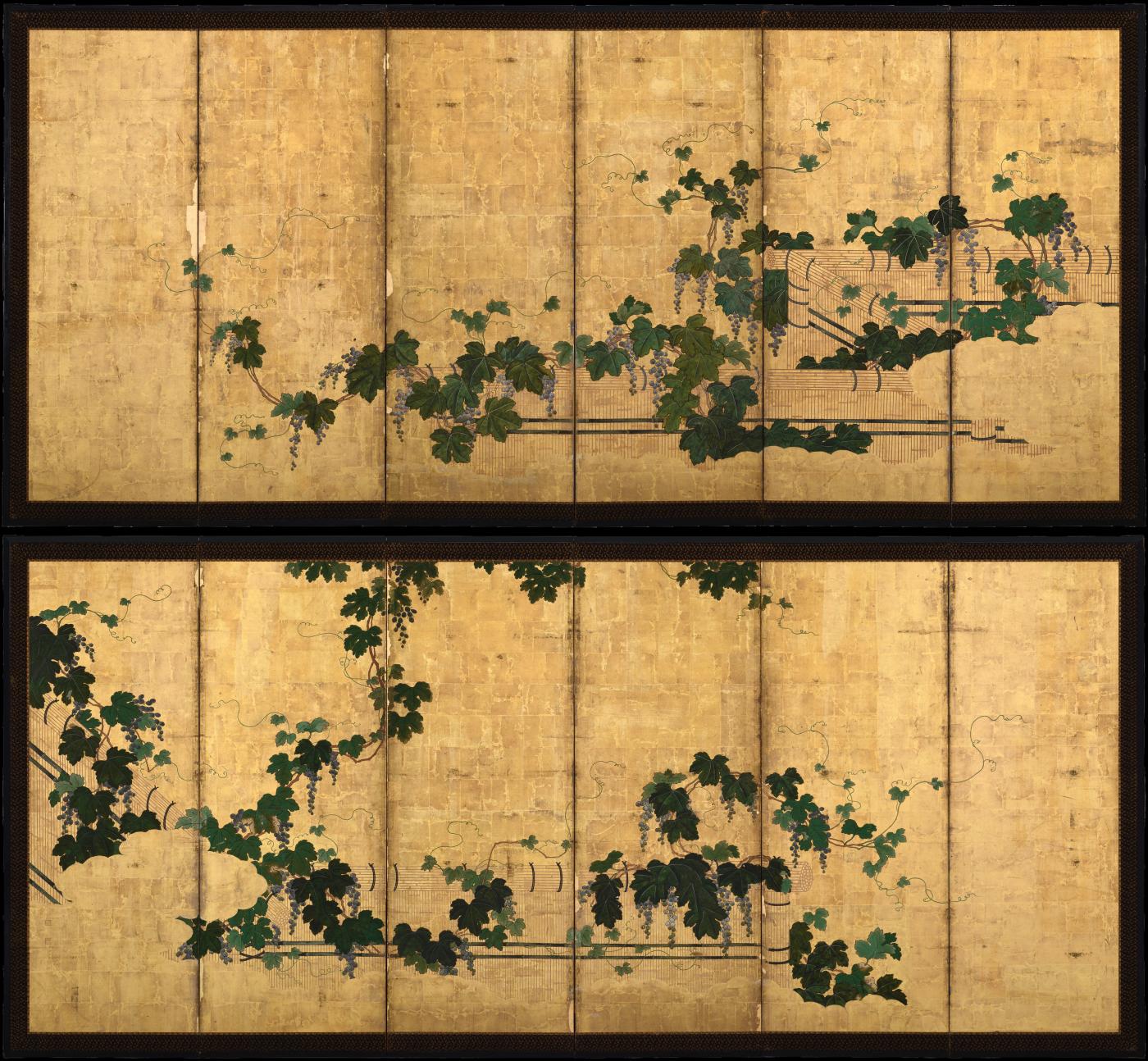
17th Century Japanese Screen Pair. Grapevines. Attributed to Kano Tsunenobu
-
Description
Attributed to Kano Tsunenobu (1636-1713)
Grapevines
Edo period, 2nd half of the 17th century
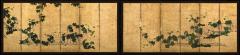
Pair of six-panel screens; ink, color and gold leaf on paper
Dimensions (each): H. 172 cm x W. 377 cm (68” x 148.5”)
Japanese screens depicting grapevines are relatively uncommon. Broadly speaking, they fall into two distinct categories: highly decorative examples employing extensive gold leaf and raised moriage decoration, and more painterly works produced by artists of the Kanō school. This screen pair belongs firmly within the latter tradition.
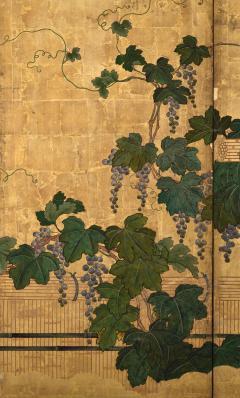
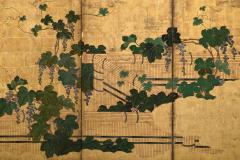
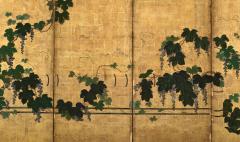
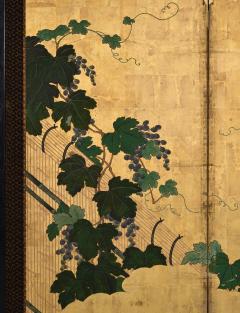
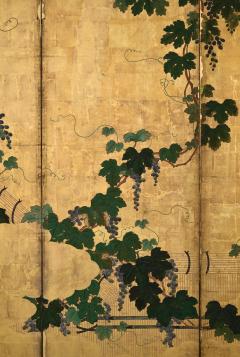
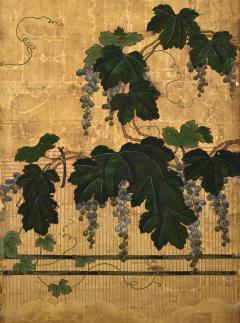
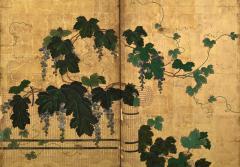
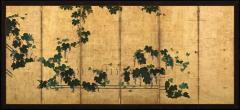
The composition is one of remarkable elegance and restraint. Grapevines, rendered in a rich range of green tones, wind gracefully across finely constructed bamboo trellises (takegaki), their forms being subtly revealed through billowing gold clouds. Clusters of ripe purple grapes announce the season of autumn, while the bamboo framework serves as a subtle compositional guide rather than the principal subject. Delicately painted with slender outlines that leave the gold leaf exposed within each bamboo stem, the trellises possess an understated refinement that rewards close examination without ever dominating the composition. The vines seem almost to float across the gold ground rather than being firmly anchored by visible trunks or heavy stems, creating an extraordinary sense of grace and fluidity. The generous use of negative space further enhances the rhythm of the composition, allowing the graceful movement of the vines to unfold naturally across the gold ground.
Unlike grapevine screens that rely upon patterning or heavily modeled moriage decoration, these screens remain unmistakably painterly in conception. Their emphasis lies not in surface embellishment, but in the confident brushwork, subtle naturalism, and harmonious balance of the composition. The beautifully patinated gold leaf, mellowed through centuries of age, provides a warm and luminous setting for the richly colored foliage and fruit.
Grapevines laden with fruit were a highly auspicious subject in Japanese painting, symbolizing abundance, fertility, prosperity, and the continuation of the family line. In Japanese literary tradition, grapes are celebrated as an autumn fruit and are recognized as a seasonal word (kigo) associated with early autumn. The motif also carried a particular appeal among the warrior class, as the Japanese word for grape, budō (葡萄), is a homophone of budō (武道), meaning “the martial ways.”
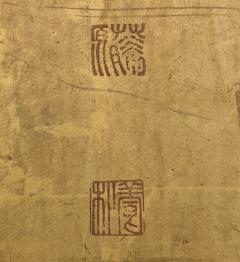
This pair of screens bears later seals attributing the work to Kanō Tsunenobu (1636–1713), one of the four great masters of the Kanō school and successor to his uncle Kanō Tan’yū as head of the Edo Kanō atelier. Although the seals themselves are not contemporary with the painting, the confident brushwork and sophisticated compositional balance support an attribution to a highly skilled Edo Kanō painter. The work displays the restrained elegance characteristic of the Edo Kanō tradition, favoring harmonious spatial design and refined decoration over the more colorful and overtly decorative manner associated with the Kyoto Kanō school. Its style is particularly close to the artistic lineage of Tan’yū and Tsunenobu, whose paintings combined classical discipline with an increased richness of ornamental detail. -
More Information
Period: Pre 18th Century Creation Date: 17th century Styles / Movements: Asian Art Incollect Reference #: 872230 -
Dimensions
W. 148.43 in; H. 67.72 in; W. 377 cm; H. 172 cm;
Message from Seller:
Kristan Hauge Japanese Art, based in Kyoto's museum district since 1999, specializes in important Japanese screens and paintings for collectors, decorators, and museums worldwide. Contact us at khauge@mx.bw.dream.jp or +81 75-751-5070 for exceptional access to Japanese art and history.
More Listings from Kristan Hauge Japanese Art View all 63 listings
-
Japanese Screen Pair. Showa era. Nihonga Riverside landscape. Late Summer
-
Sakai Hoitsu (1761-1828) | Autumn flowers | Japanese screen painting

-
Mid 18th Century Japanese Screen Pair. Crows & Pines by Unkoku Toshuku
-
Mitani Toshuku Unkoku School, 17th century. Japanese falcon painting.

-
Late 17th Century Japanese Screen Pair. Battle of Ichi-no-tani and Yashima
-
Early 20th Century Japanese Screen Pair – Ink Pine Trees on Gold

-
Early 20th Century Pair of Japanese Screens | Deer under Maple Trees
-
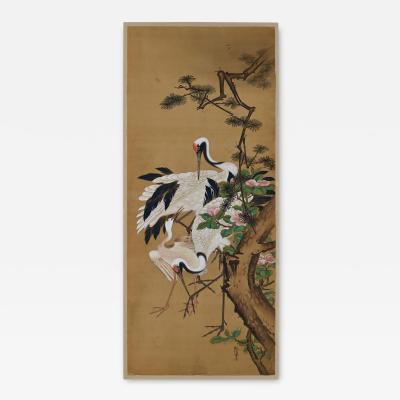
19th Century Japanese Silk Painting by Kano Chikanobu. Cranes, Pine & Camelia.
-
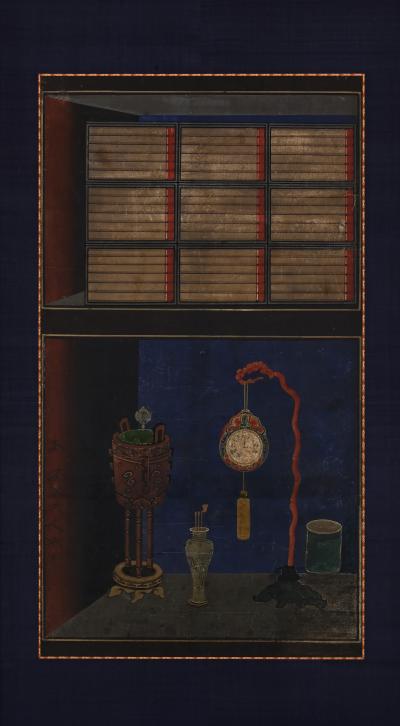
Chaekgeori painting. 19th Century Joseon. Books & Scholars’ Accouterments.
-
17th Century Japanese Screen. Ink Plum Tree & Birds by Kano Naonobu

-
Japanese Screen. Early 20th Century. Furosaki Screen. Wagtail & Chrysanthemum

-
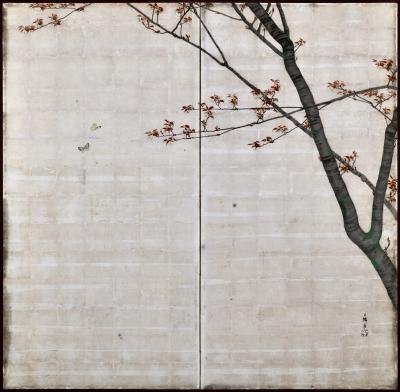
1895 Meiji Japanese Screen Pair. Cherry Blossoms & Autumn Maples on Silver Leaf
-
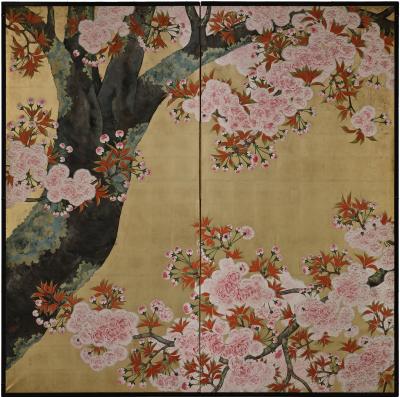
Early 20th Century Japanese Cherry Blossom Screen
-
19th Century Japanese Deer Screen by Okamoto Toyohiko. Maruyama Shijo School