

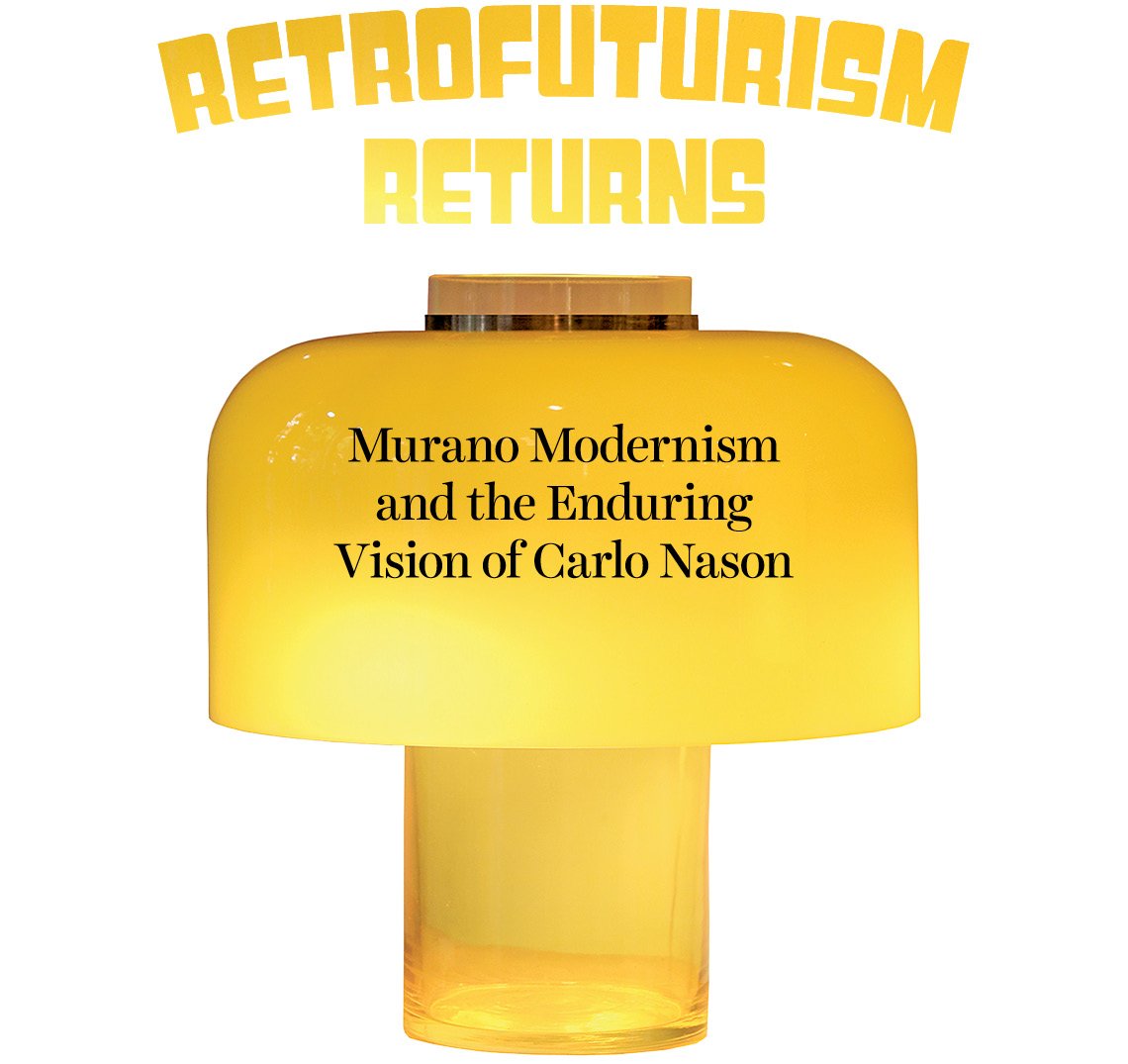
Retrofuturism Returns: Murano Modernism and the Enduring Vision of Carlo Nason
 |
by Benjamin Genocchio
When Carlo Nason died on May 5, 2026, at the age of ninety-one, we lost one of the last living legends of the spectacular post-war boom of Italian design; a visionary who helped reinvent Murano glass for the modern age. While many twentieth-century Venetian glassmakers remained faithful to historical forms, Nason looked resolutely forward, embracing the optimism of the Space Age and creating lighting that fused centuries of artisanal knowledge with an unmistakably contemporary sensibility. More than fifty years after many of his most celebrated designs first appeared, they still look as though they belong to the future.
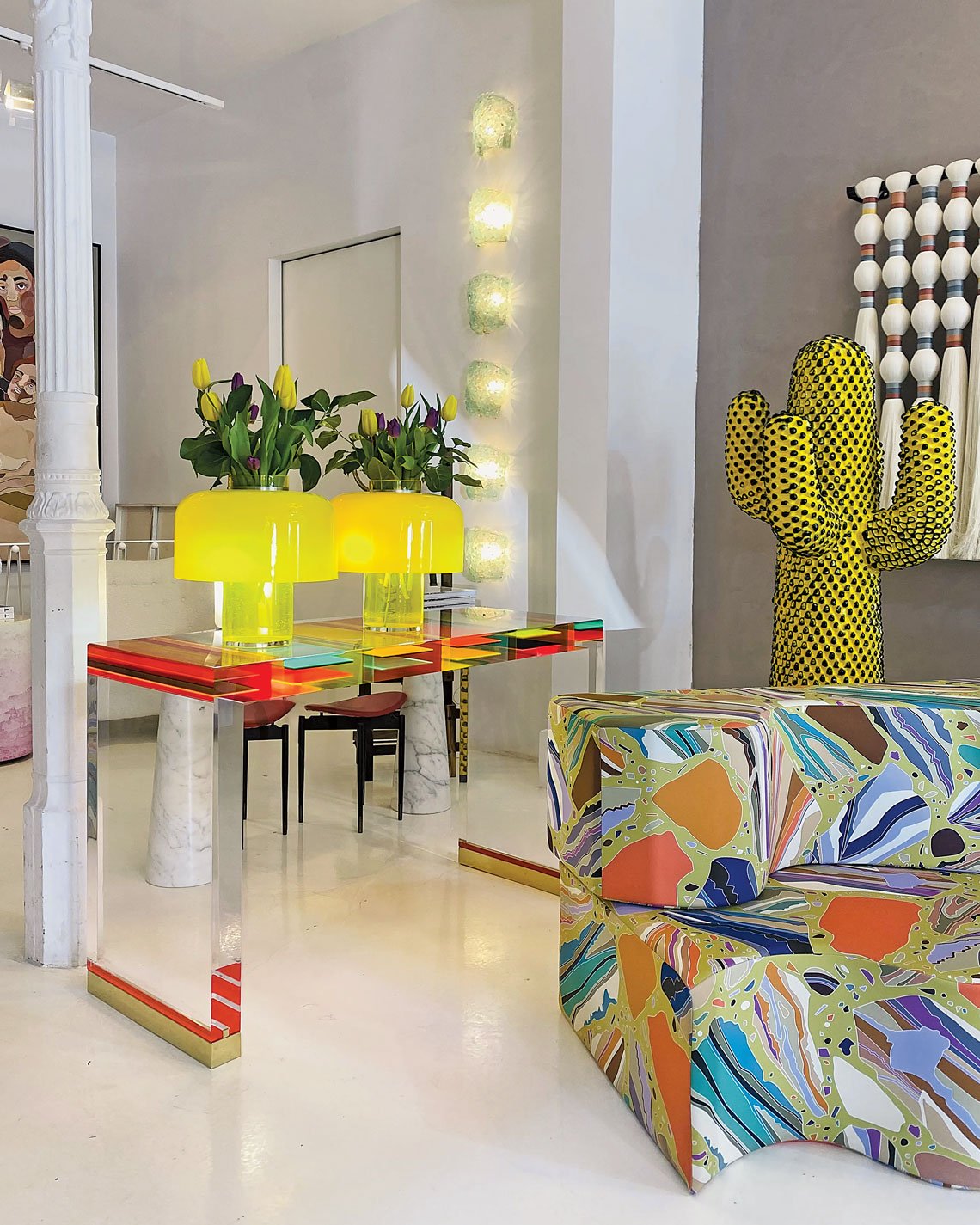 | 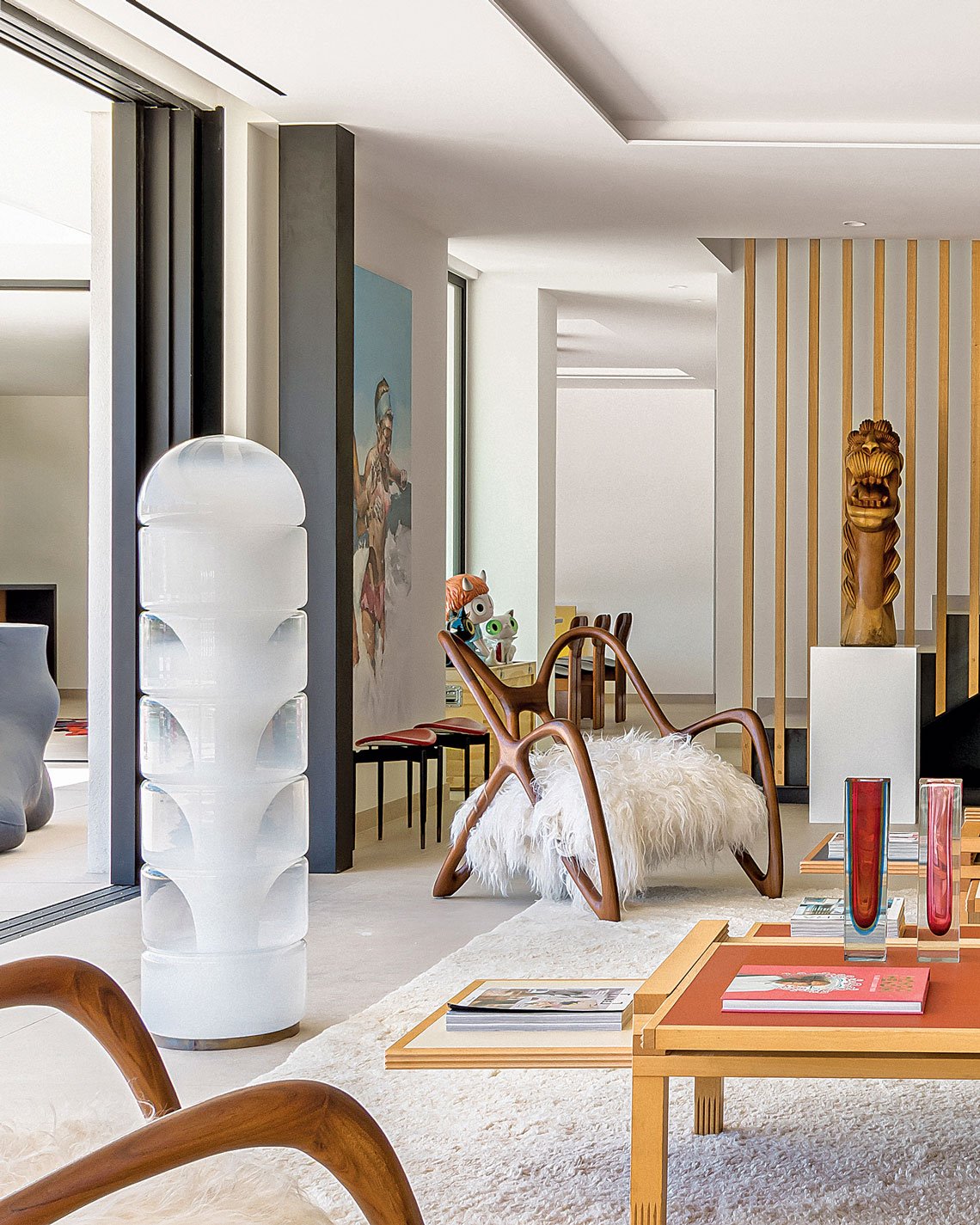 | |
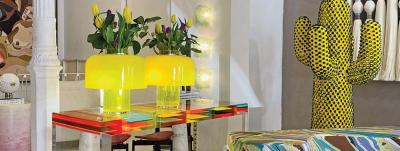
Left: In L.A. Studio’s Madrid gallery, a pair of LT 226 yellow Murano glass lamps by Carlo Nason for A.V. Mazzega sprout bouquets, adding an unexpected note of Pop Art whimsy to their futuristic form. The design has a central structure that serves as a vase. Italy, circa 1960s. Available from L.A. Studio on Incollect.com. Photo: Courtesy L.A. Studio. Right: An interior design project by L.A. Studio with Carlo Nason’s Floor Lamp Model LT 316 for A.V. Mazzega. Milky white blends seamlessly to clear, like smoke evaporating, in the sfumato glasswork. Composed in a column of seven stacked elements to produce a striking cascading effect — a softly luminous tower of light. Italy, circa 1960s. Available from L.A. Studio on Incollect.com. Photo: Courtesy L.A. Studio. | ||
Born in Venice in 1935, Nason inherited glassmaking almost by birthright. His father owned Vincenzo Nason & C., one of Murano’s leading furnaces, and from the age of eighteen he immersed himself in every aspect of production, learning the complex choreography of coloring, blowing, shaping, and finishing glass from some of the island’s finest craftsmen. Although he dutifully studied accounting at his father’s insistence, his ambitions lay elsewhere. He was drawn less to managing a family business than to exploring glass as a medium for artistic and industrial innovation. The timing proved fortuitous. By the early 1960s, international tastes were shifting decisively away from historical revivalism toward a new language of modern design. Establishing his own studio on Murano, Nason embraced the sleek optimism of the Space Age, replacing ornate decoration with fluid geometry, modular construction, and sculptural clarity. Japanese design, with its economy of form and quiet restraint, offered an equally important point of reference. Together these influences produced a body of work that looked both unmistakably Italian and remarkably international.
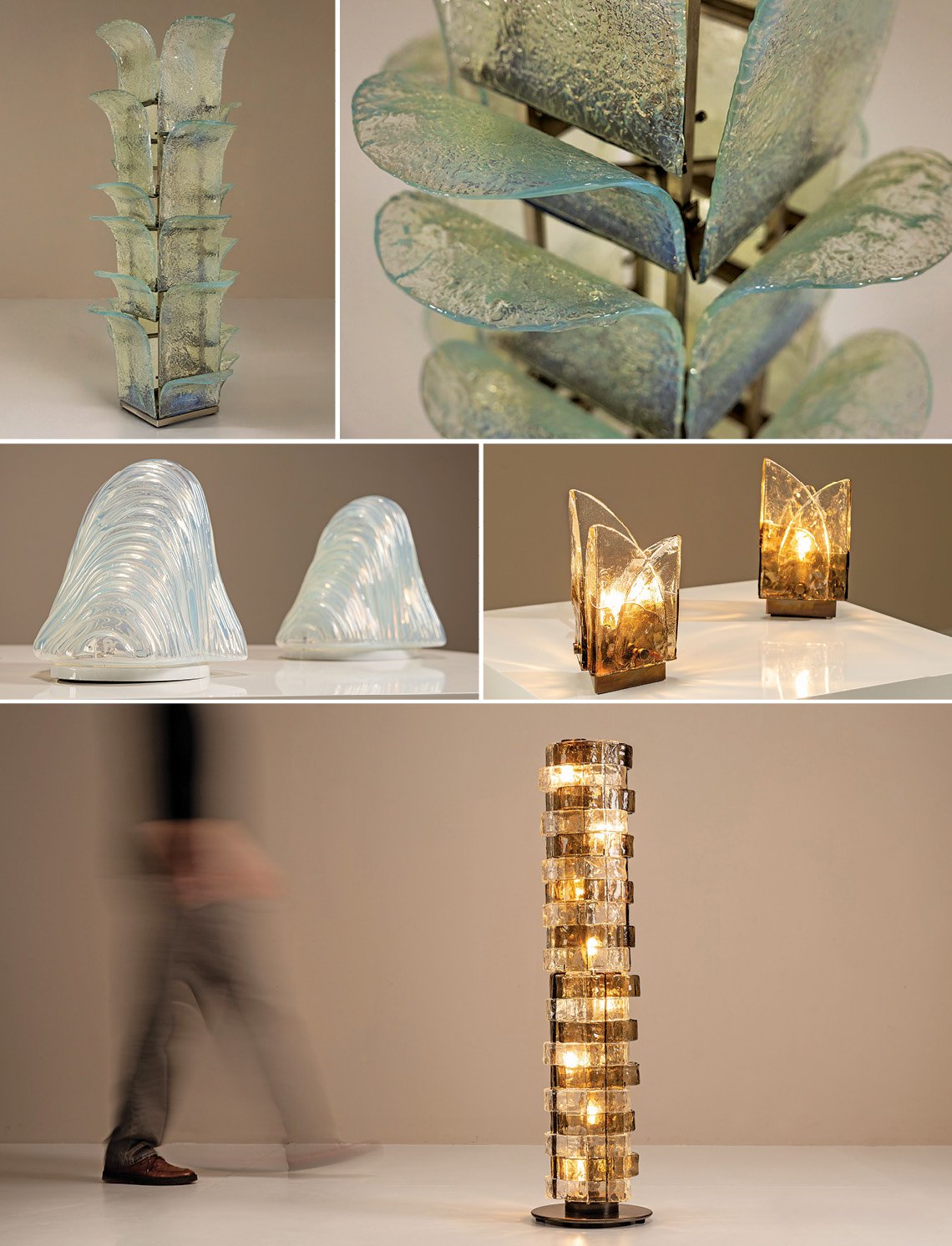 |
A selection of Carlo Nason’s designs offered by AtKris Studio. Gallery owner Krista van Oudheusden is drawn to his innovative techniques and forms and has handled scores of Nason’s fixtures. Top row: Model LT 320 Cactus floor lamp with leaves of clear blue crackled ice ghiacco technique glass. Carlo Nason for Mazzega, Italy, circa 1970s. Detail of the Cactus floor lamp leaves. 24 leaves in 3 graduated sizes can be arranged on the metal framework as desired. Unlit, the glass is soft blue; when lit, it emits a warm, golden glow. 2nd row: A pair of LT301 Iceberg table lamps in mold-blown ribbed opaline glass. Set on a white metal base, they appear to float, like icebergs, in a sea of soft light. Carlo Nason for Mazzega, Italy, circa 1970s. Historic Murano techniques meet sculptural modernity in this pair of LT 372 Leaf table lamps. Overlapping, unfolding leaves shift from tobacco brown at the base to subtle transparent green above, set on a patinated brass base. Carlo Nason for Mazzega, circa 1970s. Bottom: Model LT 378 floor lamp by Carlo Nason for Mazzega diffuses a warm, sparkling, and atmospheric light. Curved, hand-blown Murano glass segments in alternating clear and tobacco ghiacco cracked-ice textured glass are arranged in a layered lattice-like pattern. Italy, circa 1970s. Available from AtKris Studio on Incollect.com. Photos: Courtesy of AtKris Studio and Paolo Tozzi. |
Over the course of six decades, Nason designed well over a thousand lighting fixtures — pendants, sconces, table lamps, floor lamps, and chandeliers — making him one of the most prolific figures in postwar lighting design. Quantity alone, however, explains little. What distinguished Nason was his understanding that light itself could become a design material. Rather than simply illuminating interiors, his lamps manipulated transparency, opacity, reflection, and shadow to construct an atmosphere. Their purpose extended beyond function; they reshaped the experience of architectural space. Seen today, it is easy to forget how radical these objects once appeared. Nason rejected the elaborate ornament traditionally associated with Murano in favor of layered geometries, softened silhouettes, and modular compositions that reflected the technological optimism of the postwar decades. His experimentation extended well beyond form. He developed new approaches to blowing, casting, and coloring glass, while refining his own distinctive version of the pulegoso finish. This softly opalescent, bubble-filled surface gave his lamps extraordinary depth and luminosity.
Unlike some designers who supplied drawings to manufacturers and awaited their creation, Nason remained intimately involved in every stage of production. He supervised work at the furnace, designed bespoke chrome-plated fittings and structural components, and readily embraced emerging technologies, incorporating innovations such as line-operated foot switches into his lighting decades before they became commonplace. This meticulous attention to detail allowed him to reconcile traditional craftsmanship with the industrial precision that defined modern Italian design.
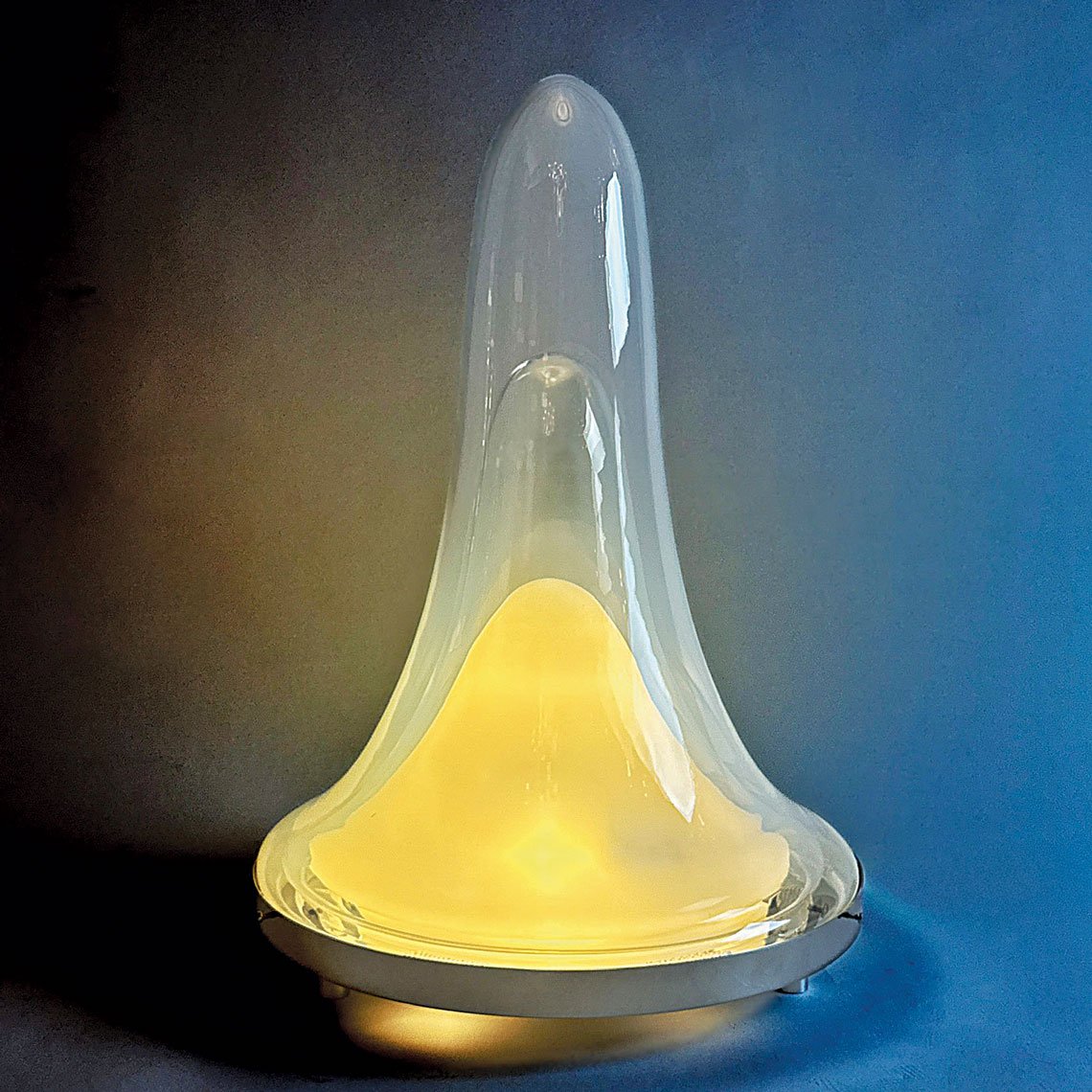 | 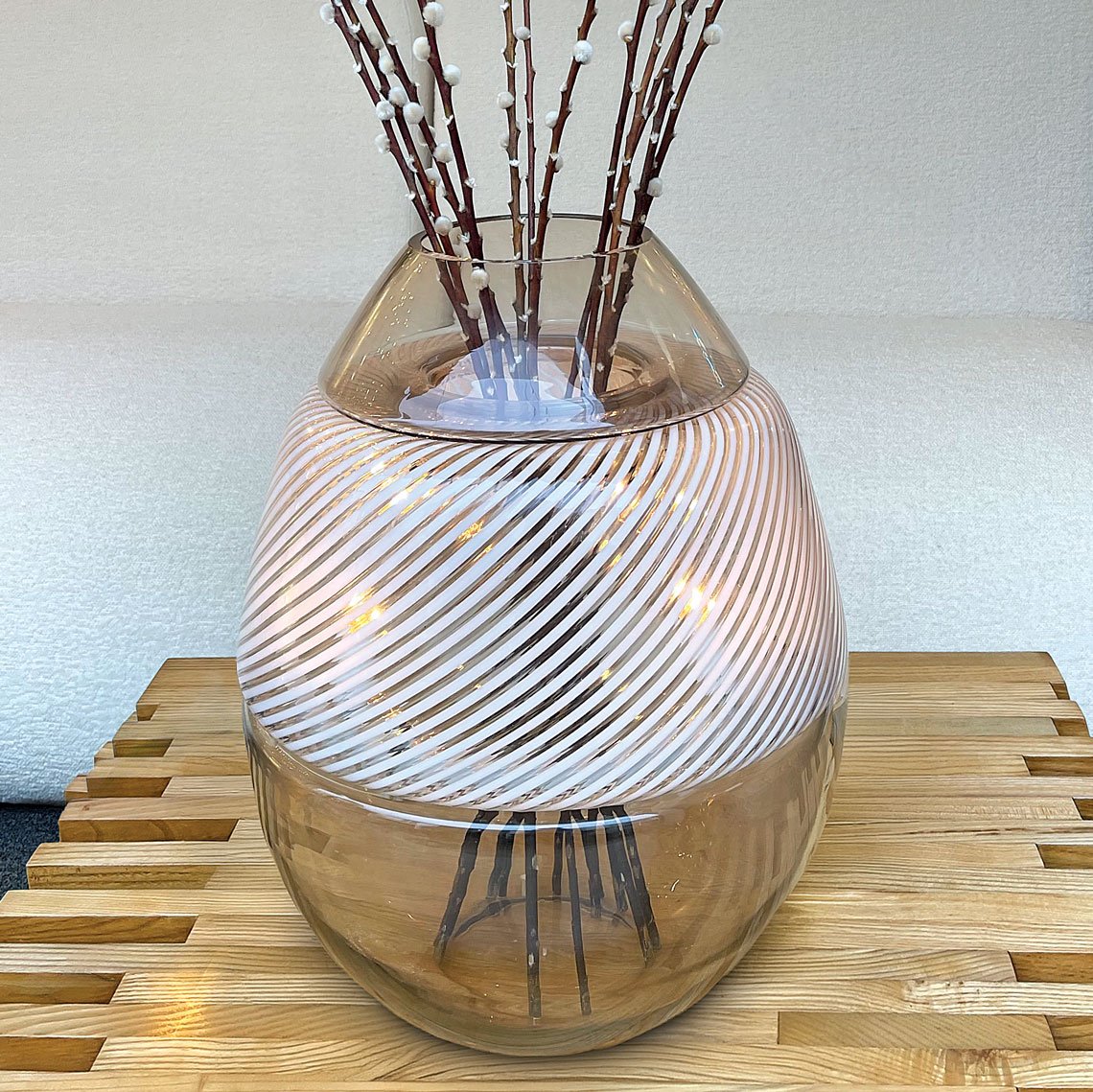 | |
Left: Designed in 1969, Carlo Nason’s LS 144 for Mazzega in opaque lattimo Murano glass and iridescent Murano glass was originally conceived as a ceiling light, although it is also often used as a table lamp. Three handblown forms stack within a nickel-plated steel base, tapering into an elongated drop. In natural light, it has a cool, milky sheen; when lit, the smallest form glows warm, opaque light, passing along the length of two layers with varied transparencies. Available from Domus Aurea on Incollect.com. Right: The LT 353 Egg table lamp and integrated vase. Built from three handblown Murano glass sections, the top and bottom are clear, with a middle section of transparent crystal and lattimo (white) spiral filigrana glass. Designed for Mazzega, circa 1970s. Available from Stanislas Reboul on Incollect.com. Photo courtesy of Stanislas Reboul. | ||
His achievements were equally the product of collaboration. Every lamp emerged through close partnerships with Murano’s master glassblowers, whose technical virtuosity enabled Nason’s increasingly ambitious ideas to take shape. Although he worked with several distinguished manufacturers — including Vetreria Vistosi and, later, Linea GB Milano — it was his long association with A.V. Mazzega, beginning in the early 1960s, that proved decisive. There he enjoyed an unusual degree of creative freedom, developing the layered glass constructions that became his signature and established him as one of Murano’s most original modernists.
No design better encapsulates that achievement than the Lotus table lamp. Widely regarded as one of the icons of twentieth-century Italian lighting, it demonstrates Nason’s mastery of combining translucent and opaque glass to orchestrate the movement of light. Four petal-like shades surround a concealed light source, their overlapping forms producing a delicate layered effect that dissolves the boundary between object and illumination.
“Carlo Nason’s inventive use of stacked and layered construction makes him a truly original and outstanding figure in the world of Murano glassmaking,” says Stanislas Reboul, the French design dealer and specialist in 1970s Italian glass. Among the works Reboul most admires are the Lotus and the remarkable ‘Sfumato’ tubular floor lamp assembled from stacked vessel-like forms. As the column rises, translucent glass gradually gives way to opacity, creating a softly diffused vertical glow that seems to shift almost imperceptibly as one moves around it. “This model is his absolute masterpiece,” Reboul says.
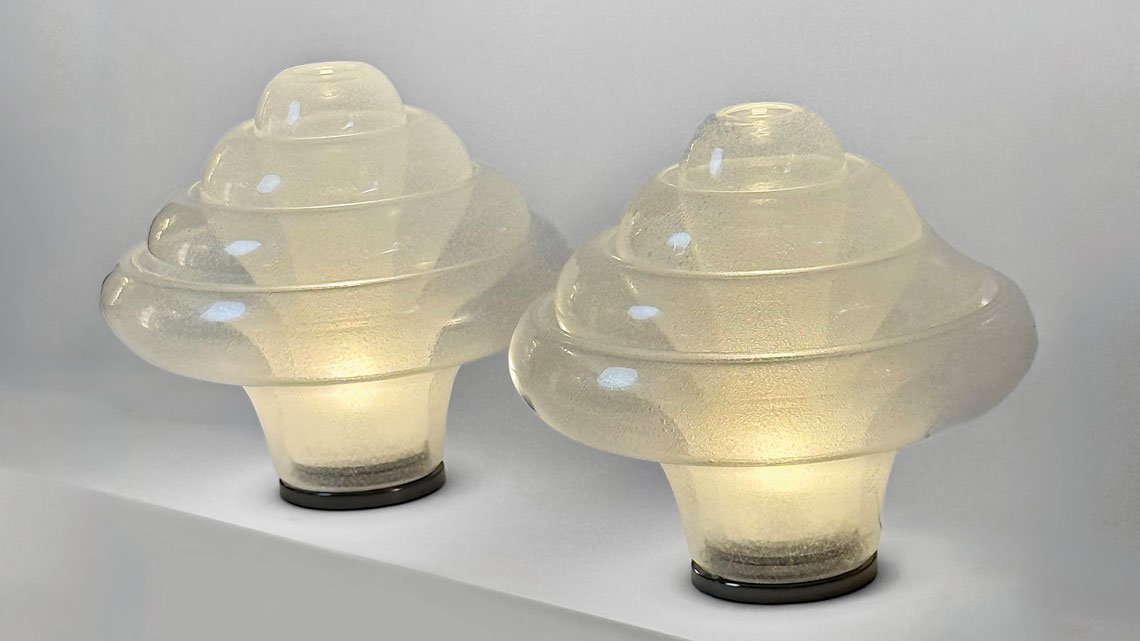 |
Known as the Lotus table lamp, Model LT 305 is one of Nason’s most poetic and beautiful designs. Four concentric forms of handblown pulegoso glass are layered into the base, elegantly depicting a blooming lotus flower. The pulegoso effect is created by mixing sodium carbonate into molten glass to produce millions of tiny bubbles, making the glass semi-opaque for a gentle, diffused light. Designed for A.V. Mazzega in 1969. Available from Domus Aurea on Incollect.com. Photo: Courtesy of Domus Aurea. |
Incollect dealer Paolo Tozzi, owner of Domus Aurea gallery in Florence, Italy, encountered Nason’s work some fifteen years ago and was immediately taken by its originality. “His designs were radically innovative,” Tozzi says. “They combined traditional Murano glassmaking with an abstract visual language that felt entirely modern.” Today Tozzi owns numerous examples, both for sale and in his personal collection. A pair of Osso table lamps occupies his bedside tables, while several pulegoso lamps illuminate his living room. “I am fascinated by his work,” he says. “I continue to acquire pieces because they represent an essential chapter in the history of Murano glass and modern Italian design.”
That reassessment has gathered momentum among specialist dealers and collectors over the past decade. Dutch dealer Krista van Oudheusden, founder of AtKris Studio, has built one of Europe’s most significant inventories of Nason lighting, sourcing examples across the continent for her gallery in Haaften. “They are exceptionally well designed,” she says. “They have a strong identity without unnecessary visual noise, which makes them remarkably easy to place in contemporary interiors.” Van Oudheusden estimates she has handled scores of Nason works over the years. “If we hadn’t sold so many already,” she says with a laugh, “I could have opened a museum dedicated entirely to Carlo Nason.”
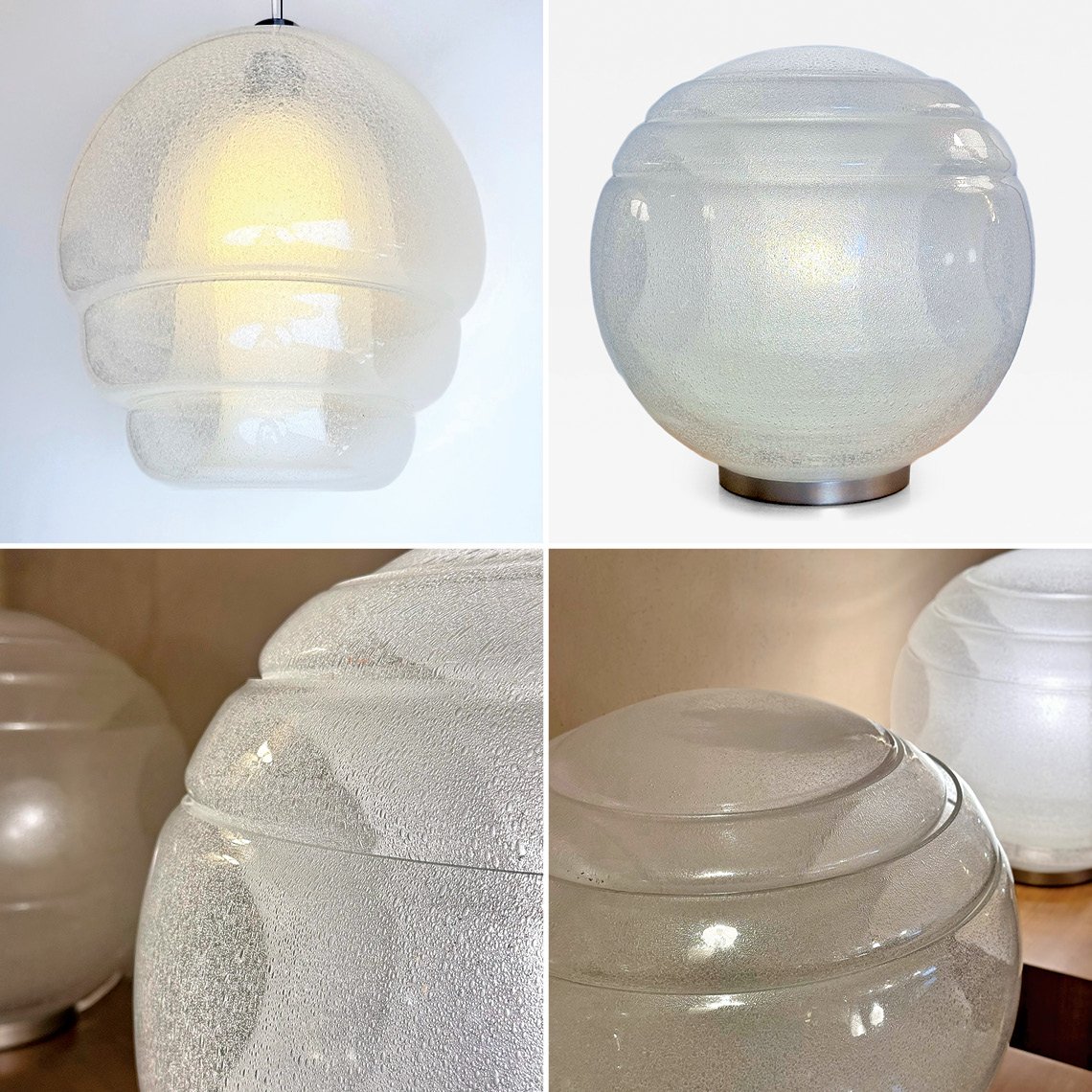 |
Top left: The LS 134 pendant light is perhaps the most iconic of Nason’s creations, named Medusa by Nason’s wife for its resemblance to a jellyfish (medusa is the Italian word for jellyfish). The four nested shades begin with an opaque inverted tulip-shaped form designed to diffuse the light source, surrounded by three nested pulegoso glass forms that reveal the complex curvature and varying density effect of the layers. Designed for A.V. Mazzega in 1969. Available from Domus Aurea on Incollect.com. Photo: Courtesy of Domus Aurea. Top right and bottom row (details): The LT 328 Sfera table lamp in hand-blown pulegoso Murano glass. Four interlocking layers are stacked to form a sphere, with a dense field of bubbles in the glass softening the light to a warm, atmospheric glow. For A.V. Mazzega, circa 1970s. Available from Domus Aurea on Incollect.com. Photo: Courtesy of Domus Aurea. |
For Van Oudheusden, Nason’s genius lay in understanding that light was not simply something emitted by an object but a material to be shaped as carefully as glass itself. She points to the Minosse table lamp, designed for Linea GB Milano, as a quintessential example of this philosophy. At first glance, the lamp appears disarmingly simple — a satin-white cylinder of Murano glass resting on an understated base. Closer inspection reveals a subtle concave recess that draws the eye toward a polished chrome sphere embedded within its centre, transforming an apparently austere object into a sophisticated study of reflection, depth, and illumination. “The satin-white Murano glass diffuses a warm, even glow, while the sculpted indentation creates movement and visual depth,” Van Oudheusden observes. “It is functional, yet entirely sculptural.”
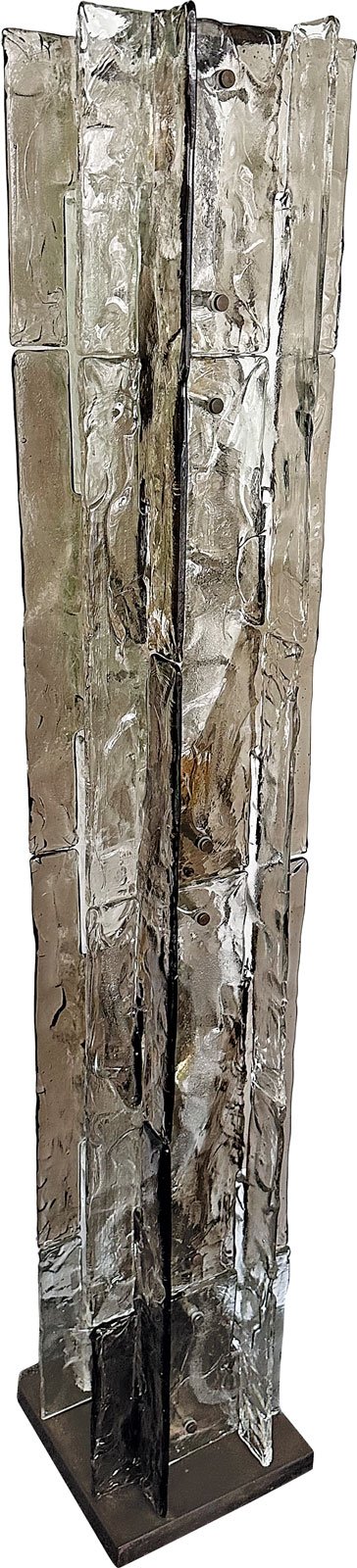 | |
A futuristic tower floor lamp in interlocking, alternating smoked and clear ghiacco glass plates. Textured to resemble cracked, melting ice, it casts an intriguing play of light and shadow and warm ambient light. Both a sculptural object and a floor lamp, it was designed for Mazzega in the 1970s. Photo courtesy of Stanislas Reboul. |
By the 1970s, Nason had begun to move beyond the layered compositions that first established his reputation, embracing increasingly experimental forms that reflected the technological optimism of the decade. Barbell-shaped floor lamps, spherical table lights, torpedo-like sconces, and boldly architectural chandeliers captured the spirit of an era fascinated by space travel, new materials, and visions of the future. Yet unlike much futuristic design of the period, Nason’s work has aged remarkably well. Its restrained palette, formal clarity, and sculptural confidence have allowed it to transcend the stylistic clichés of the Space Age, lending many of his designs an unexpected contemporary relevance.
For Carlos Lopez, founder of Madrid’s L.A. Studio, that enduring appeal lies in Nason’s remarkable economy of means. “Nason had an extraordinary ability to create designs of expressive strength from simple yet effective lines,” Lopez says. “His work never relied on excess. It was grounded in formal clarity and a nearly silent elegance.” Lopez believes Nason also occupied a uniquely fertile territory between art, design, and craft — a position that increasingly defines the most compelling collectible design today. “His creations illuminate spaces,” he says, “but they also construct their own atmospheres.”
Few works demonstrate that more eloquently than the Cactus floor lamp, perhaps the most technically ambitious object of Nason’s career. Built around a concealed metal armature supporting multiple light sources, the sculpture is composed of dozens of individually crafted glass leaves produced using the demanding ghiaccio, or ice-glass, technique. In this process, molten glass is plunged into cold water, creating a network of delicate fractures that are then sealed beneath another layer of glass. The resulting surfaces appear frozen, crystalline, catching and diffusing light with extraordinary subtlety. Each leaf can be repositioned, allowing the owner to alter not only the sculpture’s appearance but also the character of the light itself — a remarkably interactive concept decades before such flexibility became commonplace.
Nason’s work has been long appreciated by discerning interior designers. The late New York designer Amy Lau incorporated his lighting into her celebrated interiors, while dealer/designer Robert Stilin has continued to champion his work among American collectors. Yet one of the defining qualities of his career was its democratic breadth. Alongside highly sophisticated sculptural lighting, he also designed accessible objects intended for everyday domestic life, approaching even the most modest commissions with imagination and technical ingenuity.
Among the most charming is a lamp designed for A.V. Mazzega in 1960 that incorporates a flower vase into its structure. A gently curved, double-layered glass shade rests upon a hollow vessel designed to hold fresh flowers, uniting illumination and nature within a single object. The gesture is deceptively simple, yet entirely characteristic of Nason’s ability to elevate everyday rituals through thoughtful design. Lopez considers it one of the designer’s most poetic inventions. “The simple gesture of adding a vase to a lamp introduces a poetic dimension into the object, combining light and nature within a single design piece,” he says. “The illumination becomes warm and enveloping, while the vase adds life and temporality.” For Lopez, that understated humanity explains why Nason’s work continues to resonate with collectors more than half a century after its creation. “These are lamps that surprise as much as they seduce,” he says. “Their simple lines, contemporary spirit, and balance between form and function allow them to transcend trends and enter into dialogue with interiors from any era.”
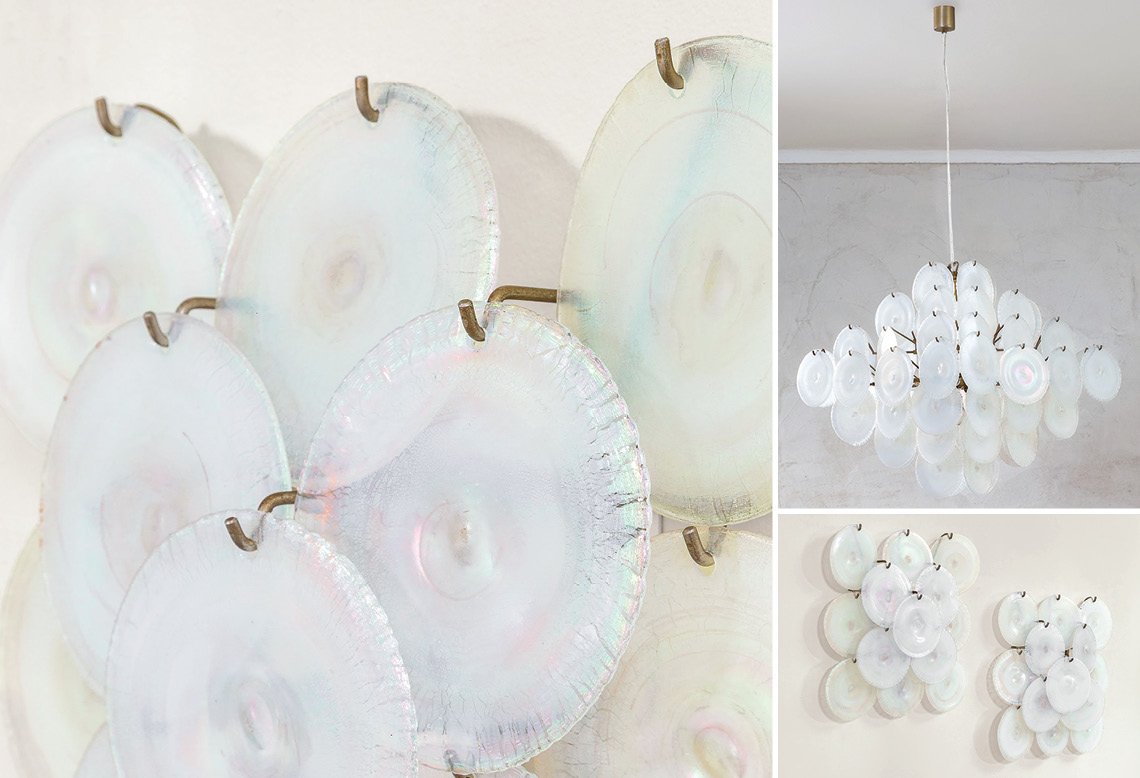 |
Left: “The discs also cannot be made anymore. They were produced in crystal, made as a soffiatura (blown piece) and then opened and etched, burnt with an acid that is not permitted anymore. They turned opaque like this, a bit fluorescent, but it is not possible to make them now. I have tried to make them many times, but they don’t turn out like they used to.” — Carlo Nason, 2019 Right: The LS 132 pendant light and matching wall lights with iridescent crystal discs. These vintage models were produced, according to Nason, through a process that is no longer allowed, making these pieces rare works of art. Designed for Mazzega, circa 1960s. Available from Società Antiquaria on Incollect.com. Photos: Courtesy of Società Antiquaria. |
That observation perhaps best captures Carlo Nason’s achievement. Although his work emerged from the extraordinary traditions of Murano glassmaking, he refused to be constrained by them. Instead, he reimagined the language of Venetian glass through the optimism of postwar modernism, creating objects that were technologically adventurous, rigorously crafted, and profoundly humane. Few designers succeeded so completely in reconciling innovation with craftsmanship, or modernity with tradition. His legacy is not simply a remarkable body of lighting, but a lasting demonstration that the most enduring forms of design illuminate both the spaces we inhabit and the ways we imagine the future.
 |