



Gio Ponti and the Art of Irrepressible Invention
 | |||
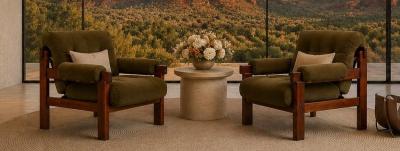
Gio Ponti for Cassina, Italy 1957, Model 811 lounge chairs and rare set of 3 floor lamps, c. 1974.
| |||
 |
By Benjamin Genocchio
 | |
Paul Donzella, Founder Donzella LTD and co-curator of the exhibition. |
Gio Ponti never stood still, and that restless inventiveness is the key to understanding his work. Just when you think you have him figured out—the elegant Milanese modernist, master of the impossibly thin chair—along comes a wildly inventive desk, an eccentric table, an object with an improbable silhouette, or a lighting fixture that defies convention.
This restlessness is what makes Ponti so compelling today, and it is the focus of Gio Ponti: Designing Optimism at Donzella Ltd. at the New York Design Center. Organized by Incollect dealer Paul Donzella and Gio Ponti expert Brian Kish, the show brings together more than 60 works created between the late 1920s and the mid-1970s, ranging from furniture, lighting, ceramics, silver, and enameled metalwork to original preparatory drawings and textiles. Together, they reveal a designer whose work has become increasingly coveted by collectors but remains stubbornly resistant to tidy stylistic or design categories.
The exhibition is the culmination of Donzella’s love of and dedication to presenting historically important design; over three years of research and sourcing, built on decades of private scholarship and longstanding relationships with Ponti collectors throughout the United States and Europe. Many featured works have remained in private hands for generations and had not previously been publicly exhibited or available on the market.
 |  | |
Left: Gio Ponti, Rare Pair of Armchairs, c. 1946. Walnut, upholstered seat. Rare Diavolo Side Table, c. 1940. African padauk wood and bamboo caning. Right: Gio Ponti, Pair of Stools, c. 1930s-40s. Gio Ponti, Rare Mahogany Bookcase, c. 1947. Photographed by Michael Mundy at 53W53, NYC. | ||
"What has always fascinated me about Gio Ponti is that no matter the medium—whether he was designing a chair, a lamp, a ceramic vessel, or an entire building—you immediately recognize the same joyful spirit and unmistakable sense of elegance. The work is itself a celebration of design," said Donzella, founder of Donzella Ltd. "Bringing these pieces together offers a rare opportunity to experience the extraordinary range of his creativity while revealing the remarkably consistent philosophy that guided everything he created. I hope visitors leave with an even deeper appreciation for why Ponti remains one of the most influential designers of the twentieth century."
The exhibition arrives amid renewed international attention to Ponti’s legacy. Later this year, Italy is establishing a museum dedicated to his vast creativity. “2026 marks a reevaluation of Gio Ponti’s place in visual culture,” said Kish. “Twenty-five years after I curated Gio Ponti: A Metaphysical World at the Queens Museum in New York, I see his work gaining new relevance. His confident agility across architecture, fine art, design, and publishing, his endlessly reinventing methods and styles, and his refusal to be tied down to a particular field of activity are better understood than ever in the 21st century.”
 |
Gio Ponti, Lounge Chairs designed for the Parco dei Principe Hotels in Rome and Sorrento, c. 1964. Produced by Cassina 7. Photography: Michael Mundy |
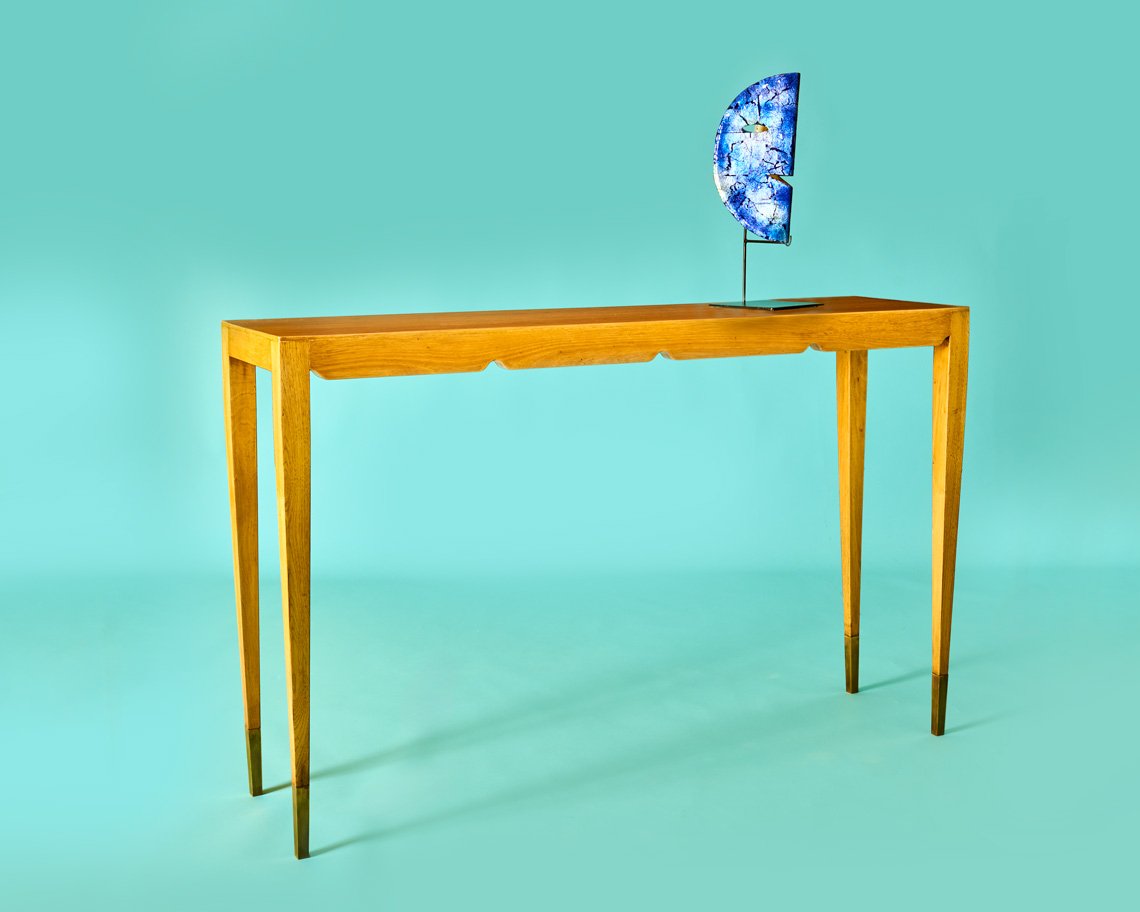 |
| Gio Ponti, Rare Console Table, c. 1942. Cherry wood, brass sabots. Gio Ponti & Paolo de Poli, Unique Mask, c. 1951. Enameled copper with silver leaf. Photography: Michael Mundy |
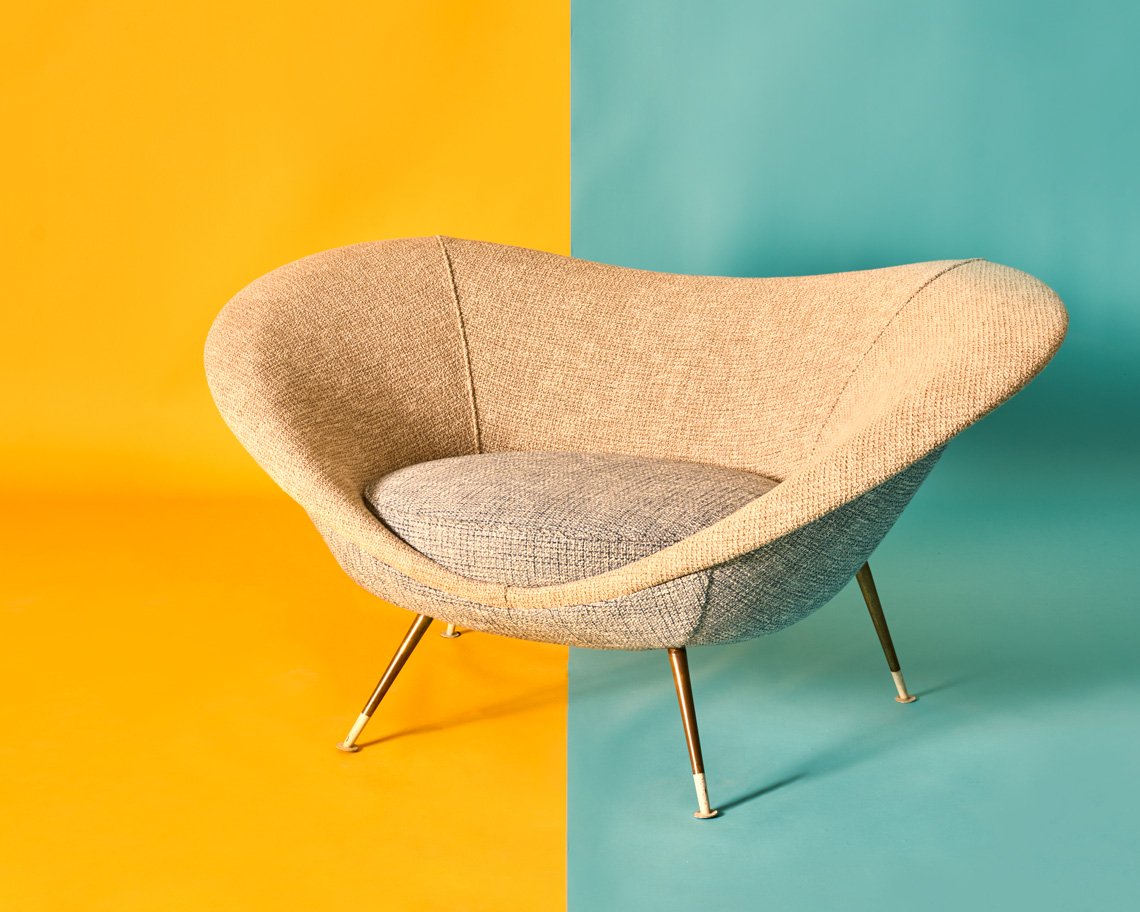 |
| Gio Ponti, Lotus Lounge Chair, c. 1957. Photography: Michael Mundy |
Ponti designed almost everything: buildings, chairs, desks, cabinets, ceramics, lamps, glass, textiles, silver, and magazine covers all passed across his drawing board during a career lasting more than half a century. He also wrote incessantly, edited magazines (Domus, the magazine he founded in 1928, remains an influential design publication today), cultivated manufacturers and artisans, and promoted other designers. Work seemed to generate still more work.
What makes this exhibition particularly interesting is its focus on unusual, rarely seen furniture designs, including rare prototypes, custom commissions, and experimental pieces that show how often Ponti reconsidered even the most ordinary domestic objects. Rather than presenting familiar modernist icons, the curators offer a nuanced account of a designer who never stopped questioning what furniture could look like.
Consider the extraordinary Desk Model AP1025 of 1953, produced with the Milanese cabinetmaker Giordano Chiesa. Made of walnut, ash and brass, it combines an elongated work surface with an asymmetrical arrangement of drawers and open storage, supported by sharply angled legs. The composition is simultaneously architectural and remarkably light, its different elements appearing to balance one another almost effortlessly.
Ponti himself was particularly proud of the design. "This is my masterpiece. I call it my show horse," he wrote, describing it as a piece of furniture that was simple but not formally inert. It is a revealing distinction. For Ponti, simplicity never meant the absence of invention. Even a desk had to possess a certain visual energy.
 |  | |
Left: Gio Ponti, Rare Custom Console Table, c. 1952. Ash wood, brass sabots. Rare Diavolo Side Tables, c. 1940. African padauk wood and bamboo caning. Right: Unique Burled Walnut Custom Club Chair, c. 1932. Rare Diavolo Side Table, c. 1940. African padauk wood and bamboo caning. Photographed by Michael Mundy at 53W53, NYC. | ||
A second desk, made around 1957 for Villa Goldschmidt in Buenos Aires, takes the idea further. Produced by Giordano Chiesa in elm veneer, ash and brass, it has an exceptionally thin horizontal top, dramatically angled supports and two drawers suspended beneath the surface. Its components seem stretched and rearranged until the desk resembles an abstract composition that happens to be functional.
The two desks share a concern with structural lightness, but their personalities are different. One is elegant and measured; the other is almost provocatively sculptural. Taken together, they show that Ponti was not interested in arriving at a single solution and repeating it.
The same spirit animates a rare group of tables. A pair of side tables from around 1940, made by Mario Quarti in African padauk wood and bamboo, have curving, sculptural legs and contrasting surfaces. Their combination of rich wood and bamboo caning feels surprisingly decorative, even exotic, for a designer so closely associated with the streamlined furniture of postwar Italy.
A rare Arlecchino cocktail table of around 1956 is a circular construction of brass and glass with an open geometric grid beneath its transparent top. An example belonged to Ponti himself and stood in his family home on Via Dezza in Milan. The table is both rigorously geometric and playful, its structure providing the decoration rather than merely supporting it.
>
These objects complicate the familiar image of Ponti as a designer pursuing ever greater simplicity. He was certainly interested in eliminating unnecessary material, but he was equally attracted to unusual shapes, unexpected combinations and the visual possibilities of ornament. In Ponti’s work, reduction and decoration were not necessarily opposites, as conventional art and design history has frequently taught us. They were different means of making an object interesting to look at, at least for him.
The exhibition's seating provides an equally revealing account of Ponti's changing ideas. A rare swivel armchair designed around 1936 for the first Montecatini office building in Milan, with its aluminum, steel, Bakelite and red vinyl, looks almost like a piece of industrial equipment. It belongs to the world of modern offices, machinery and efficiency, a considerable distance from the elegant domestic furniture for which Ponti is best known.
 |  | |
Left: Gio Ponti, Zig Zag Cabinet, c. 1947. Mahogany with faux drawer fronts in birds-eye maple. Right: Gio Ponti and Piero Fornasetti, Rare Display Cabinet designed for Casa Ceccato, Milan, 1950. Ferrara walnut root with hand-painted and lithographic transfer-printed panels depicting maps of Venice. Photographed by Michael Mundy at 53W53, NYC. | ||
Compare it with a sculptural mahogany and leather armchair from around 1946, whose dark angular wooden supports and generous proportions give it an almost expressionist character. It is most likely unique. Or consider the striking Model 811 lounge chairs made by Cassina in 1957, with their dynamic, reclining wooden frames, restrained wings, rubber supports, and ribbed leather cushions. Each approaches seating from a different direction and mindset.
Ponti's celebrated Leggera chair series, produced in the 1950s, represents one extreme of this experimentation, with the designer reducing the traditional chair to astonishingly economical, lightweight structures. Yet the Donzella exhibition makes clear that lightness was only one interest. Comfort, theatricality, movement and visual surprise were equally important.
His collaborations were central to this process. Ponti may be remembered as one of the giants of industrial design, but some of his most extraordinary objects emerged from close relationships with specialist manufacturers and artisans. He worked with Richard Ginori, Venini, Fontana Arte, Cassina, and numerous smaller workshops, often using their expertise to test ideas that might otherwise have remained fanciful drawings.
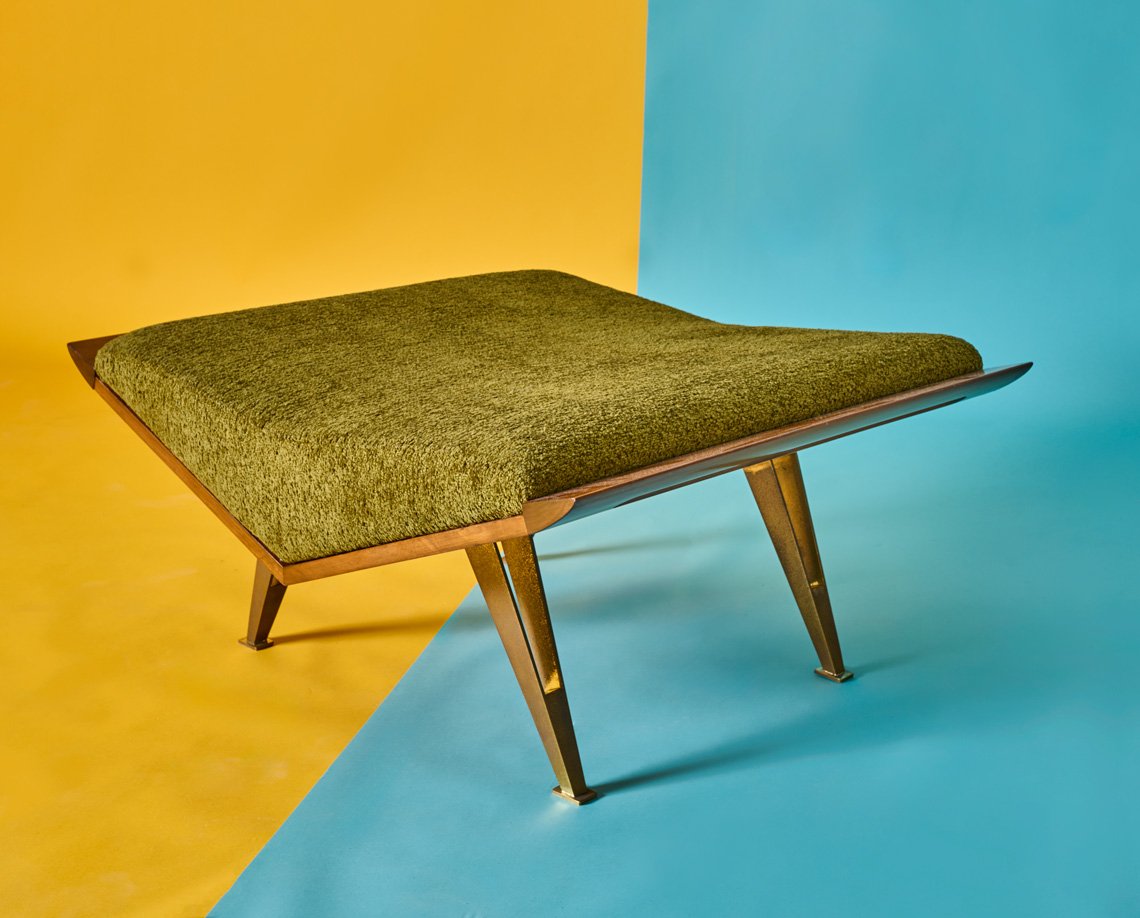 |
| Gio Ponti, Rare Bench, c. 1953. Incised walnut panels, sculptural brass legs. Photography: Michael Mundy. |
One of the exhibition's most compelling examples is a remarkable display cabinet designed with Piero Fornasetti in 1950 for Casa Ceccato in Milan. Produced by Giordano Chiesa, it combines richly figured Ferrara walnut with illuminated display compartments, a drop-down writing surface, and decorative imagery of Venice executed by Fornasetti. Maps and architectural references transform the cabinet into a miniature imaginary world. Here, furniture becomes something closer to a theatrical set, collapsing the distinction between decoration, architecture and functional design.
The cabinet also demonstrates how complicated authorship could be in Ponti's world. Its achievement belongs not simply to a famous designer but to the productive exchange between Ponti, Fornasetti and Chiesa. The combination of expert construction and exuberant decoration is precisely what makes the piece so memorable.
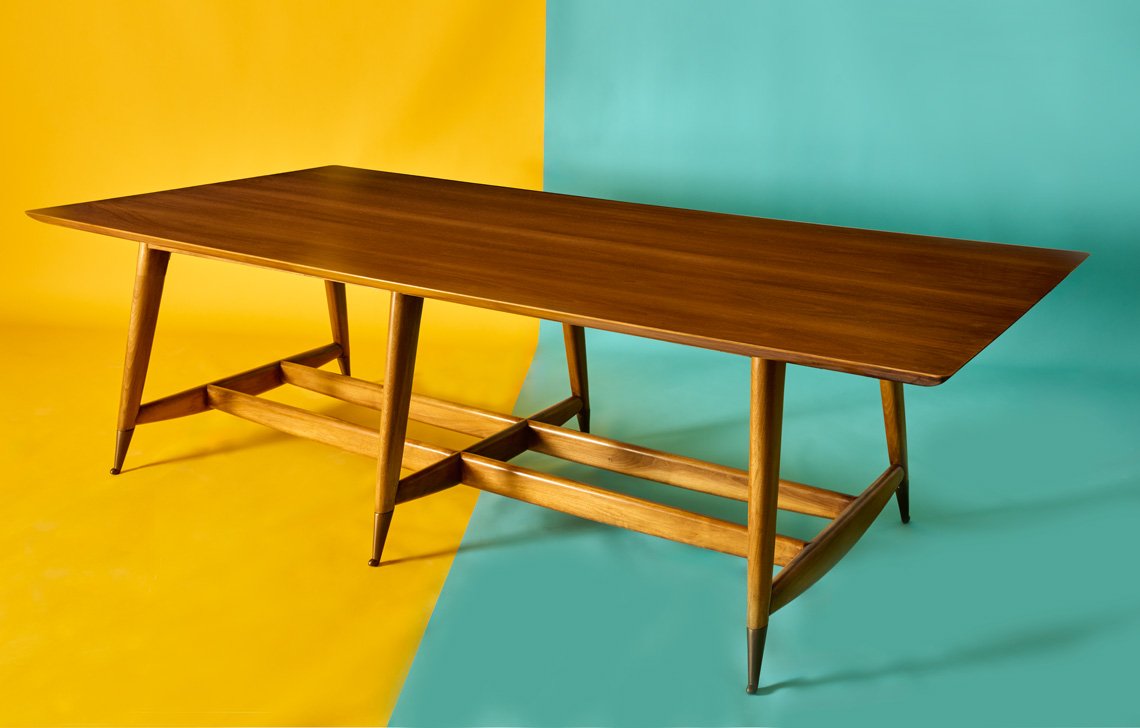 |
Gio Ponti, Rare Dining Table, c. 1952. Mahogany veneer, brass sabots. Photography: Michael Mundy. |
Other collaborations are no less surprising. A rare Venini table lamp from around 1946, with red, pink and white striped glass and an applied ruffled ring, is almost extravagantly decorative. A porcelain lamp made for Richard Ginori around 1927, ornamented with Persian-inspired poppies, belongs to a different aesthetic universe. Both express Ponti's curiosity about materials and surface, even if neither conforms to the conventional image of Italian modernism.
Ponti's early work for Richard-Ginori, where he became artistic director in 1923, hardly looks like the work of a future modernist hero. His ceramics borrowed freely from classical antiquity, architectural fantasy and decorative traditions. Rather than abandoning ornament as his career developed, he learned to manipulate it, sometimes letting decoration dominate an object and at other times making structure itself the decorative element.
The exhibition also offers an unusually intimate glimpse of the designer through a prototype telephone side table from around 1954. Made of ashwood, laminate, brass and rubber, it was produced by RIV in Turin and eventually found its way into Ponti's own home. No other examples are known. With its compact proportions, angled surfaces and practical arrangement, it is a modest object compared with the elaborate commissions elsewhere in the exhibition, but no less inventive.
This range is what makes Ponti so difficult to categorize. His work moves between industrial production and one-off commissions, between ornament and abstraction, and between expensive materials and economical construction for more popular, mass-market designs. There is no straightforward march here toward modernism or minimalism, no single aesthetic destination, just endless, irrepressible invention.
Exhibition Details:
Dates: October 8 – December 22, 2026
Address: Donzella Project Space, 200 Lexington Avenue, Suite 1509, New York, NY 10016
Hours: 9:30 am – 5:30 pm, Monday – Friday
 |
Discover More From Donzella on Incollect
 |