







Precision Made: Eben Blaney Reinvents Tradition with Precision Craftsmanship
 |
The Westport Sidecase of laminated birch with thick white oak veneer and tapering walnut legs. The top and sides have a hand-scraped white pigment applied to fill the grain, which runs in one direction from the side panel, across the top, and down the other side panel. Doors are ash veneered and finished with pigmented varnish that allows the wood’s texture to show through, and even the back is finished, allowing the piece to float in a room. Like all of Eben’s made-to-order pieces, this can be customized in a multitude of ways. |
 |
Eben Blaney Reinvents Tradition with Precision Craftsmanship
by Benjamin Genocchio
Contemporary furniture designer and maker Eben Blaney is the son of a midcoast Maine wooden boat builder. For those unfamiliar with the area, MidCoast Maine is a region along the central Maine coast, renowned for its rocky shoreline, picturesque towns, bays, fishing boats, and sheltered harbors. Blaney was born and grew up here, and today lives and works a few miles from his old family home. His father’s wooden boatbuilding business was next door to the house. Tradition and heritage, it goes without saying, are at the core of his woodworking skills and techniques.
 |
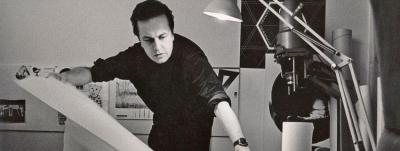
Clockwise from right: 1. Eben Blaney in his Edgecomb, Maine, woodworking studio. 2. The Cirrus Console with a top case in bleached ash and curved, bowed drawer fronts, and a base in white oak with exposed, pegged mortised and tenon joinery. 3. Any wonder why this is named the Crane Console? As sparely elegant as an origami crane, this piece has mortise and tenon joinery and is sculpted by hand to its exquisite finished form. |
Blaney was not always destined to be a furniture maker. He initially rebelled against a career in woodworking, moved to Seattle, and spent the majority of his 20s there. “I wanted to be a rock star,” he says, then laughs. In Seattle, he found out that he loved music, but “wasn’t a performer”, so to make money, he dipped back into working for local builders, doing custom cabinetry for homes. He returned to Maine, finished an English Literature degree, but once again found himself working in woodshops to make ends meet.
“I think it was about 1997 or 1998 when I made my first piece of furniture professionally,” he recalls. “I was 30 years old and had done plenty of carpentry and custom cabinetry by then, all as an employee. But I landed a job working for a custom furniture maker. I quickly appreciated the creative potential of furniture design and began envisioning my own pieces. It was the combination of both the building and the designing that I found not only extremely satisfying, but was something I was cut out to do.”
 | .jpg) | |
Left: The Cormorant Console has an ebonized, elliptical tiger maple top on a split-sided, hand-sculpted black walnut base with blackwood pegs at points of exposed joinery. Right: The Fancy Breakfast Table, with special details that make it fancy, indeed. This distinctive, sculptural table has a black lacquered maple top with walnut supports and a pedestal base of curved, black lacquered maple joined to walnut feet with a walnut support disk. | ||
.jpg) |
Both subtle and distinctive in overall form and details, the Farmhouse Modern dining table is constructed of all solid walnut. Arched leg panels pierced by a trapezoidal stretcher and beveled tabletop edges give the table a light, refined appearance. |
Today, he operates a design and woodworking studio in a two-story building in Edgecomb, Maine, with the studio on the ground floor and a gallery upstairs. He designed and built the building himself in 2003. He makes and sells 20-30 pieces of furniture a year, usually to collectors in Maine, Boston, New York, Philadelphia, and Washington, D.C. Some are ready-made pieces from his showroom, others are custom commissions.
“I’ve had a surprising amount of pieces commissioned by architects for their private homes,” he says. More and more, his work is being purchased by designers, and he has sold pieces to prominent NYC interior designers Victoria Hagan Interiors, Shawn Henderson, Jarvis Studio, and others.
The studio portion of the building is filled with machinery — a mixture of vintage tools and modern power tools. There is a large space for a couple of workbenches, a smaller solid woodworking bench with vises, and a larger one that rolls away to create open floor space when needed. “It’s a really good place not only to work, but to meet with clients to discuss projects because they can see so much,” Blaney says, “from the variety of raw materials to the models, from the in-process work to the finished pieces up in the showroom.”
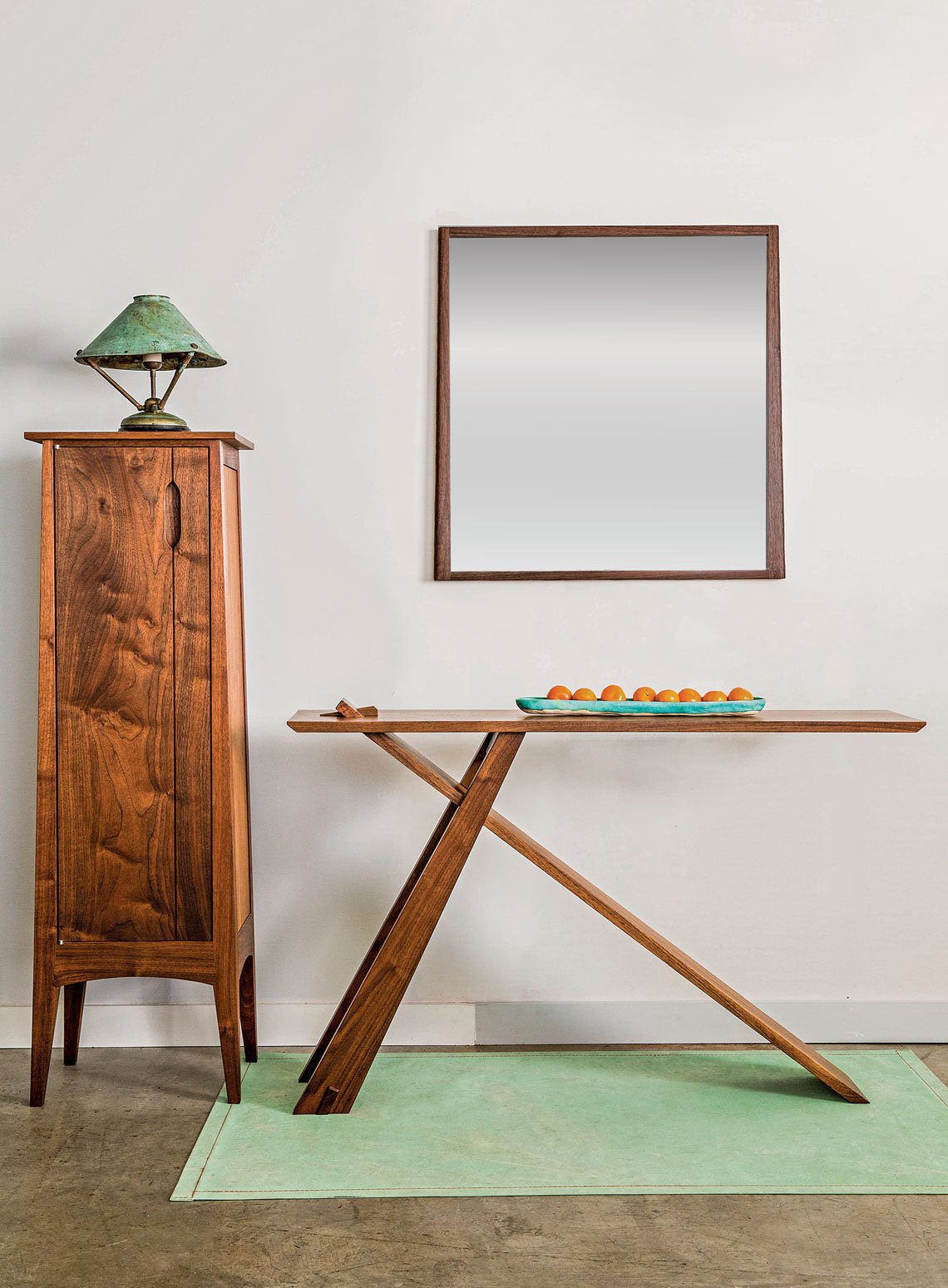 | 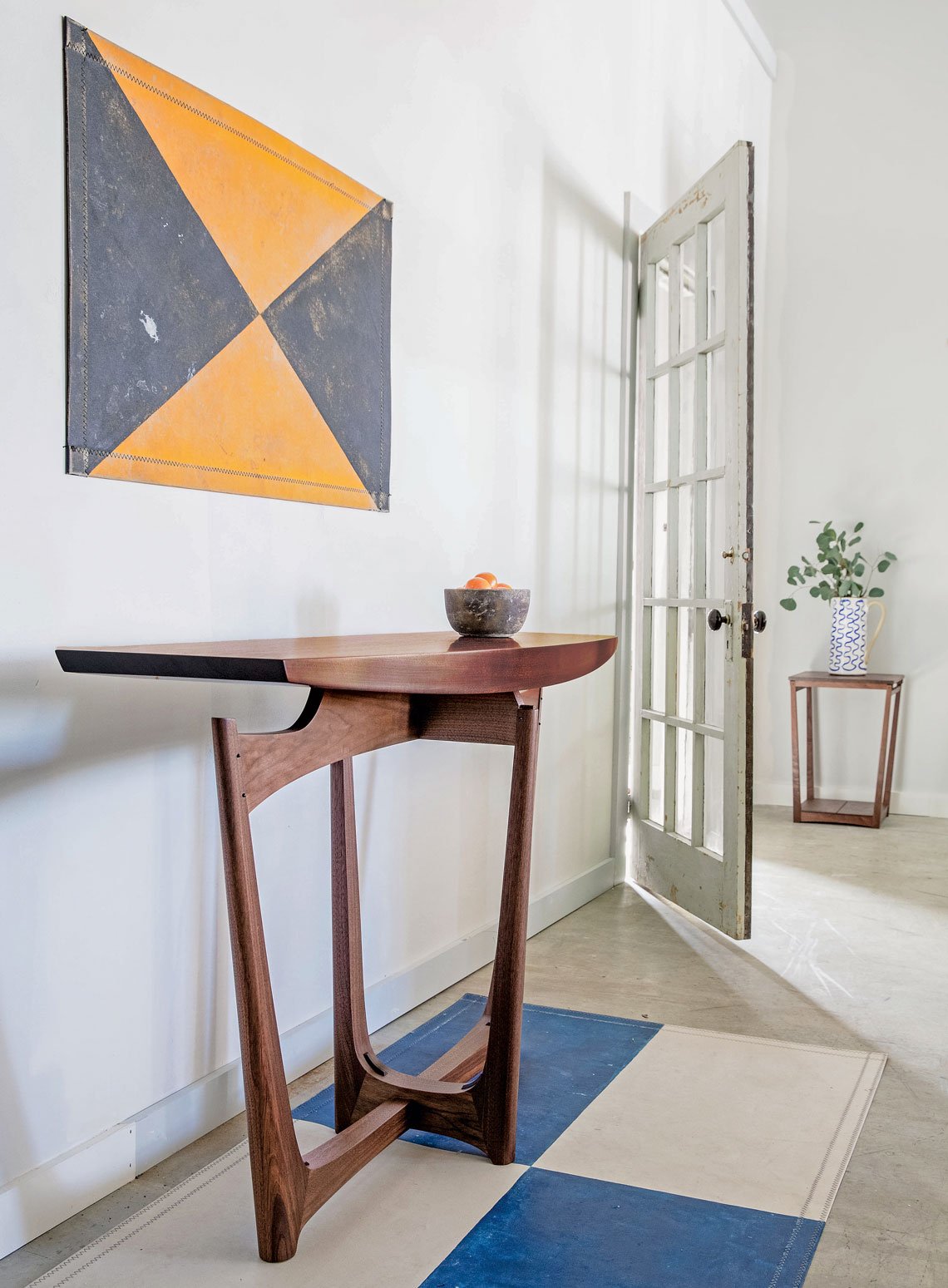 | |
Left: The Tapered Cattail Cabinet in black walnut, the Tapered Frame Mirror in black walnut, and the ingeniously designed Wedge Console Table. A knock-down piece with three components plus a wedge which, when inserted, locks the whole structure in place. The hand-cut precision joinery is all visible, and it ships flat. In walnut with a hand-rubbed oil finish. Right: Cirrus 3 Console in walnut with a hand-rubbed oil finish. At the end of the hall is a Tapered Frame Side Table, which is also available in a round top version. | ||
Blaney’s body of original furniture can best be described as eclectic and evolving. “I don’t want to limit myself,” he says, “and so I keep on exploring and experimenting with new forms.” He also has a growing portfolio of varied custom projects. “Things are always a little different when you are working with parameters imposed on you, as with a custom commissioned piece for a particular use and a particular space, but I like the challenge of coming up with creative solutions for clients. It can be a lot of fun.”
Laura Knoll is one of his many admiring and dedicated clients, having commissioned a bed and a desk for her new home. “Eben is an amazing craftsperson and artist, but he is also incredibly skilled at translating and guiding a client’s vision for a custom built piece. He is patient and meticulous and displays curiosity and delight in developing a new design. His many sketches allowed me to figure out what I was really looking for, and Eben was always eager to spend time explaining materials and construction.”
Blaney’s influences are varied, he says, from Japanese design, Shaker, and mid-century furniture to African sculpture. But his designs are usually so “highly distilled” by the time they’re realized in a finished piece that it is difficult to pinpoint an original inspiration. “That said,” he adds, “I’m pretty sure that the fair curves of Maine boat hulls and the structural elements of boatbuilding found their way into several of my designs, noticeably my Cirrus Console Table designs.”
 |
Solid walnut Tapered Sideboard with a hand-rubbed oil finish, hand-carved pulls and hand-cut dovetails on drawers. The top drawer can be replaced with an open compartment for display. Customizable dimensions, woods, and finishes available. |
Growing up in Maine with a tradition of wood craftsmanship informs his use of certain joinery elements as visual details. “Being self-trained as an artist and woodworker, my education in furniture design came on the job,” he says. “I first gravitated to the Arts & Crafts and Craftsmen movements with the exposed joinery and celebration of the craftsmanship. As my awareness grew, the artist in me quickly moved to more spare, sculptural work. But I still like using joinery and the elements of structure as visual elements within otherwise spare or minimal contemporary forms.”
He works 7 days a week in the studio, beginning his day quite early, around 6:30, “to start orienting myself for the day ahead.” He removes clamps from the previous day’s glue-ups, cleans up, and then does some sketching and tends to emails. “I return to work in the studio around 8 am for the day, until around 6 pm. I’m working on ongoing projects; I always have two or three underway and I like to bounce between them. Some days I spend more time at my drafting table, if I’m getting underway with something new or on a deadline.”
The idea for a design frequently starts from an aspect or detail of a piece that he is presently building. “Often one feature can suggest or unlock the idea for a whole new structure by simply following its own internal logic,“ he says. Other times, ideas come from sketches in his notebook. “I do a lot of free sketching,” he explains, “playing with ideas of structures. I think about gestures, stances, and balance, and my sketching explores these. When I go back through the pages of drawings, I gravitate to ones that seem especially fresh and different.”
 |
The Davis Credenza is a low, sleek, multi-functional storage piece originally created for a Manhattan client. The central, mobile, bow-front cabinet has two curved doors and open shelving for stereo components. This central unit is on wheels and docks between the two flanking cabinets, which have drawers with integral recessed finger pulls. Shown here in white oak, it is fully customizable in dimensions, features, woods and finishes. |
He works mostly in walnut, he says, “for its natural beauty.” But he also likes and works with ash and oak for their grain textures and tones, as well as maple for its smooth, tight grain. “Mostly I am working with the available domestic hardwoods, though I have used other, exotic woods in several pieces. For example, I’ve used a lot of genuine mahogany that I consider very beautiful and enjoyable to work with, to shape and carve,” he says. “I especially like to ebonize it with a dye or various other solutions. The grain of the mahogany stays visible, has movement, and provides a useful, beautiful pairing with the rich, varied tones of the walnut.”
His most successful designs are his console tables, of which there are many. The Crane Console table is especially popular and can be produced in many materials and finishes. Its aerodynamic shape is immediately striking, but up close, you can see that the component pieces are finely joined with handcrafted mortise and tenon joinery. It’s then hand-sculpted to a final, elegant form and finished in a manner that highlights natural wood grains.
The Wedge console table is another popular design. It is a relatively simple and very clever design composed of three components that are assembled to create a cantilevered tabletop. “The diagonal member passes through channels in the leg assembly, and the top portion passes through a steeply hand-cut mortise in the single board top, where a small walnut wedge is inserted to lock the structure in place,” Blaney explains. “The precision joinery involved in this piece is all cut by hand and on display. It has a hand-rubbed oil finish and ships flat, making it easy and inexpensive to ship.”
Designers and clients are also enamoured of his benches and case pieces. The popular Westport Sideboard is created in a laminated birch substrate with thick white oak veneer. “Joined with reinforced mitered corners with continuous grain orientation across the top and down sides, the case is hand-scraped with a white pigment to fill the grain,” Blaney explains. “The inset back is similarly finished, allowing the piece to be placed away from a wall. Doors are ash veneered and finished with durable pigmented conversion varnish to color, but not to hide the wood’s prominent texture and beauty.” There are subtle recesses on the top edge of the doors for opening.
.jpg) |
The Townsend 2 Coffee Table in white oak. Hand-sculpted base with traditional mortise and tenon joinery. Oval top with a steeply beveled underside gives it a light, refined appearance. |
Blaney firmly believes that “form follows function” in furniture, and for that reason, there is little decoration on his furniture. But, his pieces are also frequently playful, with expressive elements woven into the minimal forms. The dynamic angles and overall design stances of his Biped tables, his Steppin’ Out table, or Heron table are good examples, along with the vibrant colors he sometimes uses on them. He also likes to highlight different wooden elements by painting or staining them. “They play off each other,” he says, “I think the contrasts enhance the overall beauty of a piece.”
Dimensions, woods, and finishes are all customizable with the case pieces, Blaney says, and he encourages clients to contact him to discuss pieces. There are also a variety of internal configurations possible, not just for the case pieces but also for his bookshelves and desks. “Most of my pieces can be customized, and nearly every design of mine that I reproduce is altered in some way from the original version, either its dimensions, woods, or finish, based on clients’ requests,” he says. “A recent project involved scaling down the dimensions of my Organic Round pedestal table for a San Francisco-based designer, at the request of their client.”
He does most of the work on the pieces himself, he says, except for the upholstery, which he contracts out. “When my work and delivery schedule require, I have a handful of pretty skilled craftspeople in the area I rely on for help in the studio, and I have had some short-term help, but by and large, all the work from design, modeling, building, and finishing is done by me. I pride myself on being a good designer, but equally as a precision craftsman, so it only follows that everything that goes out of the studio is something that I have worked on.”