




Arild baron de Rosenkrantz
Danish, 1870 - 1964
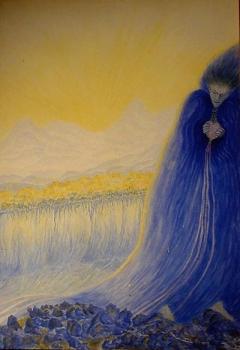
Arild Rosenkrantz was throughout his life a `spiritual seeker'. He reached the peak of his spirituality in 1912 when he met Rudolf Steiner, the creator of `Anthroposophy', the connection of human understanding with the spiritual world.
Born in Frederiksborg Castle, Denmark, son of the Danish minister to Italy, Rosenkranz trained at the Academie Julian in Paris and in 1888 he was introduced by his mother to the French writer, art critic and mystic, Joséphin Péladan. In the years 1892-1895 he exhibited at Perladan's Symbolist Salon de la Rose + Croix in Paris. Joséphin Péladan had set about bringing together all the young Symbolistes painters in Europe and his speech at the launch of the Salon in 1892, declared: Artists who believe in Leonardo and The Victory of Samothrace, you will be the Rose + Croix. Our aim is to tear love out of the western soul and replace it with the love of Beauty, the love of the Idea, the love of Mystery. We will combine in harmonious ecstasy the emotions of literature, the Louvre and Bayreuth.
After a year in the United States in 1896, where Rosenkrantz had worked on the Gallatin window at The Decorative Stained Glass Company in New York and designed a window for Tiffany on the subject of King Alfred the Great, he moved to London and there established himself as a spiritual artist. In London his work came strongly under the influence of Burne-Jones, and he showed work in the final exhibitions of the New Gallery which had been the favored gallery of Burne-Jones and his followers in the 1890's and which closed in 1909. He had many commissions including twelve large panels for the ceiling in the dining room at Claridges Hotel, London, and made stained glass windows and bronze sculptures for a number of English churches and castles. He also illustrated the Danish edition of Edgar Allen Poe's “Tales of Mystery Adventure” and many other
Literary works.
In 1914 Rosenkrantz joined the artists working with Rudolf Steiner to create the first Goetheanum in Dornach, Switzerland. Here he worked with other artists on the decoration of the small cupola, and through Steiner's influence his style of painting completely changed. In 1922-23 Rosencrantz produced large pastel drawing's of The Seven Seals which were an interpretation of the Seals as explained by Rudolf Steiner in “Occult Seals and Columns” (1907). These drawings were executed under the guidance of Rudolf Steiner for a portfolio edition, published in England
With black and white illustrations (1924).
His most important works included The Omnipresent, a sculptured war memorial at St George's Church, Camberwell, 1918, and stained glass at Taplow, Berkeley Castle, St Paul''s church, Onslow Gardens. Subsequently he exhibited work at the Abbey Gallery, the Beaux Arts Gallery, the Baillie Gallery and above all Cooling and Sons' Gallery where he had annual exhibitions in the 1930's. His last recorded exhibition was at Cooling's in 1939. He also had works accepted at exhibitions at the Royal Academy of Art in Copenhagen and the Guildhall in London.
Celebrating his seventieth birthday in Denmark in 1940. Rosenkrantz was forced to stay because of the unexpected German occupation. He was invited to stay at the family castle Rosenholm, in Jutland, where he continued to work spending his last years painting, lecturing and writing in his native country. He left a collection of his paintings to be exhibited at Rosenholm Castle, which can still be viewed to this day.
Born in Frederiksborg Castle, Denmark, son of the Danish minister to Italy, Rosenkranz trained at the Academie Julian in Paris and in 1888 he was introduced by his mother to the French writer, art critic and mystic, Joséphin Péladan. In the years 1892-1895 he exhibited at Perladan's Symbolist Salon de la Rose + Croix in Paris. Joséphin Péladan had set about bringing together all the young Symbolistes painters in Europe and his speech at the launch of the Salon in 1892, declared: Artists who believe in Leonardo and The Victory of Samothrace, you will be the Rose + Croix. Our aim is to tear love out of the western soul and replace it with the love of Beauty, the love of the Idea, the love of Mystery. We will combine in harmonious ecstasy the emotions of literature, the Louvre and Bayreuth.
After a year in the United States in 1896, where Rosenkrantz had worked on the Gallatin window at The Decorative Stained Glass Company in New York and designed a window for Tiffany on the subject of King Alfred the Great, he moved to London and there established himself as a spiritual artist. In London his work came strongly under the influence of Burne-Jones, and he showed work in the final exhibitions of the New Gallery which had been the favored gallery of Burne-Jones and his followers in the 1890's and which closed in 1909. He had many commissions including twelve large panels for the ceiling in the dining room at Claridges Hotel, London, and made stained glass windows and bronze sculptures for a number of English churches and castles. He also illustrated the Danish edition of Edgar Allen Poe's “Tales of Mystery Adventure” and many other
Literary works.
In 1914 Rosenkrantz joined the artists working with Rudolf Steiner to create the first Goetheanum in Dornach, Switzerland. Here he worked with other artists on the decoration of the small cupola, and through Steiner's influence his style of painting completely changed. In 1922-23 Rosencrantz produced large pastel drawing's of The Seven Seals which were an interpretation of the Seals as explained by Rudolf Steiner in “Occult Seals and Columns” (1907). These drawings were executed under the guidance of Rudolf Steiner for a portfolio edition, published in England
With black and white illustrations (1924).
His most important works included The Omnipresent, a sculptured war memorial at St George's Church, Camberwell, 1918, and stained glass at Taplow, Berkeley Castle, St Paul''s church, Onslow Gardens. Subsequently he exhibited work at the Abbey Gallery, the Beaux Arts Gallery, the Baillie Gallery and above all Cooling and Sons' Gallery where he had annual exhibitions in the 1930's. His last recorded exhibition was at Cooling's in 1939. He also had works accepted at exhibitions at the Royal Academy of Art in Copenhagen and the Guildhall in London.
Celebrating his seventieth birthday in Denmark in 1940. Rosenkrantz was forced to stay because of the unexpected German occupation. He was invited to stay at the family castle Rosenholm, in Jutland, where he continued to work spending his last years painting, lecturing and writing in his native country. He left a collection of his paintings to be exhibited at Rosenholm Castle, which can still be viewed to this day.

