














Frank Stella
American, 1936

Frank Stella (born May 12, 1936) is an American painter and printmaker who is known for his contributions to the development of minimalism, post-painterly abstraction, and geometric abstraction. Stella was born in Malden, Massachusetts, and studied art at Phillips Academy in Andover and later at Princeton University.
Stella gained fame in the late 1950s and early 1960s with his "Black Paintings," which were large canvases with simple geometric shapes painted in black enamel. These works were praised for their stark simplicity and their rejection of traditional ideas about painting and art.
Throughout his career, Stella has continued to experiment with different techniques, materials, and forms. He has created sculptures, installations, and murals in addition to his paintings, and he has worked with a wide variety of media, including metal, paper, and fiberglass.
In the 1980s, Stella began creating large-scale metal sculptures that combined abstract forms with references to historical and cultural motifs. These sculptures were often brightly colored and featured complex, layered shapes that were meant to be experienced from multiple angles.
Stella has been the recipient of numerous awards and honors throughout his career, including the National Medal of Arts in 2009. His works can be found in the collections of many major museums around the world, including the Museum of Modern Art in New York, the Art Institute of Chicago, and the Tate Modern in London.
Stella gained fame in the late 1950s and early 1960s with his "Black Paintings," which were large canvases with simple geometric shapes painted in black enamel. These works were praised for their stark simplicity and their rejection of traditional ideas about painting and art.
Throughout his career, Stella has continued to experiment with different techniques, materials, and forms. He has created sculptures, installations, and murals in addition to his paintings, and he has worked with a wide variety of media, including metal, paper, and fiberglass.
In the 1980s, Stella began creating large-scale metal sculptures that combined abstract forms with references to historical and cultural motifs. These sculptures were often brightly colored and featured complex, layered shapes that were meant to be experienced from multiple angles.
Stella has been the recipient of numerous awards and honors throughout his career, including the National Medal of Arts in 2009. His works can be found in the collections of many major museums around the world, including the Museum of Modern Art in New York, the Art Institute of Chicago, and the Tate Modern in London.


Sale



Sold
Frank Stella
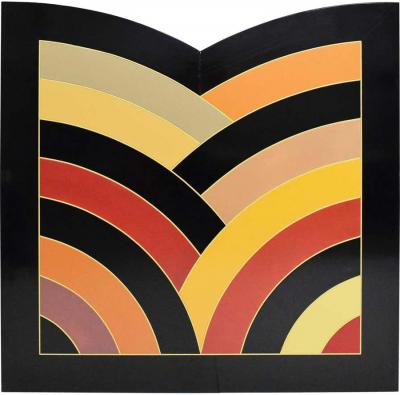
Frank Stella "Swan Engraving III" Etching 1982 (Signed and Dated)
H 70 in W 55 in D 1 in

 Loading...
