








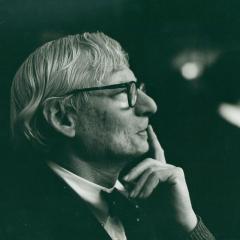
Louis Kahn
American, 1901 - 1974
Related Article: Top 7 Designs by Modernist Architect Louis Kahn
Louis Kahn, one of the most highly acclaimed architects to come out of the United States in the 20th century, was known for creating monumental architecture that combined Modernism with his unique and poetic philosophy. Louis Kahn believed that architecture should be monumental and spiritually inspiring. His designs remain a testament to this belief. His complex spatial compositions, mastery of light, and the powerful universal symbolism embodied in his designs are what make Louis Kahn’s architecture a keystone of 20th-century modernism.
Born Itze-Leib Schmuilowsky in 1901 in what is now Estonia, Louis Kahn moved with his family as a young child to Philadelphia. His family changed their surname to Kahn in 1915 to assimilate, and Louis became a naturalized citizen. Growing up, his family could not afford pencils, so they made their own charcoal sticks from burnt twigs so that Louis could draw. Having loved drawing and design his whole life, he went on to attend the University of Pennsylvania and completed a degree in Architecture in 1924. Kahn opened his own architectural practice in 1935.
Kahn was always interested in architecture’s role in societal change. He created housing for factory workers during World War II, and later worked on buildings for labor unions. He began his influential teaching career at Yale in 1947, where he would remain for a decade before becoming a professor of architecture at his alma mater, the University of Pennsylvania.
The depth and solidity of his buildings were translated from his passion for the medieval architecture he studied on a tour of Europe through the ancient walled French town of Carcassonne and the castles of Scotland. Louis Kahn designed all over the world – across the United States, and in India and Bangladesh. Kahn infused international style with his highly personal taste. Though he only arrived at his distinct architectural style in his early 50s, over the span of those two decades before his death at the age of 73, Louis Kahn became one of the most highly influential Modernist architects of the century, along with contemporaries Le Corbusier and Mies van der Rohe. Kahn inspired many high-tech architects of the late 20th century, such as Renzo Piano, who once worked in Kahn’s office, Richard Rogers, and Norman Foster.
Some of his most famous projects include the Yale University Art Gallery in New Haven, Connecticut, the Kimbell Art Museum in Fort Worth, Texas, the Salk Institute in San Diego, California, Jatiyo Sangshad Bhaban (National Assembly Building) in Dhaka, Bangladesh, the Phillips Exeter Academy Library in Exeter, New Hampshire, First Unitarian Church in Rochester, New York, and the Margaret Esherick House, in the Chestnut Hill area of Philadelphia, Pennsylvania.
Kahn was often described as a guru or a mystic because of his deeply insightful understanding of architecture. Even his death has become a well-known bit of architectural lore. In 1974, after just returning home from a trip to India, he died of a heart attack at Penn Station. His family was not notified until two days afterwards because of miscommunication between the New York and Philadelphia police departments. However, the briefcase he was carrying at the time of his death contained designs for a Franklin D. Roosevelt memorial on New York’s Roosevelt Island. Those designs eventually were faithfully carried out decades later and his last built work, Four Freedoms Park, was completed posthumously in 2012.

