









Offered by:
Jeff R. Bridgman Antiques, Inc.
Historic York County
York, PA , United States
Call Seller
717.502.1281
Showrooms
Rare Suffrageette Pennant With Iconic Bugler Girl
-
Description
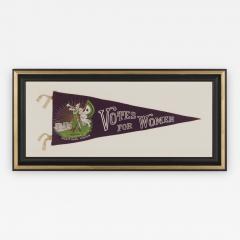
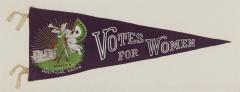
RARE SUFFRAGETTE PENNANT WITH ICONIC BUGLER GIRL OR "CLARION" IMAGE, MADE FOR HARRIOT STANTON EATON BLANCH'S WOMENS POLITICAL UNION IN NYC, 1910-1915 :
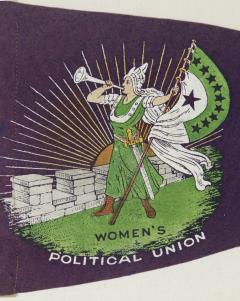
Triangular, felt, suffragette pennant with a violet ground, printed with white, green, and gold, featuring an iconic Suffrage movement image known as the Bugler Girl or Clarion Girl. Incorporated and beneath are the words "Women's Political Union." To the right, fanciful lettering "Votes for Women."
Suffragette banners and pennants are particularly scarce and sought-after. This is a rare and highly desired variety and arguably the best style of pennant that exists in terms of both color and imagery. Two basic versions of it are known. The other has the same image, but the text instead reads "Vote for Woman Suffrage," and the stylized lettering is different.
The Bugler Girl has its roots in the English Suffrage movement. It was designed by a British artist and suffragette named Caroline Watts (1868-1919), for a poster advertising a suffrage March in 1908. Watts was an illustrator who worked in the art nouveau style and was commissioned by book publishers David and Marie Nutt. Following David's death, Marie took part in the famous 1907 "Mud March" and afterwards published several books on the suffragette movement, which is perhaps how Watts became involved.
The Women's Political Union was the brainchild of American suffragette leader Harriot Eaton Stanton Blatch (1856-1940). Blatch was the daughter abolitionist Henry B. Stanton and suffrage pioneer Elizabeth Cady Stanton, who served as the first president of the National American Woman Suffrage Association (NAWS) and co-authored the landmark, four-volume, "History of Woman Suffrage" with Susan B. Anthony, Matilda Joslyn Gage, and Ida Husted Harper. Following graduation from Vassar College, Harriot assisted these women by compiling research for the book. She then moved to England for 20 years, marrying a British businessman. In 1902 she returned to the States and became involved with two significant suffrage groups, the Women’s Trade Union League and the National American Woman Suffrage Association. In 1907, disgruntled with their ineffectiveness and stagnation, she founded the Equality League of Self-Supporting Women, which appealed to the working class. Before this time the suffrage organizations in America were largely represented by socialites, whose numbers could not effectively influence the vote. In 1910 the Equality League changed its name to the Women's Political Union (WPU) and organized America's first large-scale suffrage parade, which took place on Fifth Avenue in New York.
To advertise the activities of the WPU, Harriot pirated the Bugler Girl, adapting it for the American audience and adding stars to the flag held by the Clarion figure to represent states that passed suffrage legislation. She also adopted the violet, white and green colors of her British suffragette peers. Colors in America were generally yellow and white, but Blatch wanted to distinguish the organization.
In 1915 the WPU merged with suffragette leader Alice Paul's Congressional Union, which later morphed into the National Woman’s Party. This pennant therefore represents Blatch's use of the traditional British Colors and Bugler Girl for promotion of the WPU between 1910 and 1915.
The count of stars on the various suffrage items that have them often represent states that had already adopted their own suffrage measures. A notable piece of suffrage ephemera shows the image of an American national flag with 4 stars for the 4 states that had adopted full suffrage, under which a slogan appears that reads: "The Union of States as They Ought to Be." The star count can therefore provide a clue to the specific year of use. Note that there are 10 violet stars on the flag held by the Clarion figure, 9 of which are together in a crescent formation (due to the profile of the flag) on a green field, and the other of which is larger, on a white field, with the others partially encircling it.
One problem with using the number of stars to date a suffrage object is that their count was possibly arguable between the various suffrage organizations at different points in history. This is because some states adopted full suffrage, some adopted partial measures, and some wavered back-and-forth. Wyoming was the first to offer full suffrage to women voters. It did so while still a territory and never altered its position. Washington Territory adopted it in 1883, but the measure was reversed by the Supreme Court in 1887 and then re-adopted after statehood in 1910. Illinois adopted suffrage legislation in 1913, but it only applied to presidential and municipal elections and not state elections. Kansas allowed women to vote in municipal elections from 1887 onward, but didn't provide full suffrage until 1912.
To make matters even more confusing, I have found that various reference sources list slightly different dates for various states. But these seem to be the first 10:
1. 1869 Wyoming (while still a territory, kept through statehood in 1890)
2. 1893 Colorado
3. 1895 Utah (while still a territory, kept through statehood in 1896)
4. 1896 Idaho
5. 1910 Washington State (re-granted, having been active while a territory, 1883-87)
6. 1911 California
7. 1912 Oregon
8. 1912 Arizona
9. 1912 Kansas
10. 1913 Illinois (excludes state elections)
Presuming that women's ability to participate in presidential elections was the qualification for a star on the proverbial "suffragette flag," and that the big star either represents the newest state to adopt, or the next state that suffragettes waving the banner hoped would adopt, then this Bugler Girl design was produced between 1912 and 1913.
On November 2nd of 1915 in New York State, male voters defeated a referendum that would have amended the U.S. Constitution to give all women of the state the right to vote. New York was among four eastern states where the issue came to a vote, including New Jersey, Pennsylvania and Massachusetts, all of which were unsuccessful. Public support had been favorable in New York specifically, where the Suffrage movement was 100,000 members strong. Polls had predicted the likeliness of a win, and while it did not occur that year, a successful follow-up campaign in 1917 made New York the first eastern state to adopt suffrage.
Mounting: The textile was mounted and framed within our own conservation department, which is led by expert staff. We take great care in the mounting and presentation of flags and have preserved thousands of examples.
The mount was placed in a modern frame with a finish that is very dark brown, nearly black, with red highlights and undertones, to which a black-painted and gilded Italian molding was added as a cap. The background is ivory colored hemp fabric. The glazing is U.V. protective plexiglass.
Condition: Excellent, with only minor foxing and oxidation on the white ties. -
More Information
Origin: United States, New York Period: 1900-1919 Condition: Good. See Item Description Creation Date: 1910-1915 Styles / Movements: Folk Art, Americana Dealer Reference #: ws-080 Incollect Reference #: 244750 -
Dimensions
W. 39.75 in; H. 18.25 in; W. 100.97 cm; H. 46.36 cm;
Sold
