








Offered by:
Kristan Hauge Japanese Art
2-32 Saishoji-cho, Okazaki, Sakyo-ku,
Kyoto 606-8342 , Japan
Call Seller
81757515070
Showrooms
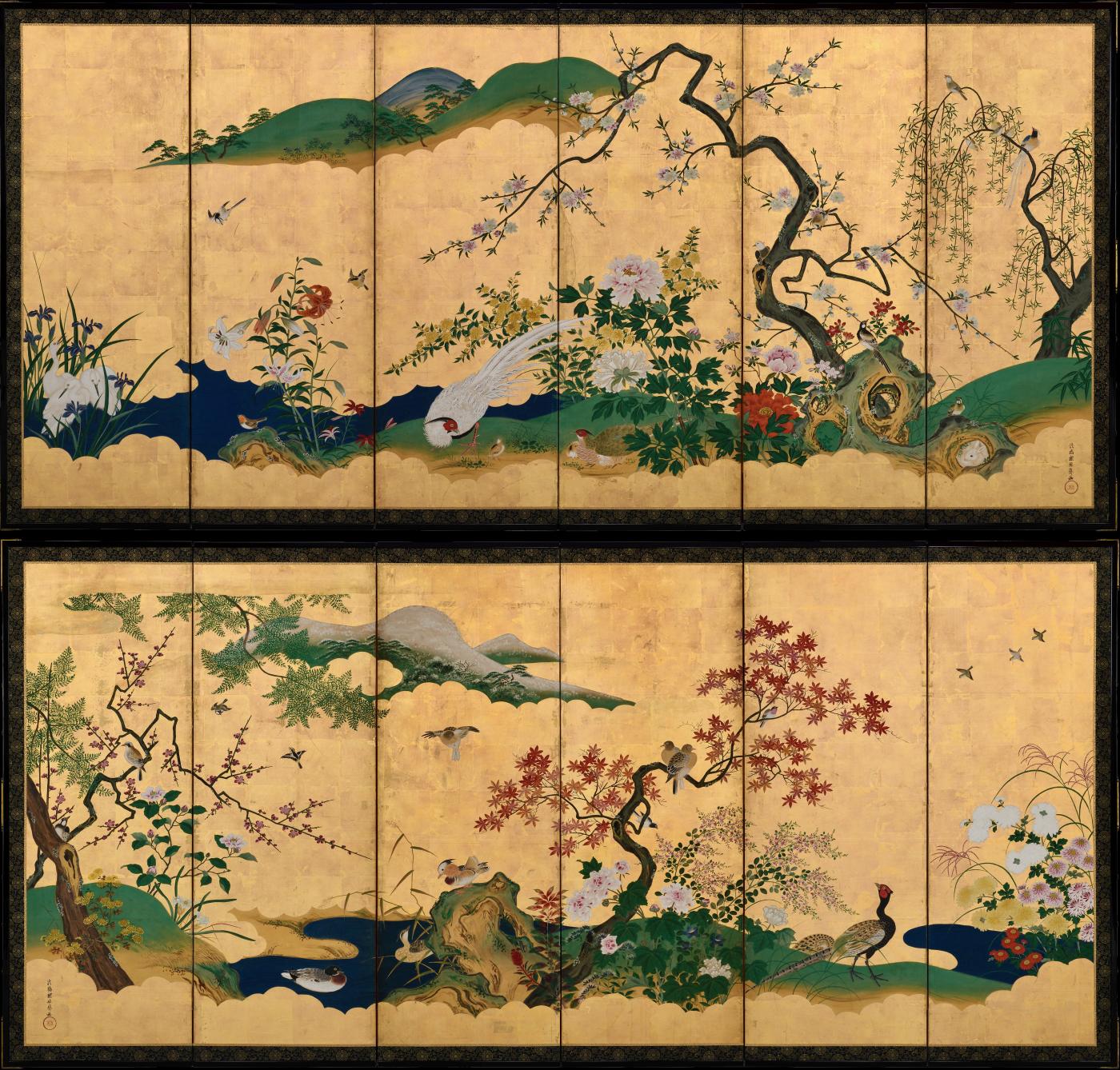
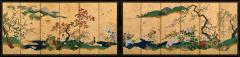
Japanese Screen Pair. 18th Century. Flowers & Birds of the Four Seasons
-
Description
Tsurusawa Tangei (1687–1769)
Flowers and Birds of the Four Seasons
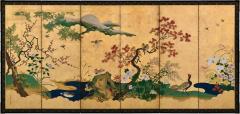
Pair of six-panel Japanese screens. Ink, colour and gold leaf on paper.
Dimensions (each screen): H. 138 cm × W. 295 cm (54.5″ × 116″)
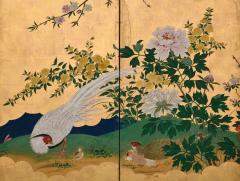
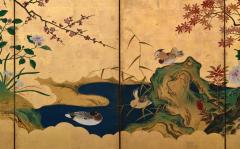
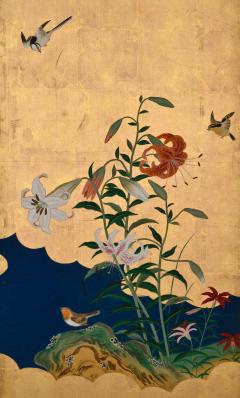
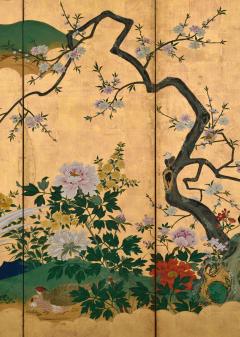
Executed in rich mineral pigments against a luminous gold ground, the pair presents an elegant interpretation of the classical Flowers and Birds of the Four Seasons (kachō shiki-e) theme. Combining the decorative splendor associated with Kyoto painting with the disciplined compositional structure inherited from the Kano tradition, the composition unfolds from right to left in accordance with traditional Japanese pictorial convention. The artist guides the viewer through a continuous seasonal cycle, linking the changing flora and fauna of the Japanese landscape within a richly decorative setting.
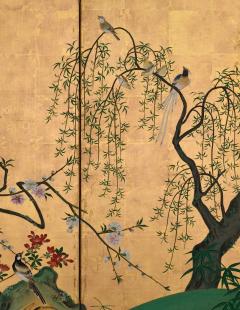
The right-hand screen begins in early spring with the fresh green foliage of a willow tree and blossoming cherry, among which Japanese white-eyes and a long-tailed bird animate the scene. The season advances into late spring with luxuriant peonies and flowering kerria, which provide a sumptuous setting for a family of silver pheasants. Summer is announced by flowering irises emerging from shallow water, where elegant white egrets shelter among the blooms.
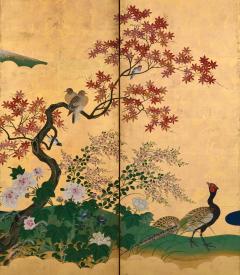
The left-hand screen is dominated by the imagery of autumn. Masses of chrysanthemums, bush clover, bellflowers, amaranth, hibiscus, and the brilliant scarlet leaves of Japanese maple create a rich tapestry of seasonal colour. Among the flowering plants appear Japanese green pheasants, pigeons, and mandarin ducks, reinforcing the harmonious interplay between bird and flower that lies at the heart of the kachō-e tradition.
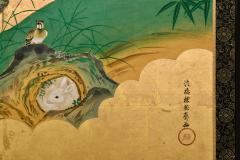
The composition then gradually transitions into winter. Snow-dusted hills emerge through banks of gold cloud, while flowering camellias provide color amidst the colder landscape. The cycle concludes with the earliest plum blossoms and fresh shoots of hinoki cypress, accompanied by a solitary woodpecker, motifs that herald the return of spring. Through this carefully orchestrated progression, the pair embodies the cyclical rhythm of nature, a theme deeply embedded within Japanese aesthetic and poetic traditions.
Tsurusawa Tangei (1687-1769) was the second-generation head of the Tsurusawa school, a prominent lineage of court painters active in Kyoto during the Edo period. Born in Edo as the son of Tsurusawa Tanzan, a pupil of Kanō Tan’yū, he moved to Kyoto at a young age and inherited the artistic traditions of the Edo Kano school. Serving as an official painter to the Imperial Court, he participated in numerous palace commissions and was awarded the honorary titles of Hōkyō in 1728 and Hōgen in 1747. While grounded in Kano painting traditions, Tangei developed a more varied and decorative style that incorporated influences from Kyoto painting, Yamato-e, and Rinpa aesthetics. His richly coloured works on gold ground exemplify the refined taste of eighteenth-century Kyoto and established the artistic direction followed by later generations of the Tsurusawa school.
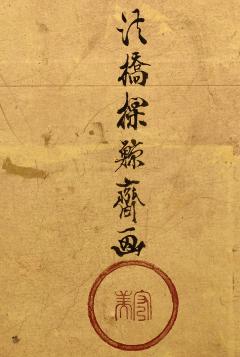
Awarded the title of Hōkyō in 1728 and promoted to Hōgen in 1747, Tangei employed these distinctions in his signatures. The present pair bears the inscription “Hōkyō Tangei sai ga” and may therefore be dated to the intervening period, between 1728 and 1747.
The Tsurusawa school enjoyed considerable prestige in Kyoto during the Edo period, serving the Imperial Court for seven generations alongside the Tosa school. Much of its reputation was built upon large-scale decorative commissions for the Imperial Palace, court nobles, and major temples. However, repeated fires that destroyed many of these buildings also resulted in the loss of a significant portion of the school’s finest work. Consequently, surviving screen paintings by leading masters such as Tsurusawa Tangei are comparatively rare and provide valuable insight into a tradition that played an important role in the artistic life of Kyoto for nearly two centuries. -
More Information
Documentation: Signed Period: 18th Century Styles / Movements: Asian Art Incollect Reference #: 873120 -
Dimensions
W. 116.14 in; H. 54.33 in; W. 295 cm; H. 138 cm;
Message from Seller:
Kristan Hauge Japanese Art, based in Kyoto's museum district since 1999, specializes in important Japanese screens and paintings for collectors, decorators, and museums worldwide. Contact us at khauge@mx.bw.dream.jp or +81 75-751-5070 for exceptional access to Japanese art and history.
More Listings from Kristan Hauge Japanese Art View all 65 listings
-
17th Century Japanese Screen. Ink Plum Tree & Birds by Kano Naonobu

-
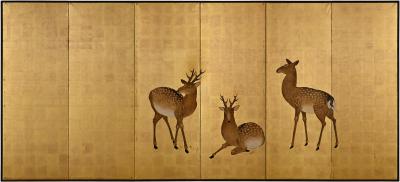
19th Century Japanese Deer Screen by Okamoto Toyohiko. Maruyama Shijo School
-
Early 20th Century Japanese Screen Pair – Ink Pine Trees on Gold

-
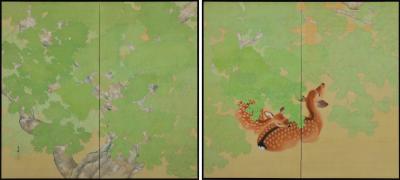
Early 20th Century Pair of Japanese Screens | Deer under Maple Trees
-
Mitani Toshuku Unkoku School, 17th century. Japanese falcon painting.

-
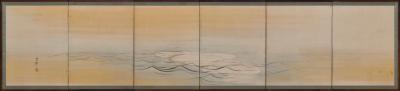
Japanese Screen. 19th Century. Reflections of the Moon
-
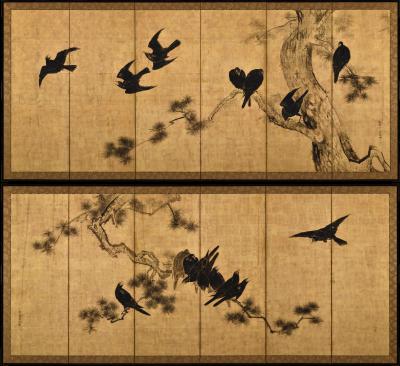
Mid 18th Century Japanese Screen Pair. Crows & Pines by Unkoku Toshuku
-
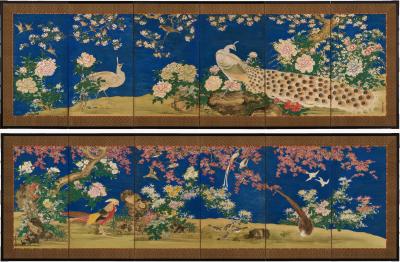
Mid 19th Century Japanese Screen Pair. Flowers & Birds of the Four Seasons
-
Japanese Screen Pair, Tigers by Kishi Renzan, Late Edo Period.

-
Early 20th Century Japanese Screen. Cat & Mouse by Otaki Uzan.

-
Japanese Screen. Early 20th Century. Furosaki Screen. Wagtail & Chrysanthemum

-
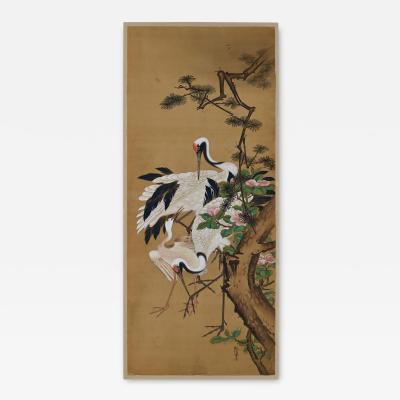
19th Century Japanese Silk Painting by Kano Chikanobu. Cranes, Pine & Camelia.
-
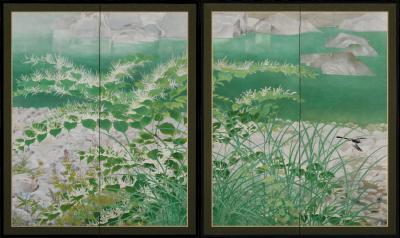
Japanese Screen Pair. Showa era. Nihonga Riverside landscape. Late Summer
-
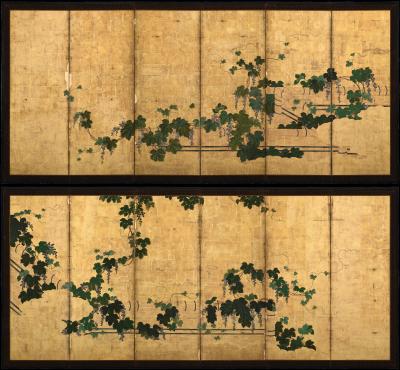
17th Century Japanese Screen Pair. Grapevines. Attributed to Kano Tsunenobu