





Offered by:
Jim's of Lambertville
6 Bridge Street
Lambertville, NJ 08530 , United States
Call Seller
609.397.7700
Showrooms
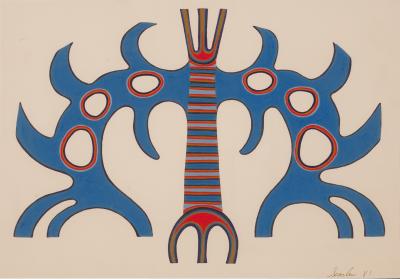
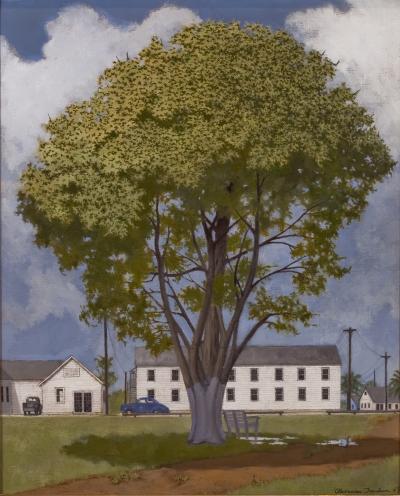
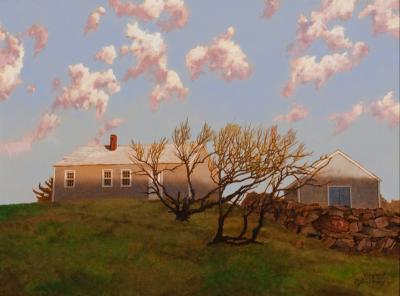
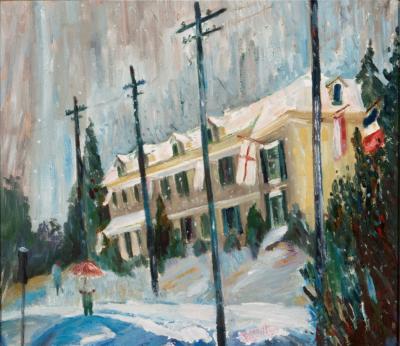
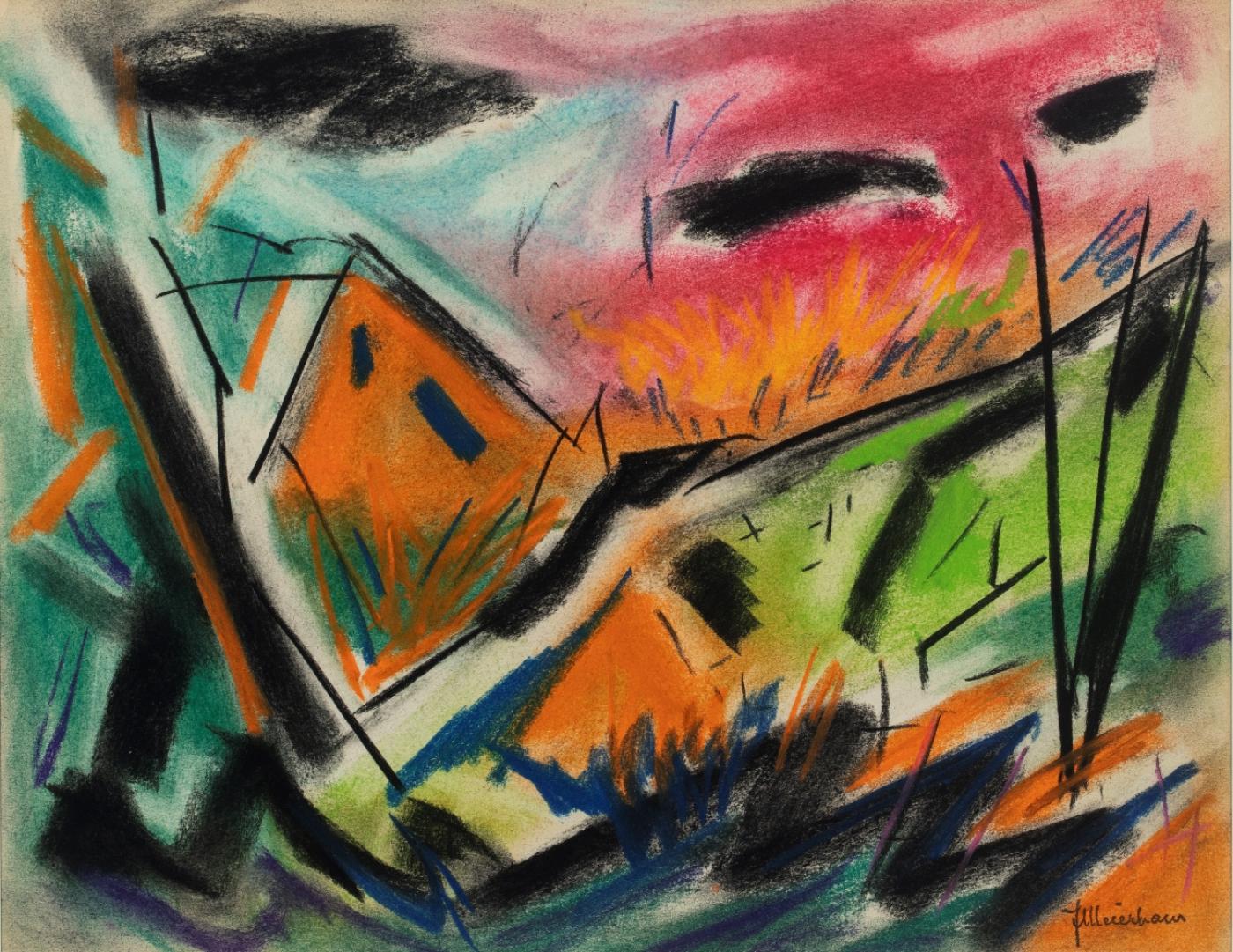
"House on the Hill"
-
Description
Jim’s of Lambertville is proud to offer this artwork by:
Joseph Meierhans (1890 - 1980)
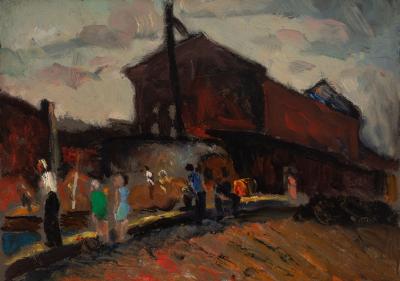
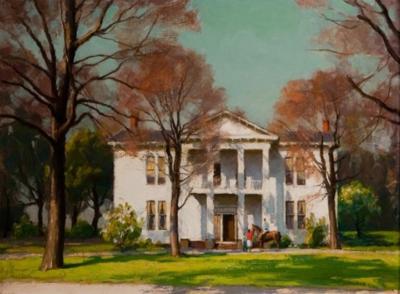
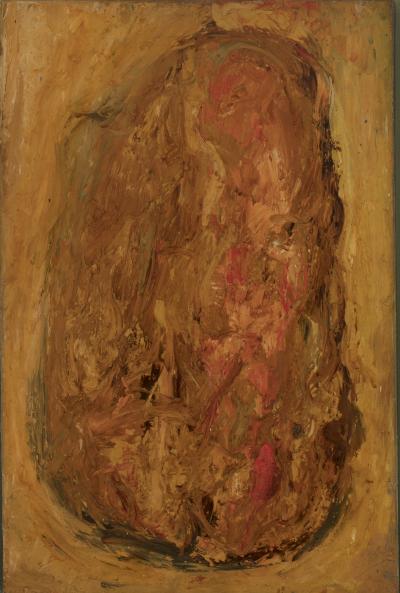
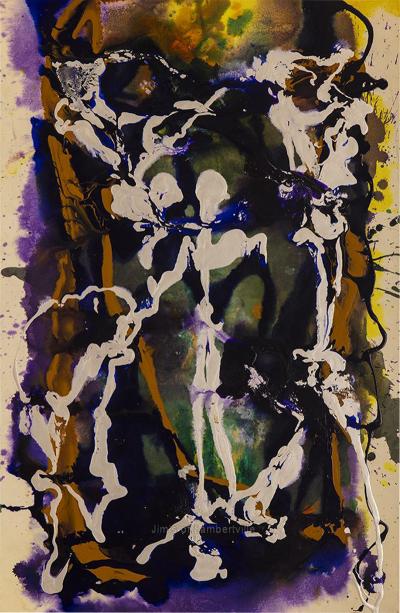
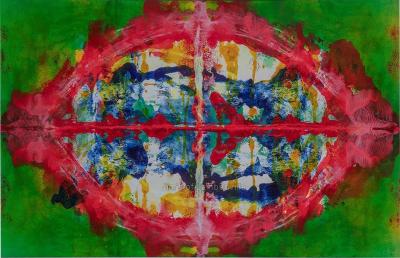
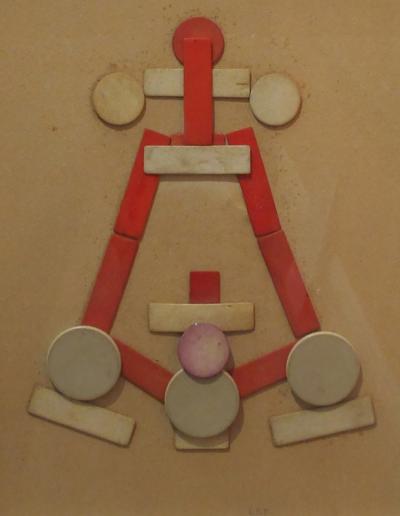
Joseph Meierhans is one of the most important modernist painters associated with Bucks County and the New Hope artists. His large body of work spans over five decades beginning with a representational Ashcan style and evolving into variations of modernism, including cubist, semi-abstract, abstract, and abstract-expressionist works.
Meierhans felt closest in spirit to Kandinsky, of whom he explained, “His distinctive style consists of very loaded canvases—representational elements co-exist with abstract shapes”. Kandinsky’s influence was apparent in Meierhans works from the 1940s. Meierhans compared painting to composing music, often saying, “A painting must sing for the eye as music does for the ears”. He felt that creating a balanced integrated abstract painting was much more difficult than painting a landscape. “Abstracts are far more difficult to execute than traditional paintings…landscapes always turn out alright, but I find myself destroying a lot of moderns. It must be a symphony of form, balance, and color…or it’s terrible”.
Born in Aargau, Switzerland, in 1890, Joseph Meierhans studied textile design in Zurich before coming to America in 1917. He first visited New York City while working for a Swiss textile mill. During this visit, Meierhans was offered a position with an American manufacturer as a textile designer and decided to stay. Meierhans was captivated by the New York art scene and soon began evening studies with Karl Knaths and later with John Sloan at the Art Students League from 1919-1921. He also studied with A. N. Lindenmuth in Allentown.
In 1932, Meierhans had saved enough money from the textile business to buy a unique 52-acre property in Hagersville, Pennsylvania, about fifteen miles from New Hope. Dubbed the Meierhans Manor, amidst rolling acres of farmland sat a stately Victorian mansion surrounded by an assortment of farm structures. There, he converted a 200-foot-long chicken coop into a studio and art gallery. For the next twenty-five years he divided his time between New York and Bucks County, devoting as much time as possible to his painting. In 1957 he retired from the textile business enabling him to concentrate solely on his art. A generous man dedicated to familiarizing people with the rich local artistic tradition, Meierhans made exhibition space in his gallery available to seven other artists each year. Over the years, Ben Solowey and Katherine Steele Renninger were among the many artists to take advantage of this opportunity.
While spending all of his “painting time” in Pennsylvania, Meierhans made efforts to stay involved in the New York art scene. He exhibited in the 1940s and 1950s at the Artist’s Gallery in New York where he was the recipient of five one-man shows. Meierhans also joined the avant-garde group known as AAA (American Abstract Artists) exhibiting in New York from 1946-1957 and in as faraway places as Europe and Japan. He also exhibited at the Whitney Museum of American Art, the Society of Independent Artists, the Salons of America, the Art Institute of Chicago, the Provincetown Art Association, American Federation of Artists Traveling Exchange, the Pennsylvania Academy of Fine Arts, Tokyo (1956), and the Crest Gallery, New Hope (solo 1958).
Sources:
New Hope for American Art by James M. Alterman
Joseph Meierhans, Princeton Gallery of Art 1985
Daily Intelligencer, Doylestown, PA 8/9/63
Call-Chronicle, Allentown, PA 9/28/58
The Archives of American Art, Smithsonian Institution -
More Information
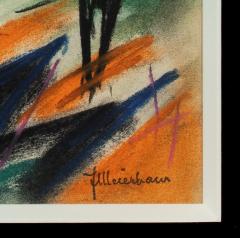
Documentation: Signed Notes: Signed lower right Origin: United States, Pennsylvania Period: 1920-1949 Materials: Pastel on Paper Condition: Good. Styles / Movements: Abstract Expressionism, New Hope School Dealer Reference #: JOL11231947 Incollect Reference #: 346182 -
Dimensions
W. 14 in; H. 11 in; W. 35.56 cm; H. 27.94 cm;
Message from Seller:
Welcome to Jim's of Lambertville Fine Art Gallery, located in the heart of Lambertville, NJ. Specializing in Pennsylvania Impressionist and Modernist paintings, antiques, and custom framing, we invite you to visit us or contact us at 609.397.7700 or via email at info@jimsoflambertville.com.