


Julian Stanczak
American, 1928 - 2017

Julian Stanczak (American, b. November 5, 1928) was an American painter and printmaker. He was born in Borownica, Poland. When World War II broke out, he was sent to a concentration camp in Perm, Siberia. Stanczak had been right-handed before he lost the use of his right arm for good at the camp. In 1942, after successfully escaping from the camp, Stanczak joined the Polish army-in-exile in Persia but soon deserted from it. After that, the artist spent his time in a Polish refugee camp in Uganda, Africa. This was where Stanczak learned to write and paint with his left hand, and where he took his first private art lessons. He then went to Borough Polytechnic Institute in London before immigrating to the United States in 1950. Four years after his immigration, Stanczak received his BFA from the Cleveland Institute of Art. In 1956, Stanczak became a United States citizen. It was also in 1956 that he received his MFA from Yale University under the training of Josef Albers (German-born American, 1888–1976) and Conrad Marca Relli (American, 1913–2000).
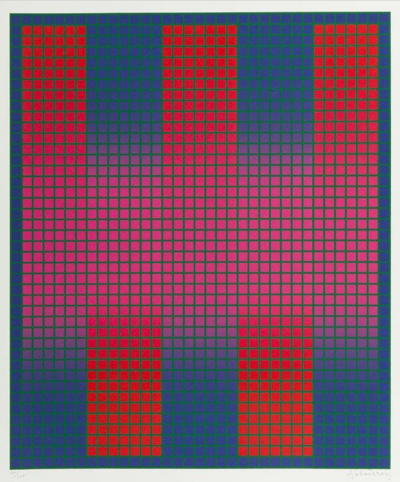
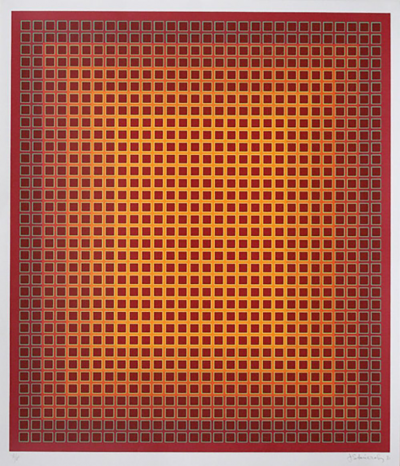
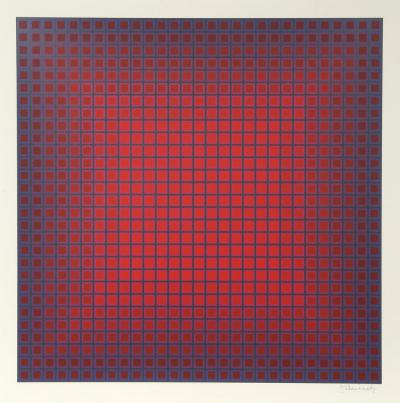
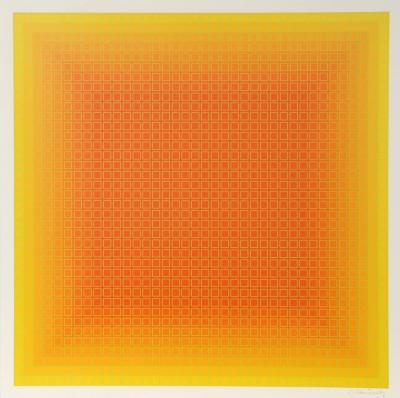
Stanczak's first major solo exhibition took place at the Martha Jackson Gallery in New York. Julian Stanczak: Optical Paintings was named after the Op Art movement. His work was also exhibited in the Museum of Modern Art's 1965 exhibition The Responsive Eye . In the early 1960s, Stanczak took advantage of the use of wavy lines and contrasting colors to make the surface plane of his works more vibrant. The work Provocative Current(1965) is a notable example of this unique style. This style of painting also paved the way for more complex artworks constructed with the rigidity of different geometrical shapes; however, it maintained the softness with many levels of color transparency. Netted Green (1972) is a famous work representing this style. Stanczak uses the same form again and again to produce compositions that reflect his visual experiences. His works are mainly based on the structures of color. In the 1980s and 1990s, Stanczak kept the geometric formation in mind, and produced bright-colored or muted-colored paintings often as pieces in a series such as Soft Continuum(1981).
In 1970, Stanczak was recognized as "Outstanding American Educator" by the Educators of America. He lived and worked in Seven Hills, OH, with his wife, the sculptor Barbara M. Meerpohl before his death on March 29, 2017.
Source: artnet
Julian Stanczak paintings
Stanczak's first major solo exhibition took place at the Martha Jackson Gallery in New York. Julian Stanczak: Optical Paintings was named after the Op Art movement. His work was also exhibited in the Museum of Modern Art's 1965 exhibition The Responsive Eye . In the early 1960s, Stanczak took advantage of the use of wavy lines and contrasting colors to make the surface plane of his works more vibrant. The work Provocative Current(1965) is a notable example of this unique style. This style of painting also paved the way for more complex artworks constructed with the rigidity of different geometrical shapes; however, it maintained the softness with many levels of color transparency. Netted Green (1972) is a famous work representing this style. Stanczak uses the same form again and again to produce compositions that reflect his visual experiences. His works are mainly based on the structures of color. In the 1980s and 1990s, Stanczak kept the geometric formation in mind, and produced bright-colored or muted-colored paintings often as pieces in a series such as Soft Continuum(1981).
In 1970, Stanczak was recognized as "Outstanding American Educator" by the Educators of America. He lived and worked in Seven Hills, OH, with his wife, the sculptor Barbara M. Meerpohl before his death on March 29, 2017.
Source: artnet
Julian Stanczak paintings

 Loading...
