









Maxfield Parrish
American, 1870 - 1966
Maxfield Parrish was a household name during the early part of the twentieth century, and today, he stands with Howard Pyle and N. C. Wyeth as a triumvirate of American artists that delighted generations with their creations. These men mark the high point in the golden age of American illustration, and through Parrish’s imaginative work, he raised himself to the regal title “Master of Make-Believe.” His famous painting Daybreak, handled by Vose Galleries, is among the most reproduced images of art history, and by the height of his career, a replica of this piece was purportedly in one out of every four homes in America.
Frederick Parrish (he would later use the surname Maxfield as first a middle name and then a professional name) was the son of well-known painter and printmaker Stephen Parrish (1846-1938), and he benefited greatly from his father’s capable tutelage at an early age. He was raised in Philadelphia, Pennsylvania, and later in Dublin, New Hampshire, and traveled often with his father on local painting expeditions. As Maxfield grew older, the pair ventured as far as Massachusetts’ Cape Ann and even to Europe to try their hands at the varied landscapes.
In 1888, Maxfield entered Haverford College to study architecture, but he spent hours of time drawing whimsical subjects, even accepting commissions for hand-drafted posters and booklet covers. He had uncovered his true passion for art by his junior year, and so entered the Pennsylvania Academy of the Fine Arts and began his studies under Robert Vonnoh and Thomas Anshutz in 1892. A dedicated student, Maxfield also attended illustration classes at the nearby Drexel Institute of Art, Science, and Industry, and was encouraged by his teacher, Howard Pyle, to attempt commercial work. Within just two years of study, Maxfield was accepting local commissions for illustrations, and in 1895, he produced his first cover design for Harper & Brothers, publishers of Harper’s Bazaar, Harper’s Weekly, Harper’s Monthly, and Harper’s Young People. Parrish’s career as an illustrator gained momentous speed, and he was soon illustrating covers, frontispieces, short stories and advertisements for other major publications such as, Scribner’s, Life, Hearst, and Ladies Home Journal. He was at his most productive period between 1901 and 1925, when he created such famous book illustrations as Knave of Hearts and Arabian Nights and earned his reputation as one of America’s foremost illustrators.
Around 1900, Parrish contracted tuberculosis, requiring a winter’s stay in Saranac Lake, New York, and in the fall of 1901, having not yet recovered from his illness, he accepted a commission from Century magazine to produce a series of illustrations for an article on the Southwest. He traveled to Castle Creek, Arizona, and became enamored with the unique effects of light and weather on the sunbaked plains and rugged canyons, and was particular drawn to the skies, describing them in a letter in Century as, “a blue from dreamland, a blue from which all the skies of the world were made…the more you look, the more unreal it grows.” His southwest experience would influence his painting for years to come, especially when he transitioned to pure landscape work beginning in the 1930s. According to his son, “Stone Hill” – Arizona Desert, painted in 1933, was done by Parrish for his own enjoyment and descended in the family for decades.
Parrish’s work captured whimsical moments, idyllic vistas and fluidly-draped youths; his backdrop was most frequently his beloved home, “The Oaks,” in Plainfield, New Hampshire. From 1936 until his death in 1966, he painted over one hundred views of New Hampshire, where he had resided since 1898. He built “The Oaks” over a series of progressive additions, creating in the end a twenty-room home with a fifteen-room studio, resplendent with Roman columns and sunken gardens. Many of Parrish’s depictions of the neighboring countryside provided the materials for calendars, greeting cards and prints for the St. Paul, Minnesota, publishing company Brown & Bigelow. These compositions often incorporated his signature dramatic juxtaposition of a tranquil, rural landscape set against a vivid turquoise blue sky, a vibrancy of color achieved by creating his own paint, ground with semi-precious stones such as lapis lazuli.
Although he lived a reclusive life, Parrish’s name was familiar to millions of Americans, and by 1925, he had achieved not just great fame, but also fortune. Remarkably, Parrish’s status as one of the first American artists to consciously create illustrations for an expansive public audience caused him to be largely overlooked by art historians. They classified him not as a fine artist, but as a “popular artist,” disregarding the fact that Parrish had obtained full membership to the National Academy. Interest in his work slowly grew throughout the 1970s, however, after Lawrence Alloway shed light on his talents and Vose Galleries hosted a major Parrish exhibition in 1977. Surprisingly, it took until the year 2000 for a revered fine art institution to host a major critical survey of Parrish’s career; the Pennsylvania Academy of the Fine Arts organized the ground-breaking exhibition Maxfield Parrish, 1870-1966 in April of 2000.
Frederick Parrish (he would later use the surname Maxfield as first a middle name and then a professional name) was the son of well-known painter and printmaker Stephen Parrish (1846-1938), and he benefited greatly from his father’s capable tutelage at an early age. He was raised in Philadelphia, Pennsylvania, and later in Dublin, New Hampshire, and traveled often with his father on local painting expeditions. As Maxfield grew older, the pair ventured as far as Massachusetts’ Cape Ann and even to Europe to try their hands at the varied landscapes.
In 1888, Maxfield entered Haverford College to study architecture, but he spent hours of time drawing whimsical subjects, even accepting commissions for hand-drafted posters and booklet covers. He had uncovered his true passion for art by his junior year, and so entered the Pennsylvania Academy of the Fine Arts and began his studies under Robert Vonnoh and Thomas Anshutz in 1892. A dedicated student, Maxfield also attended illustration classes at the nearby Drexel Institute of Art, Science, and Industry, and was encouraged by his teacher, Howard Pyle, to attempt commercial work. Within just two years of study, Maxfield was accepting local commissions for illustrations, and in 1895, he produced his first cover design for Harper & Brothers, publishers of Harper’s Bazaar, Harper’s Weekly, Harper’s Monthly, and Harper’s Young People. Parrish’s career as an illustrator gained momentous speed, and he was soon illustrating covers, frontispieces, short stories and advertisements for other major publications such as, Scribner’s, Life, Hearst, and Ladies Home Journal. He was at his most productive period between 1901 and 1925, when he created such famous book illustrations as Knave of Hearts and Arabian Nights and earned his reputation as one of America’s foremost illustrators.
Around 1900, Parrish contracted tuberculosis, requiring a winter’s stay in Saranac Lake, New York, and in the fall of 1901, having not yet recovered from his illness, he accepted a commission from Century magazine to produce a series of illustrations for an article on the Southwest. He traveled to Castle Creek, Arizona, and became enamored with the unique effects of light and weather on the sunbaked plains and rugged canyons, and was particular drawn to the skies, describing them in a letter in Century as, “a blue from dreamland, a blue from which all the skies of the world were made…the more you look, the more unreal it grows.” His southwest experience would influence his painting for years to come, especially when he transitioned to pure landscape work beginning in the 1930s. According to his son, “Stone Hill” – Arizona Desert, painted in 1933, was done by Parrish for his own enjoyment and descended in the family for decades.
Parrish’s work captured whimsical moments, idyllic vistas and fluidly-draped youths; his backdrop was most frequently his beloved home, “The Oaks,” in Plainfield, New Hampshire. From 1936 until his death in 1966, he painted over one hundred views of New Hampshire, where he had resided since 1898. He built “The Oaks” over a series of progressive additions, creating in the end a twenty-room home with a fifteen-room studio, resplendent with Roman columns and sunken gardens. Many of Parrish’s depictions of the neighboring countryside provided the materials for calendars, greeting cards and prints for the St. Paul, Minnesota, publishing company Brown & Bigelow. These compositions often incorporated his signature dramatic juxtaposition of a tranquil, rural landscape set against a vivid turquoise blue sky, a vibrancy of color achieved by creating his own paint, ground with semi-precious stones such as lapis lazuli.
Although he lived a reclusive life, Parrish’s name was familiar to millions of Americans, and by 1925, he had achieved not just great fame, but also fortune. Remarkably, Parrish’s status as one of the first American artists to consciously create illustrations for an expansive public audience caused him to be largely overlooked by art historians. They classified him not as a fine artist, but as a “popular artist,” disregarding the fact that Parrish had obtained full membership to the National Academy. Interest in his work slowly grew throughout the 1970s, however, after Lawrence Alloway shed light on his talents and Vose Galleries hosted a major Parrish exhibition in 1977. Surprisingly, it took until the year 2000 for a revered fine art institution to host a major critical survey of Parrish’s career; the Pennsylvania Academy of the Fine Arts organized the ground-breaking exhibition Maxfield Parrish, 1870-1966 in April of 2000.
Maxfield Parrish was one of the twentieth century's greatest painters and illustrators, whose work ranks among the most-reproduced in the history of art. Born in Philadelphia, Parrish learned to paint from his father, the artist Stephen Parrish, and studied at Haverford College, the Pennsylvania Academy of the Fine Arts, and the Drexel Institute. His technical skill allowed him to develop unique glazing techniques and incandescent color effects-including his own "Parrish blue" -that gave his work a mysterious, lyrical quality. He achieved national fame with his paintings, murals, book and magazine illustrations, calendars, and prints; influenced artists including Norman Rockwell and Andy Warhol; earned record prices at auction; and won countless prizes. Today, his work is featured in the Metropolitan Museum of Art, the Smithsonian American Art Museum, the de Young Museum of San Francisco, and the Carnegie Institute.
Biography courtesy of Questroyal Fine Art, LLC, www.antiquesandfineart.com/questroyal
Biography courtesy of Questroyal Fine Art, LLC, www.antiquesandfineart.com/questroyal
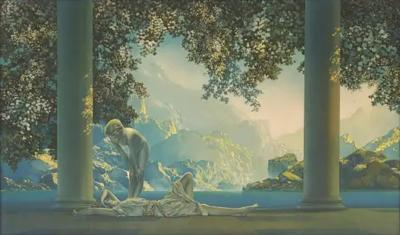
Maxfield Parrish
Maxfield Parrish Iconic Art Deco Original 1923 Print "Daybreak"
H 18 in W 30 in
$ 1,600

 Loading...
