








Andre Gisson
American, 1928 - 2004
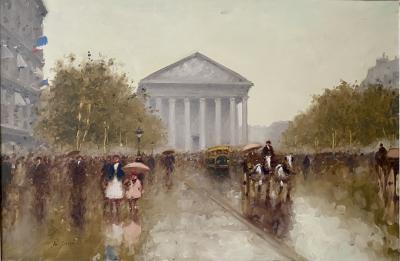
Andre Gisson is an outstanding American impressionist of unusual magnitude. Gisson was born and still lives in New York. However, his paintings reflect his extensive travels and studies in Europe and the Far East.
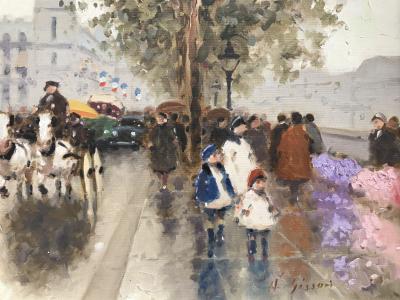
Gisson's landscapes and beach scenes create a reflective mood of serenity. This is also true of his portraits and of the manner in which he handles the human element. The order and beauty of his florals and still lifes are manifestations of the Japanese influence in his work; while the French influence is more pronounced in his landscapes, beach scenes and studies of the human figure.
Gisson feels that it is the role of the artist to extend or "explain" perception and feeling and in this way enlarge the total human vision...."Flowers for me are a way of feeling certain effects of light and conversely, light is a means for expressing something very personal about the way I experience flowers." All of Gisson's paintings have the softness of line of the classic impressionist. He is more concerned with the creation of a mood or feeling, rather than a precise depiction of the subject.
Gisson's works reflect the belief that art is expreienced in very complex ways. First, the eyes see, and then there is perception through all of the senses. Art, in its multi-leveled complexities is created and experienced, first by the artist and then by his audience.
"When I begin to paint, certain remembered sensations come to me and it is these that I translate into visual form and related subjects. These subjects--people, the nude, florals, landscapes, beaches, etc., recur constantly like obsessive memories. For the most part they are the common universal experiences of all of us, neither contemporary nor out of an antique past, but with a sentiment which I hope is recognizable to others at any time."
Biography courtesy of Roughton Galleries, www.antiquesandfineart.com/roughton
Gisson's landscapes and beach scenes create a reflective mood of serenity. This is also true of his portraits and of the manner in which he handles the human element. The order and beauty of his florals and still lifes are manifestations of the Japanese influence in his work; while the French influence is more pronounced in his landscapes, beach scenes and studies of the human figure.
Gisson feels that it is the role of the artist to extend or "explain" perception and feeling and in this way enlarge the total human vision...."Flowers for me are a way of feeling certain effects of light and conversely, light is a means for expressing something very personal about the way I experience flowers." All of Gisson's paintings have the softness of line of the classic impressionist. He is more concerned with the creation of a mood or feeling, rather than a precise depiction of the subject.
Gisson's works reflect the belief that art is expreienced in very complex ways. First, the eyes see, and then there is perception through all of the senses. Art, in its multi-leveled complexities is created and experienced, first by the artist and then by his audience.
"When I begin to paint, certain remembered sensations come to me and it is these that I translate into visual form and related subjects. These subjects--people, the nude, florals, landscapes, beaches, etc., recur constantly like obsessive memories. For the most part they are the common universal experiences of all of us, neither contemporary nor out of an antique past, but with a sentiment which I hope is recognizable to others at any time."
Biography courtesy of Roughton Galleries, www.antiquesandfineart.com/roughton



 Loading...
