


Robert Arthur Goodnough
American, 1917 - 2010
Robert Goodnough was born in Cortland, New York in 1917. He earned his Bachelor of Arts degrees from Syracuse University, Ozenfant School of Fine Art, Hans Hofmann School of Art and an M. A. degree from New York University. While in the army, he painted portraits and murals, and created art work for information and training manuals. While stationed in New Guinea he also did artwork for the daily publication CEBU. Goodnough taught painting (mostly portraiture) at New York University until 1953, and from 1953 to 1961 he taught part time at Fieldston School in New York.
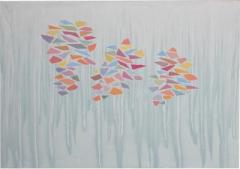
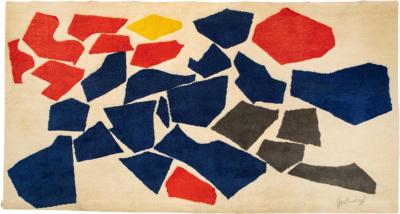
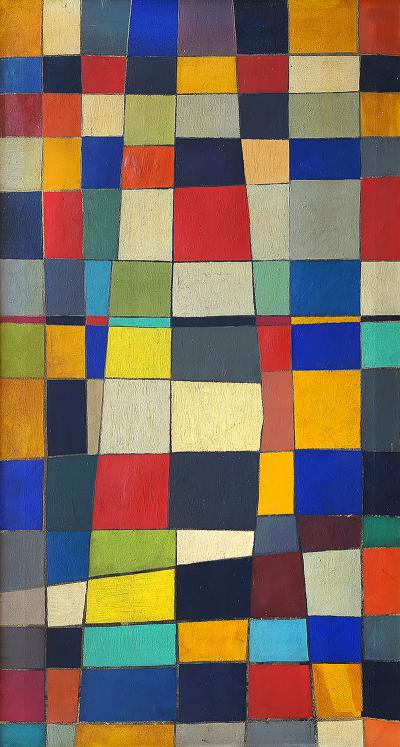
Unlike many painters, Robert Goodnough did not restrict himself to painting only on canvas. He also tried his hand at many other techniques and materials. Over the years he sculpted in wood, metal and plaster; he has done stained glass, drawings and gouaches. He also produced an impressively large number of collages, a medium for which he is particularly well known.
In turning to print making, Goodnough brought the same aesthetic, the same stance as with other media. His image, his own characteristic style of work, endows the serigraphs as strongly as in the largest oils or sculptures.
Goodnough's serigraphs are an extension of forms one has found over the years in his paintings. As a solution for the technique of silkscreen, this is particularly apt since colors and shapes can be reproduced and registered with absolute precision. It is astonishing to see a serigraph so felicitous a simulation of collage; but even more surprising is the application of color.
Perhaps Goodnough's refusal to "specialize" (the printmaker who makes prints, the sculptor who only models clay) made possible freshness, a willingness to take risks, an extension of the range of expressive possibilities. This elegant self-hood, this sophisticated knowingness made Goodnough perhaps one of the five or six finest American artists of the last four decades. One could not foretell what surprises this painter had in store for us. We can be certain, however, that whatever he turned his hand to, there would be no loss of integrity, the true basis for the Goodnough style.
Unlike many painters, Robert Goodnough did not restrict himself to painting only on canvas. He also tried his hand at many other techniques and materials. Over the years he sculpted in wood, metal and plaster; he has done stained glass, drawings and gouaches. He also produced an impressively large number of collages, a medium for which he is particularly well known.
In turning to print making, Goodnough brought the same aesthetic, the same stance as with other media. His image, his own characteristic style of work, endows the serigraphs as strongly as in the largest oils or sculptures.
Goodnough's serigraphs are an extension of forms one has found over the years in his paintings. As a solution for the technique of silkscreen, this is particularly apt since colors and shapes can be reproduced and registered with absolute precision. It is astonishing to see a serigraph so felicitous a simulation of collage; but even more surprising is the application of color.
Perhaps Goodnough's refusal to "specialize" (the printmaker who makes prints, the sculptor who only models clay) made possible freshness, a willingness to take risks, an extension of the range of expressive possibilities. This elegant self-hood, this sophisticated knowingness made Goodnough perhaps one of the five or six finest American artists of the last four decades. One could not foretell what surprises this painter had in store for us. We can be certain, however, that whatever he turned his hand to, there would be no loss of integrity, the true basis for the Goodnough style.

 Loading...
