









Listings / Fine Art / Paintings / Still Life

Offered by:
Kristan Hauge Japanese Art
2-32 Saishoji-cho, Okazaki, Sakyo-ku,
Kyoto 606-8342 , Japan
Call Seller
81757515070
Showrooms
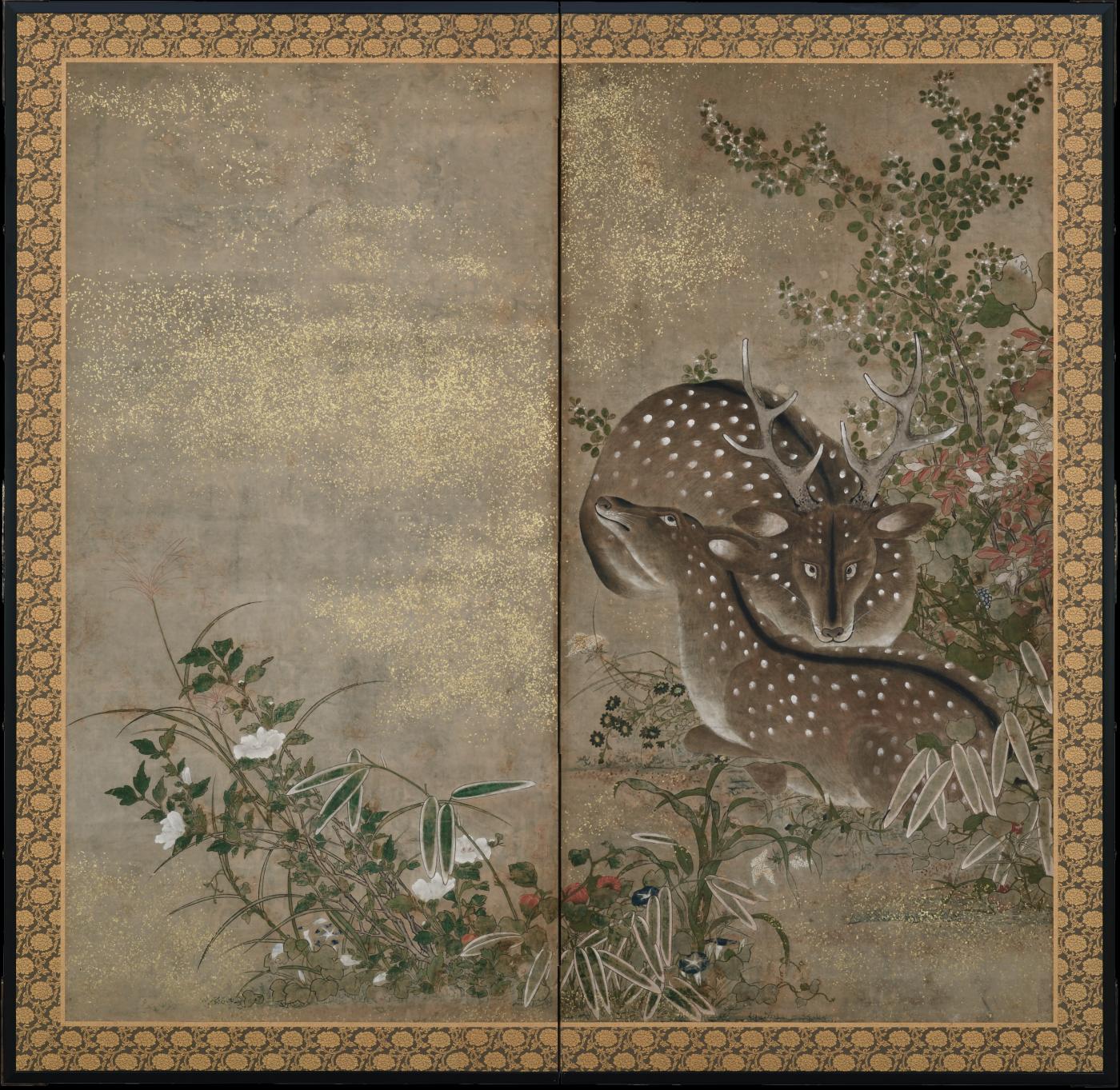
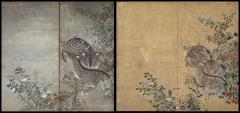
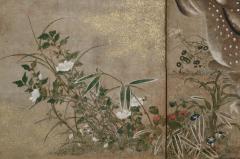
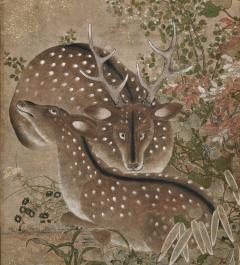
Edo period Japanese Screen. Spotted Deer and Autumn Flowers
-
Description
Anonymous
Spotted Deer and Autumn Flowers
Two-panel Japanese Screen; ink, color, gofun and gold fleck on paper.
Dimensions: H. 178.5 cm x W. 184 cm (70’’ x 72.5’’)
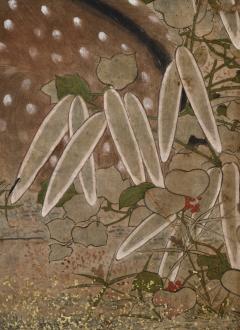
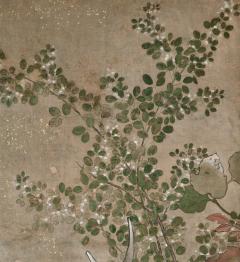
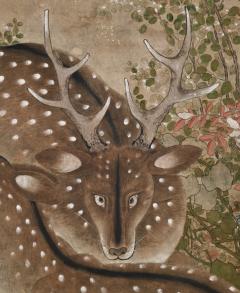
This two-panel Japanese screen, painted on paper and likely dating to the seventeenth century—presents a refined and spiritually charged vision of Spotted Deer and Autumn Flowers. The deer are not simply animals within a seasonal landscape; they evoke the sacred deer of Kasuga Shrine imagery. They recall the deer seen in Kasuga Shrine mandalas—divine messengers who descend from the heavens bearing the will of the gods. They exist slightly outside ordinary nature. The gaze of the deer is concentrated and purposeful. Their eyes possess clarity and directional intent. This quality can be directly compared to the deer in Kasuga mandala imagery, whose gazes signify spiritual awareness and divine agency.
The anonymous artist of the screen demonstrates great clarity of brushwork, color relationships and compositional design. The artist relies heavily on line as structure. The result is a strong sense of compositional coherence. The foliage interlocks with elegance and inevitability. Stems weave through one another with rhythmic continuity. The eye moves fluidly through a dense yet coherent network of forms.
We can compare our screen directly with a two-fold Japanese screen now in the collection of the National Museum of Asian Art and part of the Charles Lang Freer Collection. This screen dates to the nineteenth century and clearly models itself on the earlier design. By contrast to our screen, the Freer screen transforms the deer into creatures of heightened naturalism. The fur is more minutely described, the white spots multiplied, musculature more insistently modeled. This increased detail shifts the work away from symbolic presence toward observational realism. The approach aligns more closely with painting traditions that developed after Maruyama Okyo in the 18th century, whose emphasis on direct observation and empirical study profoundly altered Japanese pictorial language. In the Freer version, the deer are no longer emissaries of heaven—they are specimens of nature. The stag appears anxious or uncertain rather than spiritually alert. The doe stares forward blankly, her gaze unfixed and without a clear focal point. Although the nineteenth-century artist faithfully reproduces the composition, he seems to misunderstand its underlying spiritual logic. He copies the forms but not the animating idea.
The artist of the Freer screen is far less assured than the artist of our screen. Forms are less crisply delineated. Portions of the foliage are executed in a semi-boneless manner, without the firm ink outlines that anchor the original. Ink outlines, where present, lack the same decisiveness and steadiness of hand. To compensate, the later artist increases descriptive detail. Red leaves are given visible ribs; foliage is differentiated through shifts of tone and color rather than through the authority of line. Where the earlier painter achieves distinction through clarity of structure, the later painter relies on surface elaboration.
The two screens are obviously directly related in composition: the placement of the stag and doe, the sweep of autumn grasses, the clustering of flowers, even the directional flow across the panels reveal a shared design ancestry. Yet the relationship is structural rather than spiritual.
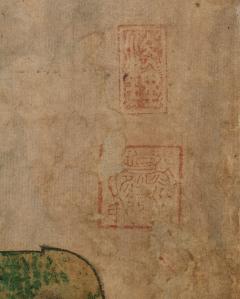
* The screen carries a pair of seals attributing it to Kano Sanraku (1559–1635), though these were almost certainly applied later by a collector or dealer. From a stylistic standpoint, there is no compelling evidence to support an attribution to Sanraku.
* If you search the web for “Spotted deer and autumn flowers national museum of asian art”, you will find an extremely high definition image of the Freer screen for comparison. -
More Information
Period: Pre 18th Century Styles / Movements: Asian Art Incollect Reference #: 852961 -
Dimensions
W. 72.44 in; H. 70.28 in; W. 184 cm; H. 178.5 cm;
Message from Seller:
Kristan Hauge Japanese Art, based in Kyoto's museum district since 1999, specializes in important Japanese screens and paintings for collectors, decorators, and museums worldwide. Contact us at khauge@mx.bw.dream.jp or +81 75-751-5070 for exceptional access to Japanese art and history.
More Listings from Kristan Hauge Japanese Art View all 68 listings
-
Mother’s Breast (Chichi) 1844. Japanese scroll painting.

-
Amaranth & Rooster | Circa 1930 | Japanese scroll painting

-
Playful Cat | Hirose Toho (1875-1930) | Japanese scroll painting

-
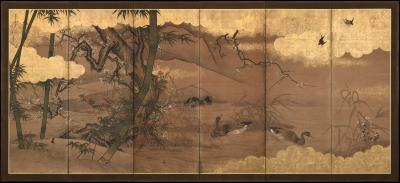
17th Century Japanese Unkoku Screen. Flowers & Birds of Winter and Early Spring
-
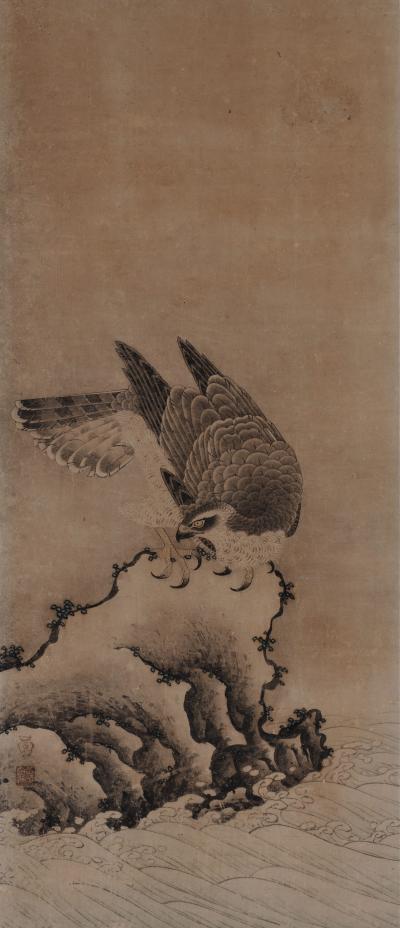
Mitani Toshuku (1577-1654). Unkoku School. Japanese falcon painting.
-
Early 20th Century Japanese Nihonga Scroll. Crow & Persimmon.

-
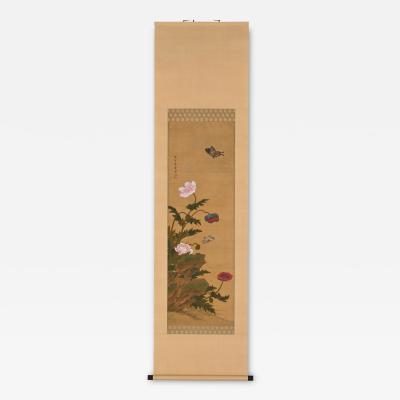
19th Century Japanese Scroll Painting by Igarashi Chikusa, Poppies & Butterflies
-
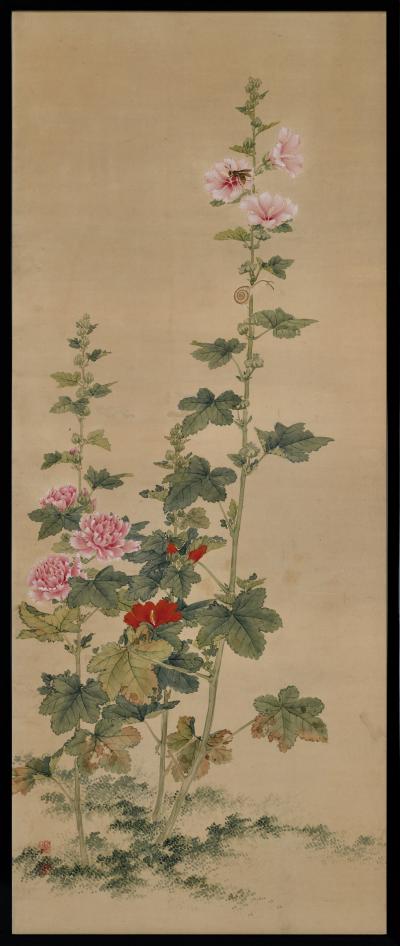
Mid 19th Century Framed Japanese Painting. Snail, Wasp & Hollyhock.
-
19th Century Japanese Shunga Hand-Scroll, Katsukawa School.

-
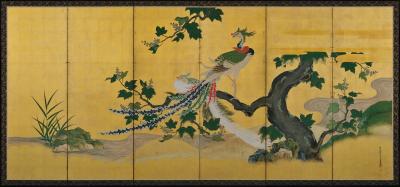
Tsunetake Yotei (18 c.) | Phoenix & Peacocks | Japanese folding screen pair
-
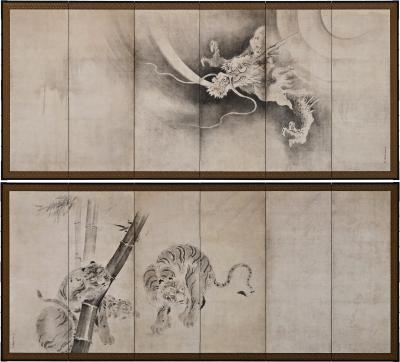
17th Century Japanese Screen Pair. Tiger & Dragon by Kaiho Yusetsu
-
Korean grapevine painting. 17th century.

-
Early 20th Century Japanese Nihonga Screen. Bamboo Forest
-
Early 20th Century Japanese Screen. Flowers of the Four Seasons