






Offered by:
Kristan Hauge Japanese Art
2-32 Saishoji-cho, Okazaki, Sakyo-ku,
Kyoto 606-8342 , Japan
Call Seller
81757515070
Showrooms
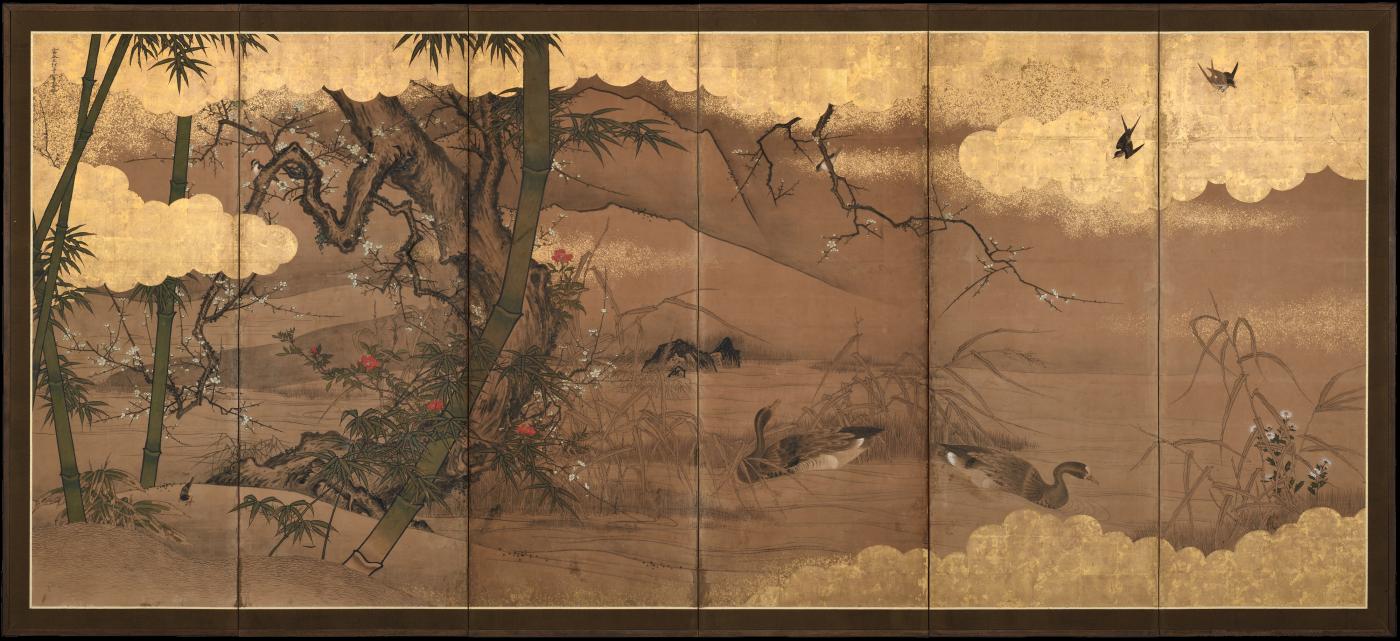
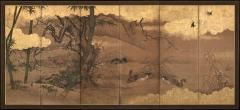
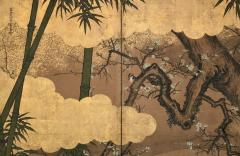
17th Century Japanese Unkoku Screen. Flowers & Birds of Winter and Early Spring
-
Description
Signed Unkoku Toyu (1660-1716)
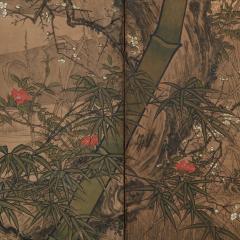
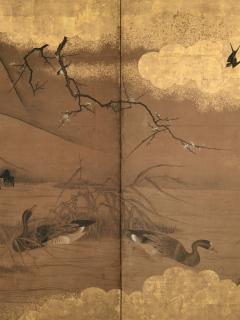
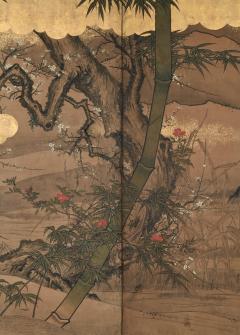
Flowers & Birds of Winter and Early Spring
A Six-panel Japanese Screen. Ink, color and gold leaf on paper.
Dimensions: H. 172 cm x W. 379 cm
Price: USD 32,000
This later 17th century Japanese screen is signed Unkoku Tōyū (1660–1716), a leading figure of the Unkoku school in the early Edo period. Tōyū was the eldest son of Unkoku Tōji, and he carried forward a lineage that deliberately anchored itself in the authority of Sesshū Tōyō.
The mood of the scene is observational and seasonal, not emblematic of power as were many screens from the more wide-spread Kano school. The composition is unified by wind and atmosphere. Everything — bamboo, plum, reeds, water, birds — participates in a single directional force moving from left to right. Unlike certain later screens that flatten elements across the surface, this composition preserves a sense of depth. Yet the recession is moderated by gold clouds and frontal placement of forms. The result is a balanced tension between depth and surface. The compositional structure — with its expansive sweep across the panels — reflects the decorative ambition of Momoyama screen painting. Yet the handling of ink remains disciplined and lineage-conscious, anchored in Sesshū-derived brush authority.
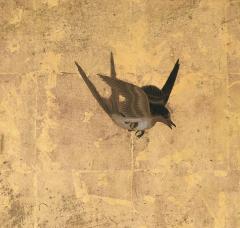
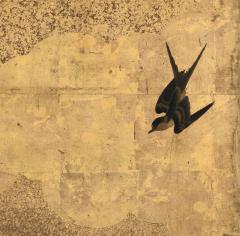
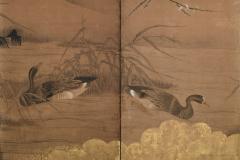
The bamboo is rendered in strong, simplified forms – their placement anchoring the composition. The foremost bamboo bends under persistent wind. That bending movement is echoed in the contour of the plum tree. This visual rhyme suggests a unifying wind moving through the entire scene. The water is not flat. Its surface undulates. These waves directly affect the ducks, whose bodies tilt and respond to the current, and suggests motion beyond the frame. It links foreground and middle ground through its horizontal rhythm. This interaction between water and bird adds naturalism and avoids emblematic stiffness. The birds are not showcased as virtuoso subjects; they’re absorbed into the seasonal rhythm of the scene. The swallows cut sharply through the pictorial space. Their angled wings and sudden directional shifts create a visual counterpoint to the more grounded forms below.
The screen represents the transition from winter to early spring. The camellia underscores winter’s persistence, while the plum blossoms, flowering in the cold, signal the approach of renewal. However, the work’s appeal extends beyond seasonal symbolism. Its real strength lies in the unified sense of movement that carries across the entire composition, giving the screen energy, cohesion, and strong visual presence — qualities that make it particularly compelling as a large-scale decorative work.
The Unkoku family’s origins are closely tied to feudal patronage. The powerful daimyō Mōri Terumoto installed the painter Tōgan in Sesshū’s former atelier, Unkokuan, after which Tōgan adopted the family name “Unkoku.” From that moment onward, the school positioned itself as the legitimate inheritor of Sesshū’s artistic mantle. As retainers of the Mōri clan, members of the Unkoku school were primarily active in the Chūgoku region, especially the Hagi and Chōshū domains, though some also worked in Kyoto. Tōyū himself was active mainly in these western domains.
Screen paintings by Unkoku Tōyū are today preserved in the Tokyo National Museum, underscoring his recognized stature within the tradition. -
More Information
Documentation: Signed Period: Pre 18th Century Styles / Movements: Asian Art Incollect Reference #: 852962 -
Dimensions
W. 149.21 in; H. 67.72 in; W. 379 cm; H. 172 cm;
Message from Seller:
Kristan Hauge Japanese Art, based in Kyoto's museum district since 1999, specializes in important Japanese screens and paintings for collectors, decorators, and museums worldwide. Contact us at khauge@mx.bw.dream.jp or +81 75-751-5070 for exceptional access to Japanese art and history.
More Listings from Kristan Hauge Japanese Art View all 60 listings
-
Early 20th Century Japanese Screen Pair – Ink Pine Trees on Gold

-
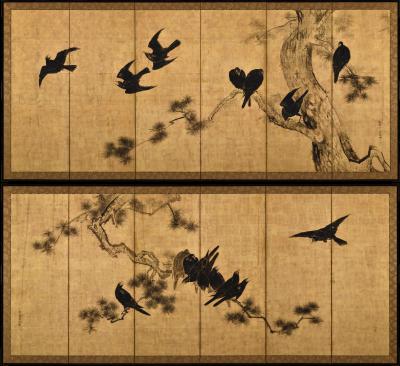
Mid 18th Century Japanese Screen Pair. Crows & Pines by Unkoku Toshuku
-
Mitani Toshuku Unkoku School, 17th century. Japanese falcon painting.

-
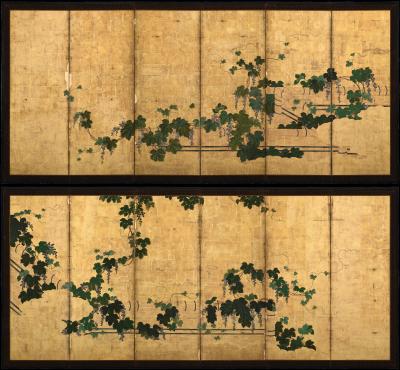
17th Century Japanese Screen Pair. Grapevines. Attributed to Kano Tsunenobu
-
Sakai Hoitsu (1761-1828) | Autumn flowers | Japanese screen painting

-
17th Century Japanese Screen Pair. Flock of Cranes. Ink and color on gold leaf.

-
Early 20th Century Pair of Japanese Screens | Deer under Maple Trees
-
Japanese Screen. Early 20th Century. Furosaki Screen. Wagtail & Chrysanthemum

-
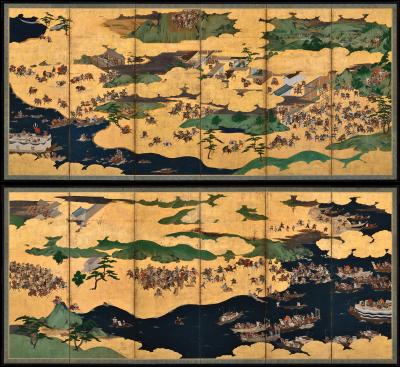
Late 17th Century Japanese Screen Pair. Battle of Ichi-no-tani and Yashima
-
Japanese Screen Pair. Showa era. Nihonga Riverside landscape. Late Summer
-
Early 20th Century Japanese Cherry Blossom Screen
-
Chaekgeori painting. 19th Century Joseon. Books & Scholars’ Accouterments.
-
17th Century Japanese Screen. Ink Plum Tree & Birds by Kano Naonobu

-
19th Century Japanese Deer Screen by Okamoto Toyohiko. Maruyama Shijo School