








Nymphenburg Porcelain Manufactory
German, 1761
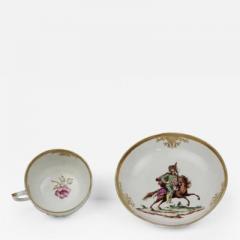
The Nymphenburg Porcelain Manufactory (in German: Porzellanmanufaktur Nymphenburg), manufacturer of Nymphenburg porcelain, is situated next to the Nymphenburg Palace in Munich, capital of Bavaria, and since the mid-eighteenth century has been manufacturing porcelain of high artistic value.
After his accession in 1745 Maximilian III Joseph, Prince-Elector of Bavaria, commanded the establishment of manufacturing companies in order to bail out the state finances. From 1747 attempts were made to manufacture porcelain and at the end of that year the former Neudeck Castle in the area now the Munich suburb of Au-Haidhausen was made available for that purpose. Up to 1754 the experiments were a miserable failure and lost considerable amounts of money, but in that year the efforts to manufacture porcelain finally began to succeed. In the same year the rococo porcelain sculptor Franz Anton Bustelli came to work at the factory. In 1755 the factory received its first commission from the Bavarian court and in 1756 came the first success in painting the porcelain in colour. The management of the jurist and entrepreneur Count Sigmund von Haimhausen from 1758 ensured that the factory was placed on a sound commercial footing. By 1761 it had moved to a cavalier house in front of the royal palace at Nymphenburg, where it is still located today.
Among the great artists who followed Bustelli were Dominikus Auliczek the elder (1734–1804) and Johann Peter Melchior. A great promoter of the works was Ludwig I, who gave them many commissions. Particular favourites were dinner services with copies of famous paintings or with Bavarian landscapes in an antique style.
In 1822 Friedrich von Gärtner, the fashionable architect, was appointed artistic director of the factory. In the middle of the 19th century its financial position deteriorated to the extent that in 1856 all artistic production was halted and it was decide to privatise the factory. It was leased out for the first time in 1862 and its focus shifted to the production of technical, medical and sanitary porcelain goods.
In 1887 Albert Bäuml (1855–1929) took a lease of the factory. His aim was to regain the previous high artistic level of the factory's products: it was Bäuml, for example, who "rediscovered" Bustelli. This aim was realised at around the turn of the 19th and 20th centuries and besides historical copies, elegant Jugendstil ceramics were developed.
Since 1975 the factory has been leased by the Bavarian government to the Wittelsbach Compensation Fund (Wittelsbacher Ausgleichsfonds). In 2011 it was taken over by Prince Luitpold of Bavaria.
The Nymphenburg Palace also accommodates the Nymphenburg Porcelain Museum (the Bäuml Collection). Guided tours through the factory can be arranged by prior appointment. Nymphenburg Palace is known to have been the working place of artists and sculptors like Hanns Goebl and Franz Anton Bustelli.
After his accession in 1745 Maximilian III Joseph, Prince-Elector of Bavaria, commanded the establishment of manufacturing companies in order to bail out the state finances. From 1747 attempts were made to manufacture porcelain and at the end of that year the former Neudeck Castle in the area now the Munich suburb of Au-Haidhausen was made available for that purpose. Up to 1754 the experiments were a miserable failure and lost considerable amounts of money, but in that year the efforts to manufacture porcelain finally began to succeed. In the same year the rococo porcelain sculptor Franz Anton Bustelli came to work at the factory. In 1755 the factory received its first commission from the Bavarian court and in 1756 came the first success in painting the porcelain in colour. The management of the jurist and entrepreneur Count Sigmund von Haimhausen from 1758 ensured that the factory was placed on a sound commercial footing. By 1761 it had moved to a cavalier house in front of the royal palace at Nymphenburg, where it is still located today.
Among the great artists who followed Bustelli were Dominikus Auliczek the elder (1734–1804) and Johann Peter Melchior. A great promoter of the works was Ludwig I, who gave them many commissions. Particular favourites were dinner services with copies of famous paintings or with Bavarian landscapes in an antique style.
In 1822 Friedrich von Gärtner, the fashionable architect, was appointed artistic director of the factory. In the middle of the 19th century its financial position deteriorated to the extent that in 1856 all artistic production was halted and it was decide to privatise the factory. It was leased out for the first time in 1862 and its focus shifted to the production of technical, medical and sanitary porcelain goods.
In 1887 Albert Bäuml (1855–1929) took a lease of the factory. His aim was to regain the previous high artistic level of the factory's products: it was Bäuml, for example, who "rediscovered" Bustelli. This aim was realised at around the turn of the 19th and 20th centuries and besides historical copies, elegant Jugendstil ceramics were developed.
Since 1975 the factory has been leased by the Bavarian government to the Wittelsbach Compensation Fund (Wittelsbacher Ausgleichsfonds). In 2011 it was taken over by Prince Luitpold of Bavaria.
The Nymphenburg Palace also accommodates the Nymphenburg Porcelain Museum (the Bäuml Collection). Guided tours through the factory can be arranged by prior appointment. Nymphenburg Palace is known to have been the working place of artists and sculptors like Hanns Goebl and Franz Anton Bustelli.
References
- Rainer Schuster, 1997. Nymphenburger Porzellan. Kostbarkeiten aus der Sammlung Bäuml und dem Residenzmuseum München. Munich: Bayerische Verwaltung der staatlichen Schlösser, Gärten und Seen.
- From Wikipedia, the free encyclopedia
Sold
Nymphenburg Porcelain Manufactory
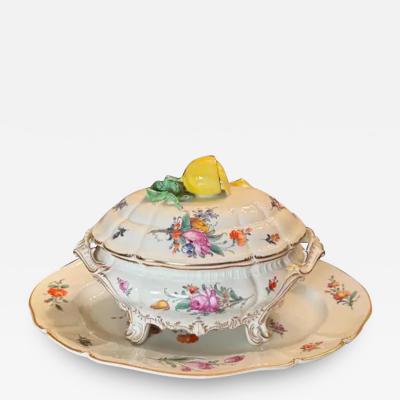
Lidded Soup Tureen & Plater, Nymphenburg, Munich German
H 7 in W 11 in D 7 in


Sold
Nymphenburg Porcelain Manufactory
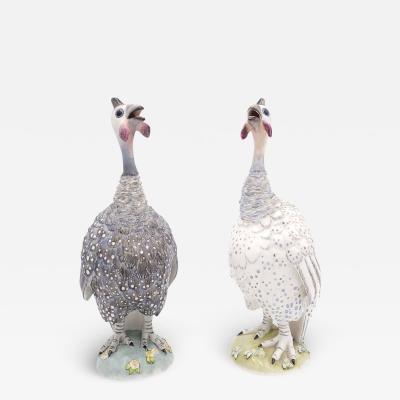
Pair of Nymphenburg Porcelain Guinea Fowl, circa 1950
H 12 in W 4 in D 5 in




 Loading...
