





Lucien Petit
French, 1957
Born in 1957 in Sancerre, Lucien Petit lives and works in Boisbelle, a village near La Borne. Trained in the techniques of ceramics, he associates very early with a personal production the image of the interior, a recurring form in all of his work.
Experienced in the production of multiple ceramic practices, Lucien Petit applies the principles of a strong artistic approach. He is initiated and inspired by his friend and artist Daniel Pontoreau and he makes many works visible around the world in contact with international artists. Also, he was an accomplice of Jacqueline Lerat during fifteen years, which allows him today to confirm all his aspirations.
Evoking the variety of forms of habitat, but also the ways of life that they generate, the artist develops an interest for the architecture, for the construction and more generally for the container governed by contrary laws of form and against -form, elevation and landslide, organic and mineral.
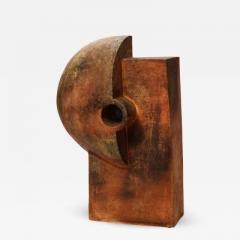
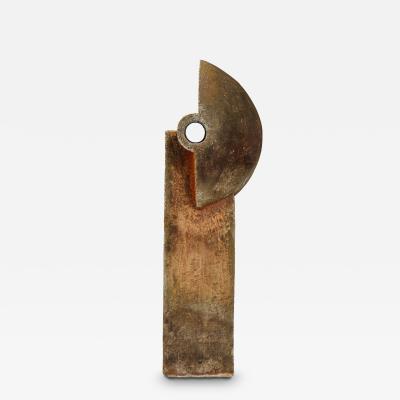
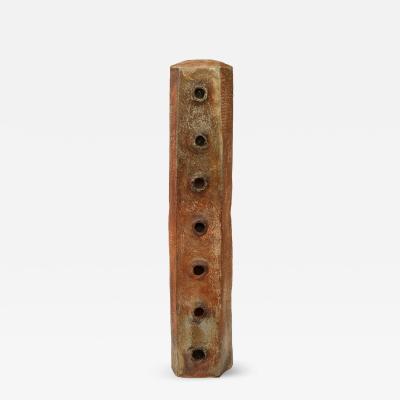
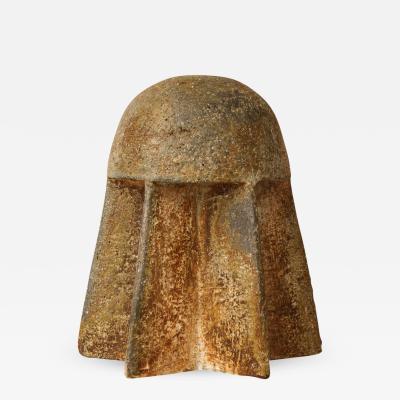
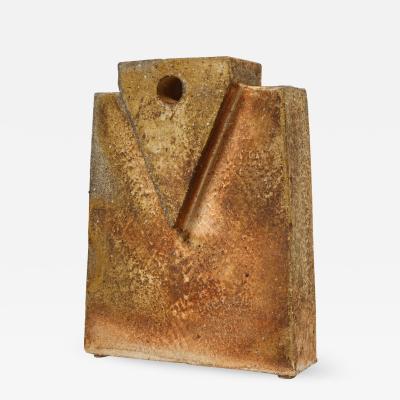
His most recent works evolving between anthropomorphism and abstraction, are part of the tradition of simple sculptors who have been able to mark the modern history of La Borne. Set in space and installed on the ground, these sculptures act as the protagonists of a silent piece reminiscent of the monoliths of a constantly changing landscape. Never frozen, it is always likely to be reconfigured or connected to other objects or foreign organic elements.
Source: http://www.lucien-petit.fr/
Lucien Petit sculpture
Experienced in the production of multiple ceramic practices, Lucien Petit applies the principles of a strong artistic approach. He is initiated and inspired by his friend and artist Daniel Pontoreau and he makes many works visible around the world in contact with international artists. Also, he was an accomplice of Jacqueline Lerat during fifteen years, which allows him today to confirm all his aspirations.
Evoking the variety of forms of habitat, but also the ways of life that they generate, the artist develops an interest for the architecture, for the construction and more generally for the container governed by contrary laws of form and against -form, elevation and landslide, organic and mineral.
His most recent works evolving between anthropomorphism and abstraction, are part of the tradition of simple sculptors who have been able to mark the modern history of La Borne. Set in space and installed on the ground, these sculptures act as the protagonists of a silent piece reminiscent of the monoliths of a constantly changing landscape. Never frozen, it is always likely to be reconfigured or connected to other objects or foreign organic elements.
Source: http://www.lucien-petit.fr/
Lucien Petit sculpture


 Loading...
