









Offered by:
Carlton Hobbs, LLC
PO Box 877
Tuxedo Park, NY 10987 , United States
Call Seller
212.423.9000
Showrooms
9784 A VERY RARE AND MASSIVE PAIR OF FAÏENCE JARDINIÈRES
-
Description
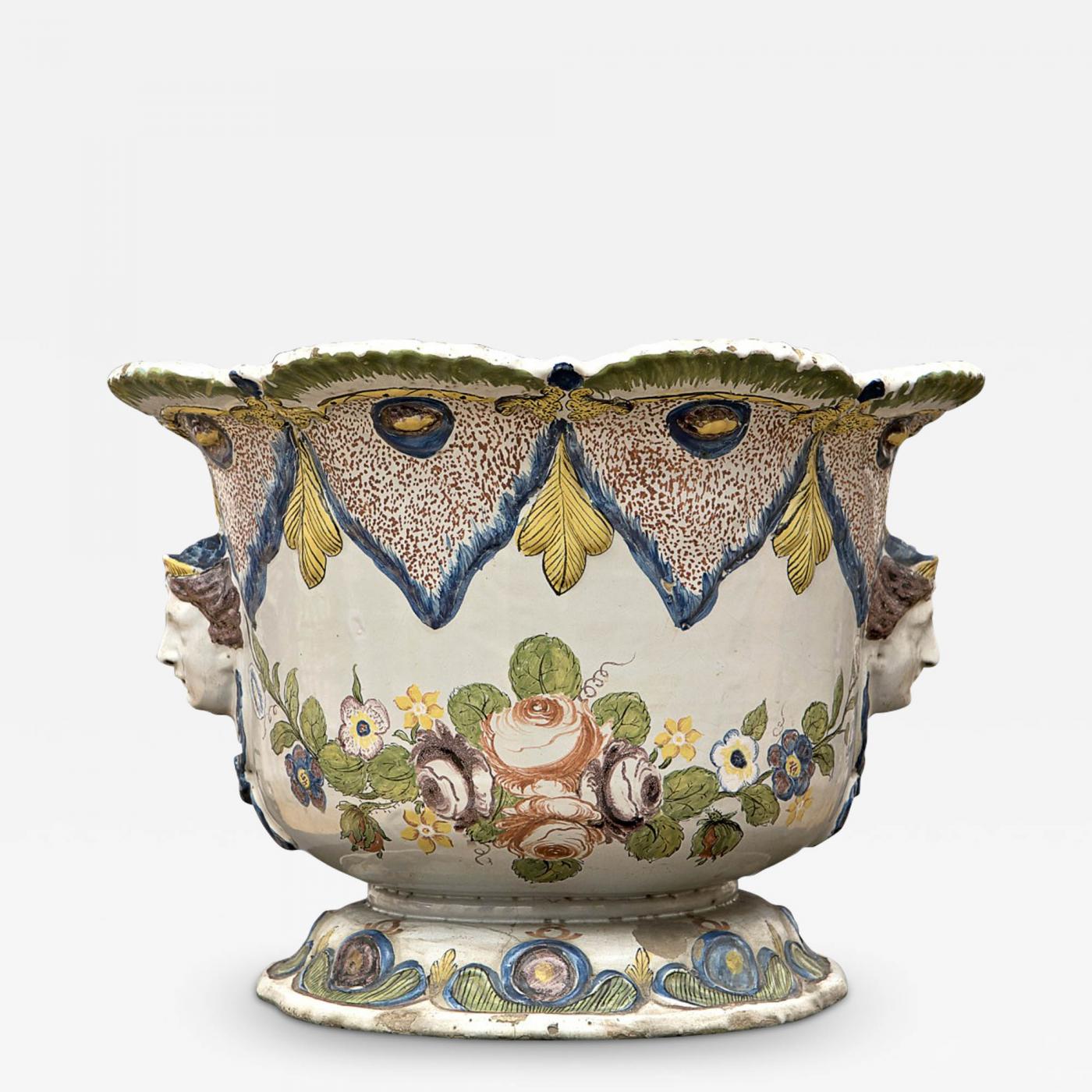
9784 A VERY RARE AND MASSIVE PAIR OF FAÏENCE JARDINIÈRES ATTRIBUTED TO PHILIPPE MOMBAERS OR JACQUES ARTOISENET Brussels. Third Quarter Of The Eighteenth Century. Measurements: Height: 15 3/4″(40 cm) Diameter: 22″ (56 cm)
Of glazed earthenware. The undulating flared crimped edge above a stipple decorated lambroquin raised pattern, the main body painted with a floral swag to each side interrupted by protruding classical female masks. The whole resting on an ogee molded base with raised repeating floral motifs.
Faïence is the French translation of Faenza, the Italian town where the tin-glazed earthenware, commonly called maiolica, was largely developed. From the 16th century these earthenware makers emigrated to France and Belgium, where new production centers were established and flourished. The first known sample of maiolica appeared in Antwerp as early as 1510,1 however it was in the 18th century that production reached its pinnacle.
In 1705, potter Cornelis Mombaers opened a factory on the Rue de Laeken in Brussels, along with a Dutch partner, Dierick Witsemburgh. Due to the War of the Spanish Succession and the resulting political climate, Mombaers’ business suffered and he was forced into bankruptcy. However, Cornelis’ son, Philippe Mombaers, was able to restore the factory in 1724. Philippe had been an apprentice to his father and went on to study in the great earthenware centers at Nevers, Rouen and Delft, experience which lent considerably to the factory’s successful reincarnation.
Philippe Mombaers was influenced by the foreign earthenware centers he visited, evidenced by the shapes, patterns and colors used in his factory. Copper-green, manganese blue and yellow are abundant among the pieces produced by Mombaers. Floral patterns remained an important motif in the Rue de Laeken productions, and throughout Brussels. These include examples in the innovative style termed décor à la draperie, ornate pieces on which painted drapery and floral motifs are combined with high relief. Created by Philippe Mombaers circa 1730-1740, the faïence manufacturers of Brussels adapted it to Louis XV and rococo styles between 1750 and 1775, however, a certain rusticity remains.2
Philippe’s son-in-law, Jacques Artoisenet, worked in Mombaers’ Rue de Laeken factory for several years, but left in 1751 to form a rival establishment. Competition from Artoisenet’s “Moriaen” factory on Rue de la Montagne caused Philippe Mombaers’ workshop to suffer greatly, as his son-in-law “had no scruples about luring workers away from Rue de Laeken or copying their patterns.”3
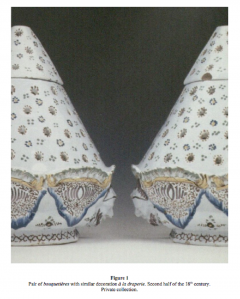
Figure 1 depicts a pair of related bouquetérie or pique-fleurs (types of jardinières) in décor de la draperie, dating from the second half of the 18th century. Both the present jardinières and the flower-holders share an undulating crimped rim with green and yellow edges from which hang brown stippled lambrequin patterns of with blue borders. Additionally, two female masks protrude from opposite sides of both the present jardinières and the bouquetéries. A further example is illustrated in a rare Brussels Philippe Mombaers faïence pique fleurs and cover from the second quarter of the 18th century sold by Christie’s Amsterdam, 15 May 2002 (figure 2).
Footnotes:
1. Pringiers, Baudhuin. Faïence Et Porcelaine De Belgique =: Faience En Porselein in België = Earthenware and Porcelain in Belgium : 1700-1881. Bruxelles: Racine, 1997. 81.
2. Lemaire, Jean, Hugo Maertens, and Sébastien Clerbois. Faïence Et Porcelaine De Bruxelles. Bruxelles: Éditions Racine, 2003. Print. 47.
3. Pringiers, 95. -
More Information
Period: 18th Century Condition: Good. Styles / Movements: Traditional Incollect Reference #: 721976 -
Dimensions
H. 15.75 in; Diam. 22 in; H. 40.01 cm; Diam. 55.88 cm;
Message from Seller:
Carlton Hobbs, LLC specializes in the acquisition, conservation, and research of 17th to 19th century British and Continental furniture and works of art, with a focus on pieces of exceptional merit, including royal and aristocratic provenance. For inquiries, contact 212.423.9000 or email stefanie@carltonhobbs.com.
More Listings from Carlton Hobbs, LLC View all 278 listings
-
9088 AN EXTRAORDINARY CARVED AND PALE GREEN PAINTED GROTTO TABLE
-
9260 A RARE PAIR OF MAHOGANY AND GILT-BRONZE MOUNTED SECRETAIRE
-
11297 A REMARKABLE BOIS DE FER VENEERED SINGLE DOOR CABINET
-
9825 A LARGE GILTWOOD AND BLUE PAINTED NEOCLASSICAL LAYETTE
-
9517 A FINE GEORGE III MAHOGANY & EBONY INLAID CHIPPENDALE PERIOD PEDESTAL DESK
-
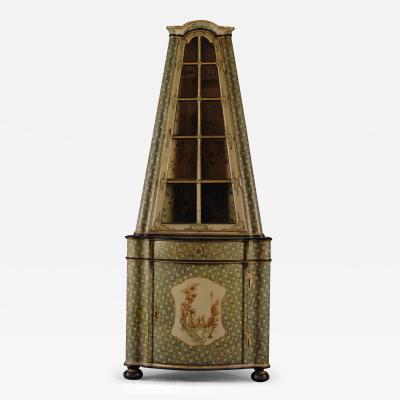
9124 A ROYAL PAINTED CORNER CABINET ATTRIBUTED TO JOSEPHUS MOY
-
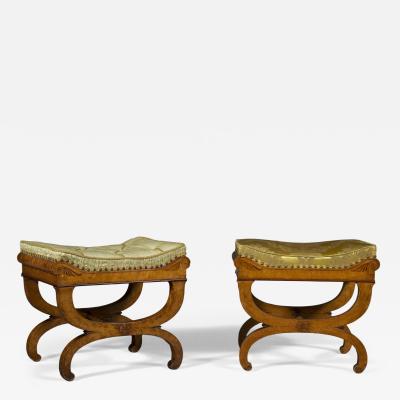
A Charming pair of birds eye maple and amaranth inlaid X-form stools
-
9266 A FINE PAIR OF WHITE PAINTED & SILVER GILT CONSOLE TABLES

-
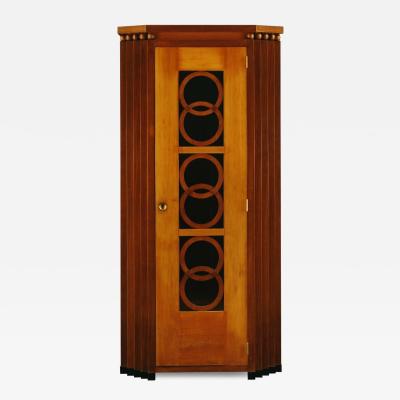
9435 AN INTERESTING MAHOGANY AND CHERRY WOOD SECESSIONIST PERIOD VITRINE
-
9079 A LATE BAROQUE CARVED AND MARBLEIZED SIDE TABLE

-
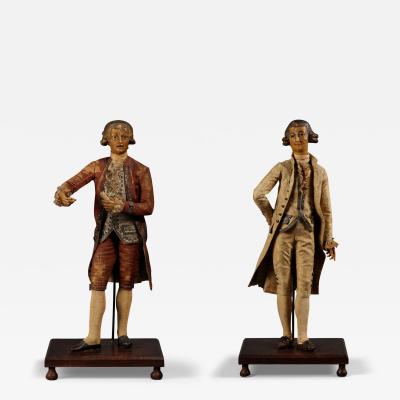
9915 AN EXTREMELY RARE PAIR OF WAX SCULPTURES OF GENTLEMEN
-
A good late-Baroque period geometric table top composed of fine marble specimens
-
9040 A MAGNIFICENT REGENCY GILTWOOD CONSOLE TABLE
-
8003 TABLE À GIBIER French

