









Showrooms
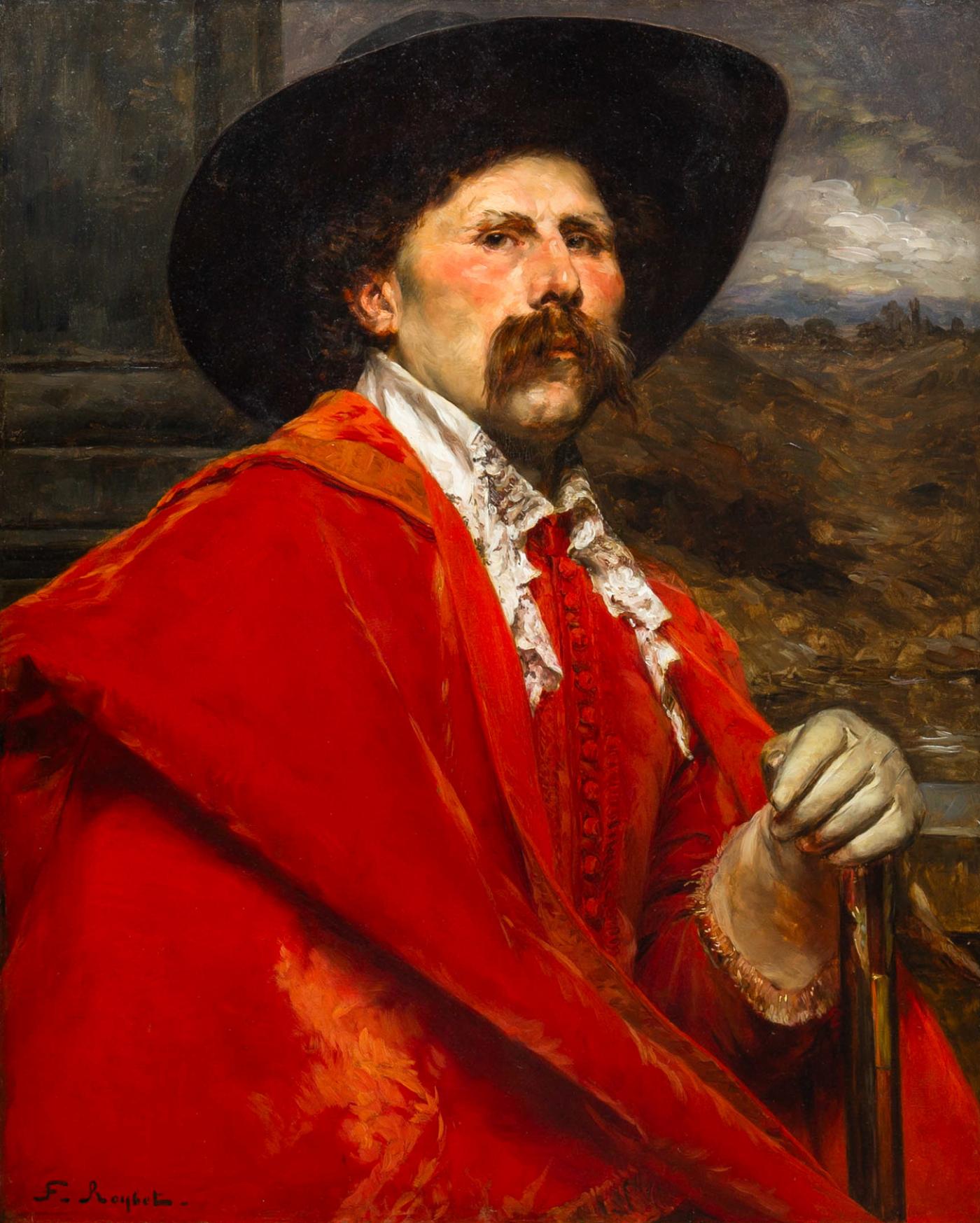
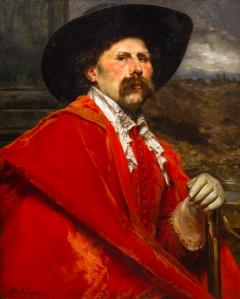
"The Man in the Red Coat" | Ferdinand Léon Roybet
-
Description
FERDINAND VICTOR LÉON ROYBET
French, 1840-1920
"L'homme au manteau rouge" (The Man in the Red Coat)
Oil on cradled wooden panel | panel numbered and labeled "15903" | signed lower left "F. Roybet" | executed circa 1900
Provenance: formerly with Christie's, New York (02 Feburary 2011, lot 158), property of a Private Collector
40 3/8" H x 34" W x 2 1/2" D [frame]
32 1/8" H x 25 3/8" W [panel]
A richly executed character study depicting a 17th-century musketeer, shown in three-quarter view with a direct, unflinching gaze. Dressed in a crimson velvet cloak and broad-brimmed black hat, the figure rests one hand on a cane and wears a white lace collar rendered in precise detail. Typical of Roybet’s mature work, the composition emphasizes the theatricality of costume, the intensity of expression and a total command of color and texture.
This painting was offered with Christie's, New York (09 February 2011, lot 158, estimate $ 5,000-7,000) where it was bought-in. While the present painting is undated, a relatively similar figure and pose was featured in L’Illustration in Paris in 1905 (see attached image). Red cloaked cavaliers feature prominently in Roybet's ouevre, suggesting this high chroma dramatic color scheme was popular with his clients.
Housed in a very fine and probably original giltwood frame.
Condition: Professionally conserved, sealed in a new traditional Dammar varnish. Panel in very good condition: no bowing or splits. Paint layer is in excellent condition with inpainted small loss in right background and around edges where frame rubs. Under UV examination: subtle flaring around edges and right background where inpainting was completed (perhaps 3% of surface), red overcoat does not flare because the conservator chose not to remove the old varnish on the coat. A vibrant and clear surface, excellent condition. Ready to place.
ref. 412EAK09C
Ferdinand Roybet (French, 1840–1920)
Ferdinand Victor Léon Roybet was a French painter, draftsman, and printmaker known for his richly detailed historical genre scenes and portraits, often depicting 16th- and 17th-century figures in elaborate costume. His work is distinguished by its dramatic use of color, technical precision, and deep engagement with historical material culture. Roybet’s paintings frequently evoke the influence of Old Masters such as Velázquez and Frans Hals, both of whom he studied closely.
Born in Uzès, in the Gard department of southern France on April 12, 1840, Roybet moved with his family to Lyon in childhood. He received formal artistic training at the École des Beaux-Arts de Lyon, where he studied drawing under Joseph Vibert. During this period, he befriended the realist painter Antoine Vollon, who would later help him establish himself in Paris. After relocating to the capital in the early 1860s, Roybet continued his studies under Jean-Georges Vibert and copied paintings at the Louvre, gradually refining his distinctive style.
Roybet debuted at the Paris Salon in 1865. The following year, his painting Le bouffon du roi Henri III (The Jester of Henry III) was awarded a medal and purchased by Princess Mathilde Bonaparte for 5,000 francs—an event that secured his early reputation. He became known for portraying musketeers, cavaliers, and finely dressed courtiers, typically set in imagined 17th- and 18th-century interiors. His command of texture, particularly in rendering silk, velvet, and metallic threads, was widely admired.
In the 1870s, Roybet undertook study trips to Belgium, the Netherlands, and North Africa. In the Netherlands, he engaged deeply with the works of Hals, Rembrandt, Rubens, and Jordaens. In Algeria, he produced numerous ink drawings, gaining some recognition as an orientalist, though this remained a minor theme in his work. By the mid-1870s, he had returned to Paris and continued to build a successful career, eventually purchasing a grand residence at 9 rue de Prony in the 17th arrondissement.
Roybet exhibited regularly at the Salon and participated in international expositions in Berlin, Vienna, and Antwerp. He was awarded the Médaille de la Maison at several of these events. In 1893 he was named a Chevalier of the Légion d’Honneur, and in 1900 was promoted to Officier. That same year, American industrialist Cornelius Vanderbilt purchased one of his paintings for 100,000 francs at the Palais de l’Industrie—an unusually high price for the time and a testament to Roybet’s transatlantic appeal.
Though best known for costumed historical subjects, Roybet also maintained a successful portrait practice, particularly among the French and American bourgeoisie. Many of these sitters are depicted in period dress, aligning with his broader theatrical and historicist approach. His later work, produced in the final decades of his life, often emphasized single-figure compositions and religious themes, including a monumental altarpiece cycle representing the Passion of Christ.
Roybet died in Paris on April 10, 1920. In 1927, his former pupil and collector Consuelo Fould established the Musée Roybet Fould in Courbevoie, near Paris, in a building originally designed for the 1878 Exposition Universelle. The museum remains one of the primary repositories of his work. Paintings by Roybet are also held in numerous public collections, including the Musée d’Orsay, the Petit Palais, the Hermitage Museum, and institutions across the United States. -
More Information
Documentation: Signed Period: 1900-1919 Styles / Movements: Other Dealer Reference #: 412EAK09C Incollect Reference #: 841550 -
Dimensions
W. 34 in; H. 40.375 in; D. 2.5 in; W. 86.36 cm; H. 102.55 cm; D. 6.35 cm;
Message from Seller:
Silla, Ltd. is a family-owned antique gallery located at 117 W Burd St., Shippensburg, PA 17257, specializing in 19th and early 20th century bronze sculptures and unique period furniture. For more information or to schedule a visit, contact us at sales@sillafineantiques.com or call 717.708.9017.
More Listings from SILLA View all 372 listings
-
Pair of Louis XVI Style Lamps | Entwined Snake Handles

-
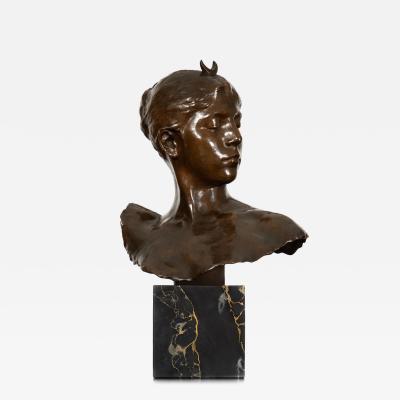
French Antique Bronze Sculpture Bust of Diana by Falguiere ca. 1880
-
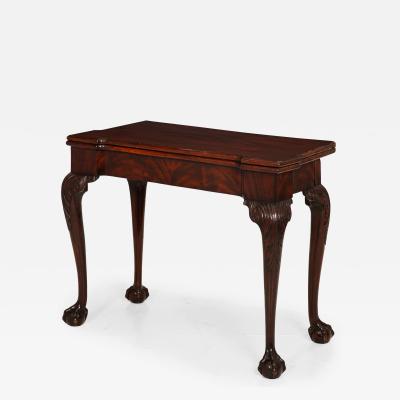
English George III Mahogany Gate Leg Card Game Table circa 1770
-
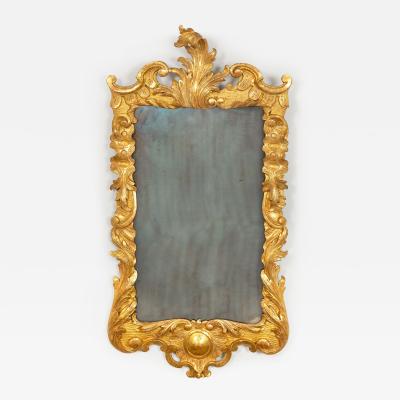
Fine George II Carved Giltwood Wall Mirror, English or Scottish circa 1750
-
Set of Six Mid Century Modern “CH66" Dining Chairs by Nicos Zographos

-
Pair of Mid Century Modern “CH66" Dining Chairs by Nicos Zographos

-
Pair of Bronze and Black Granite Demilune Console Tables, Manner of Jansen

-
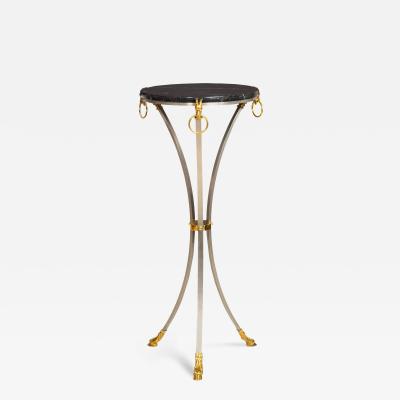
Hollywood Regency Steel Marble Top Pedestal Plant Stand Gueridon Table
-
Mid Century Modern “CH66" Dining Chair by Nicos Zographos

-
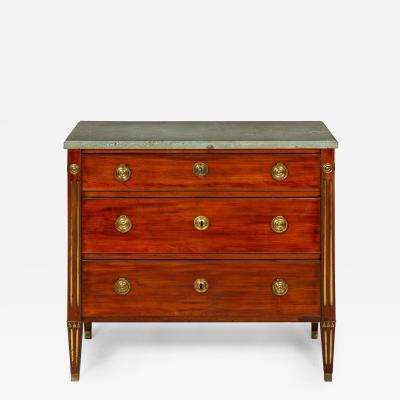
Circa 1790 Swedish Gustavian Marble Top Mahogany Desk Commode Chest
-
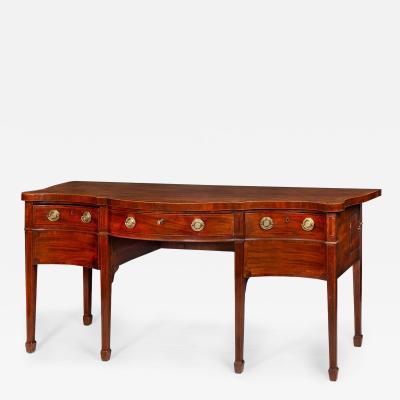
George III Period Inlaid Mahogany Serpentine Sideboard, English ca. 1790
-
Set of 4 Mid Century Modern “CH66" Dining Chairs by Nicos Zographos

-
Baltic Neoclassical Mahogany, Brass & Leather Writing Desk, late 19th century

-
American Chippendale Carved Tilt-Top Ball and Claw Tea Table ca. 1770