




Listings / Fine Art / Paintings / Still Life

Offered by:
Thomsen Gallery
8 East 67th Street
New York City, NY 10065 , United States
Call Seller
212.288.2588
Showrooms
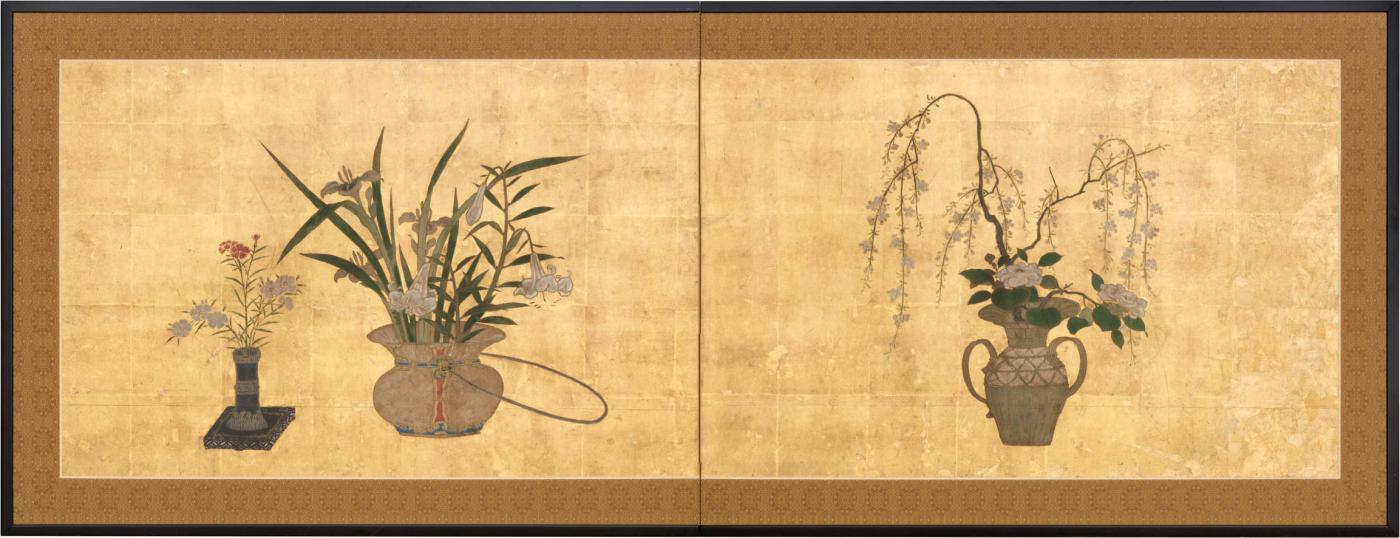
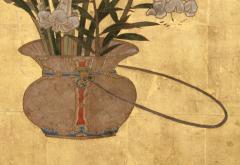
Ikebana Baskets and Flowers, 18th century
-
Description
Ikebana Baskets and Flowers, 18th century
Two-panel folding screen; ink and mineral colors on paper with gold leaf
Size 26¼ x 68½ in. (67 x 174 cm)
T-4574
The Japanese custom of recording flowers and containers—particularly in connection with chanoyu (the “Tea Ceremony”)—can be traced back to the late fifteenth century, when either Noami or Soami, cultural advisors to the shogun Ashikaga Yoshimasa (1436–1490), compiled a work entitled Kundaikan sochoki that documented the decoration of his formal reception rooms, describing, appraising, and illustrating his prized Chinese possessions including a few flower vases and arrangements. In 1499 the Ikenobo, Japan’s oldest school of floral art, produced a scroll entitled Kao irai no kadensho, the first of many that document exemplary flower arrangements with colored illustrations and copious annotations.
These flower-arrangements “portraits” later became a popular subject for painting, mostly produced in professional ateliers in the city of Kyoto. The present low screen, likely intended to be used during chanoyu, is more decorative than educational in intent and shows arrangements intended for three seasons of the year. By the eighteenth century most of the vessels used, especially in the formal style seen here, would still have been of Chinese manufacture, although Japanese copies were beginning to be made.
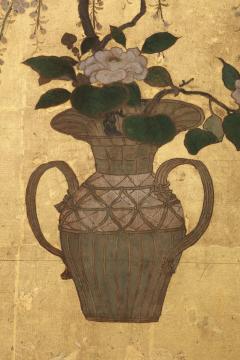
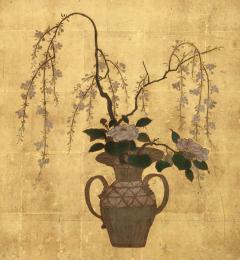
The painting is precise enough for some of the plaiting techniques used in the manufacture of the baskets to be identified. The sides of the basket at the right are largely executed (using Japanese terminology) in ajiro-ami (twill weaving), in which strips of bamboo of one direction “float” over two or more strips of the other direction, creating a V-shaped pattern; the ajiro-ami is overlaid with widely spaced verticals, probably plaited into the structure of the base, connecting at the top to a lattice-like framework that covers the shoulder of the basket. The shoulder and possibly also the neck appear to be done in versions of masu ajiro-ami, “box” twill plaiting, while the handles are of bent bamboo secured with ties of bamboo or perhaps rattan.
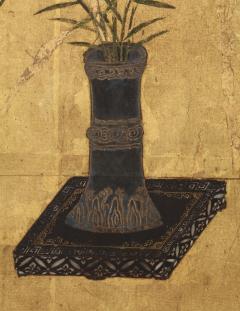
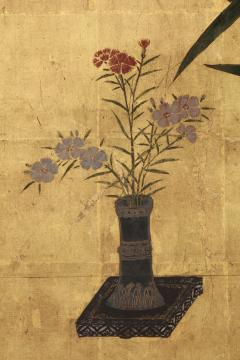
The basket on the left-hand panel seems at first glance to have sides executed in yotsume-ami square plaiting, in this case bundling ten or twelve bamboo strips at a time, while the mouth is, again, in ajiro-ami. However, the colored components around the base and neck and on the side might be made from shippō, cloisonné enamels, suggesting that the whole “basket” may not be bamboo at all but a cast bronze vessel imitating bamboo and with passages of enamel decoration. The vessel at left is more straightforwardly bronze, possibly Chinese of about the twelfth to fourteenth century, or perhaps a later Japanese imitation from around the beginning of the Edo period (1615–1868). It rests on a shell-inlaid lacquer tray, also Chinese or possibly from the Ryūkyū Islands (present-day Okinawa Prefecture).
The flowers may be identified as follows, in seasonal sequence from right to left: the spring arrangement at the right is of a variety of tsubaki (camellia), perhaps tōtsubaki (Camellia reticulata) combined with shidarezakura (weeping cherry); the early-summer arrangement at the left pairs oniyuri (tiger lily) and kakitsubata (iris); and the early-autumn arrangement in the (likely) Chinese bronze vase is of nadeshiko (fringed pinks). -
More Information
Period: 18th Century Styles / Movements: Asian Art Incollect Reference #: 783887 -
Dimensions
W. 68.5 in; H. 26.38 in; W. 174 cm; H. 67 cm;
Message from Seller:
Thomsen Gallery, now located at 8 East 67th Street, New York City, NY 10065, specializes in important Japanese paintings, folding screens, hanging scrolls, ceramics, ikebana bamboo baskets, lacquerware, and contemporary works by select artists. Owned and directed by Erik and Cornelia Thomsen, the gallery brings decades of expertise in Japanese art to a global clientele, including private collectors and major museums. For inquiries, contact them at 212-288-2588 or info@thomsengallery.com.
More Listings from Thomsen Gallery View all 204 listings
-
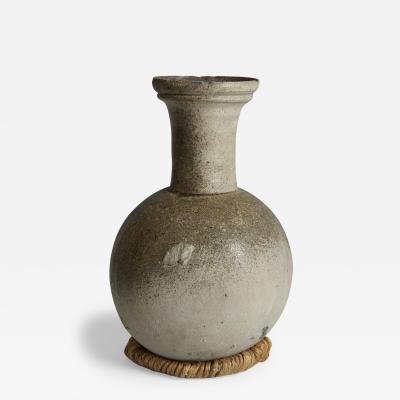
Sue-Ware Flask
-
Nishimura Seiki 西村青歸 Mountain Stream in Spring and Fall , 1917

-
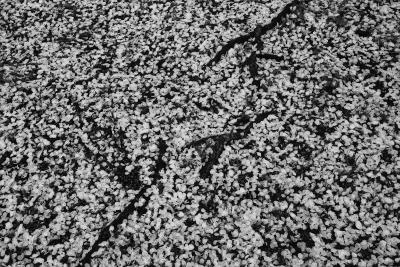
Mizu 42 (Water 42), 2012
-
Mizu 44 (Water 44), 2012
-
Silver Tea Kettle, ca 1920
-
Bamboo, 1980s
-
Places Along the Tokaido, ca 1620
-
Collie and Myna Bird (In a Peaceful Garden, The First Signs of Autumn), 1926
-
Kanji (Characters), 1951
-
Double Golden Triangle Series
-
Kobayashi Gokyō Pine Trees, 1910s–20s

-
Double Golden Triangle Series
-
Writing Box with Phoenix, 1910s-20s
-
Pine in Rain (T-3814)