







Martin Johnson Heade
American, 1819 - 1904
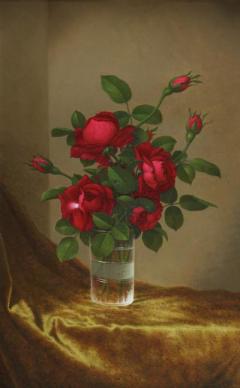
Martin Johnson Heade was born in 1819. He studied art with Edward and Thomas Hicks c.1838. Heade was a great luminist painter of the 19th century. He focused on four basic themes; atmospheric landscapes of marsh and shore, tropical hummingbirds in vivid color, floral still lifes and portraits, to a lesser extent. From 1841-83, Heade moved around extensively and in 1863 took his first of several trips to Brazil, Nicaragua and Jamaica. These trips were to prepare Heade to illustrate a book birds but publishers rejected it. Eventually he settled in St. Augustine, FL. Heade was primarily a portrait painter until the age of 40. Heade later became intent on conveying mood rather than realistic representation using distorted perspectives. He died in 1904. Biography courtesy of The Caldwell Gallery, www.antiquesandfineart.com/caldwell
Martin Johnson Heade Paintings
Martin Johnson Heade Paintings
Martin Johnson Heade's career was longer and more varied than that of most American artists. He began as a portraitist but switched in mid-career to landscape painting. Heade was born in rural Pennsylvania in 1819 and first studied portrait painting under Quaker painters Edward and Thomas Hicks. While in his twenties, Heade refined his skills as a professional portrait artist. His occasional landscapes were roughly imitative of the then-popular Hudson River School style.
Heade, an incessant traveler throughout his life, spent two years in Italy and visited France and England in the 1840s. Over the next 15 years, he lived in several American cities, still working primarily as a portrait painter. By age 40, he had not yet produced a work of enduring artistic merit. Heade's turning point came in the late 1850s, when he moved to New York City. He gave up portrait painting and focused instead on landscapes and shore scenes, topographically inspired by the salt marshes around the Narragansett Bay region of Rhode Island. His later landscapes-and the still lifes he painted near the end of his career-are lush and rich in color, reflecting his luminist style.
As exemplified by his Approaching Storm: Beach Near Newport (1860, Museum of Fine Arts, Boston), Heade's luminist landscapes are eerie and compelling. Intent primarily on conveying mood, Heade sacrificed realistic representation, while elongating form, distorting perspective and exaggerating color contrast. More than 100 of his seascapes and marsh paintings survive.
Heade had an avowed lifelong obsession with hummingbirds. In 1863, he made the first of three trips to South America. He first went to Brazil to prepare illustrations for a book on hummingbirds. When the book project was ultimately rejected by a London publisher, Heade began a series of paintings in the 1870s which dramatically combined orchids and hummingbirds in lush tropical settings. The combination of the tiny birds and the large overwhelming flowers in these paintings was unprecedented. The pictures were startling-not just because of the uniqueness of subject and intensity of color, but also because of the underlying sensual evocativeness of the flowers. Two Fighting Hummingbirds with Two Orchids (1875, location unknown) is one of the best examples of this period.
Heade finally settled in St. Augustine, Florida, about 19 years before his death there in 1904. He continued to paint seascapes and birds. He also painted a number of still lifes, frequently incorporating flowers, more for evocative effect than for decorative addition.
Public Collections:
Metropolitan Museum of Art, New York City
Museum of Fine Arts, Boston
Biography courtesy of Roughton Galleries, www.antiquesandfineart.com/roughton
Heade, an incessant traveler throughout his life, spent two years in Italy and visited France and England in the 1840s. Over the next 15 years, he lived in several American cities, still working primarily as a portrait painter. By age 40, he had not yet produced a work of enduring artistic merit. Heade's turning point came in the late 1850s, when he moved to New York City. He gave up portrait painting and focused instead on landscapes and shore scenes, topographically inspired by the salt marshes around the Narragansett Bay region of Rhode Island. His later landscapes-and the still lifes he painted near the end of his career-are lush and rich in color, reflecting his luminist style.
As exemplified by his Approaching Storm: Beach Near Newport (1860, Museum of Fine Arts, Boston), Heade's luminist landscapes are eerie and compelling. Intent primarily on conveying mood, Heade sacrificed realistic representation, while elongating form, distorting perspective and exaggerating color contrast. More than 100 of his seascapes and marsh paintings survive.
Heade had an avowed lifelong obsession with hummingbirds. In 1863, he made the first of three trips to South America. He first went to Brazil to prepare illustrations for a book on hummingbirds. When the book project was ultimately rejected by a London publisher, Heade began a series of paintings in the 1870s which dramatically combined orchids and hummingbirds in lush tropical settings. The combination of the tiny birds and the large overwhelming flowers in these paintings was unprecedented. The pictures were startling-not just because of the uniqueness of subject and intensity of color, but also because of the underlying sensual evocativeness of the flowers. Two Fighting Hummingbirds with Two Orchids (1875, location unknown) is one of the best examples of this period.
Heade finally settled in St. Augustine, Florida, about 19 years before his death there in 1904. He continued to paint seascapes and birds. He also painted a number of still lifes, frequently incorporating flowers, more for evocative effect than for decorative addition.
Public Collections:
Metropolitan Museum of Art, New York City
Museum of Fine Arts, Boston
Biography courtesy of Roughton Galleries, www.antiquesandfineart.com/roughton

