


Singapore Sling: Mark Curley concocts a color-drenched tropical cocktail for living
 |
 |
Mark Curley concocts
a color-drenched
tropical cocktail for living
By Marianne Litty
Photography by MarcusL Photography
Imagine you’re an interior designer. Describe your dream clients. You might start with this scenario: a warm, vivacious, sophisticated couple with international backgrounds and residences in Miami, New York, and the south of France. They love living amidst a kaleidoscope of color and appreciate fine craftsmanship. Art lovers and collectors, they’re enthusiastically involved in the design process and eagerly join you on shopping expeditions to hunt for the perfect pieces. Their home is a gathering spot for friends and family, and they entertain frequently. Fun-loving, and a bit daring, they have discerning taste. You’ve developed a close relationship with them through multiple projects and truly enjoy their company. And they’ve just told you about their latest acquisition: an apartment in an ultra-luxury building in vibrant, multicultural Singapore.
 | |
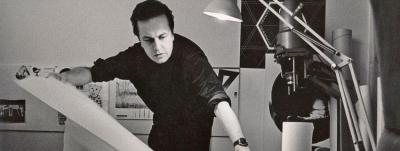
Mark Curley, Lafayette MC, photo: Adam Razak |
This is the delightful situation Mark Curley found himself in a few years ago. Curley studied architecture in his native Ireland, then moved to New York in 2002 and worked as an architect for MR Architecture + Decor, led by David Mann. There he gained the exposure that shifted his focus to interior design. “In Ireland, architecture and interior design are not combined in architecture school, and this was the first time I could truly see what the interiors process involved,” he explained. In 2015, after designing his “dream clients’” chic and colorful Miami residence, he was ready to launch his own firm, Lafayette MC. Over the years, the projects for their multiple residences deepened the mutual respect and admiration shared between the couple, their two sons, and Curley, evolving into a warm, familiar social relationship.
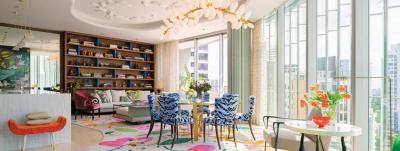
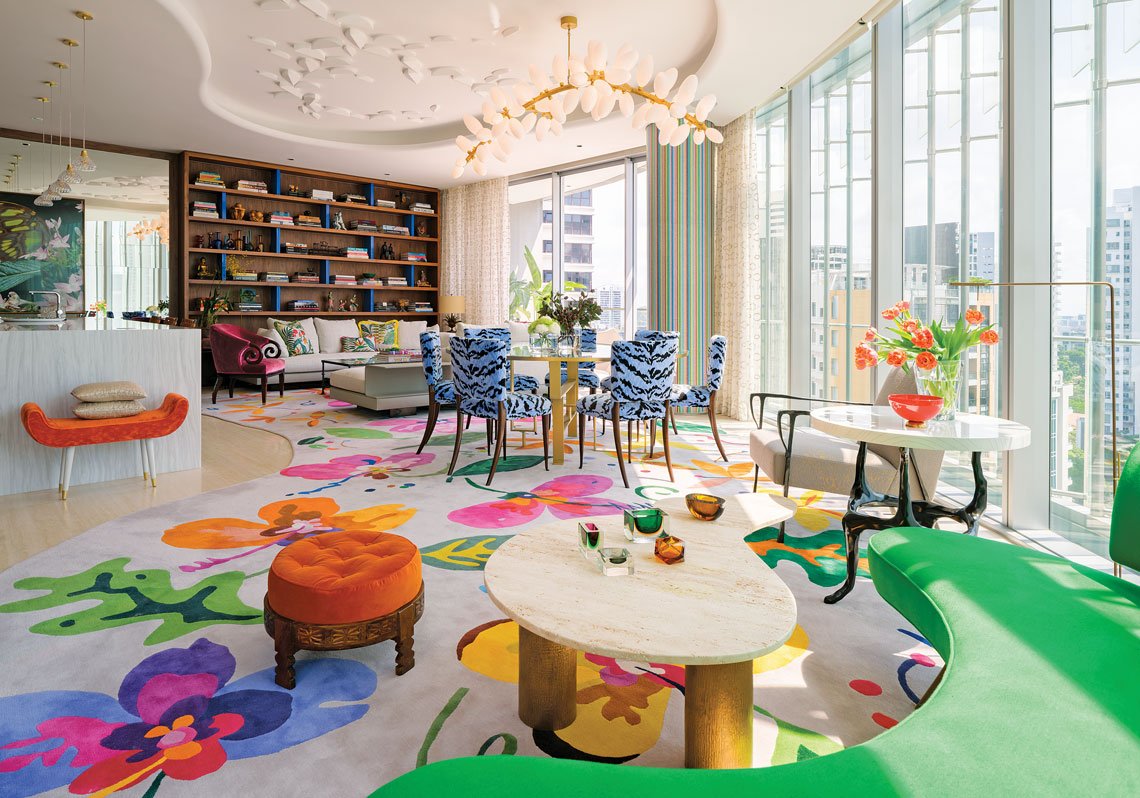
The Singapore apartment’s expansive living room is half-moon shaped, following the curved contours of the glass-walled tower. Curley drew on his skills as both architect and interior designer to bring the room to life, with each element complementing the design scheme. He gave attention to every surface, including the ceiling, for which he designed a pool-like cove detail scattered with sculpted abstract leaf shapes. Exacting precision met artistry in creating this feature; while Curley drew the shape freehand on the floor, the contractor laser-projected it onto the ceiling to preview the effect. The final template was sent to fabricators in Malaysia, where it was produced in sections and shipped back for installation. Each leaf was crafted in wood, primed with gesso for a perfectly smooth surface, painted, and placed following the laser template. This meandering leaf detail complements artisanal lighting designer Lindsey Adelman’s articulated Kingdom chandelier, which is suspended from within the recessed cove.
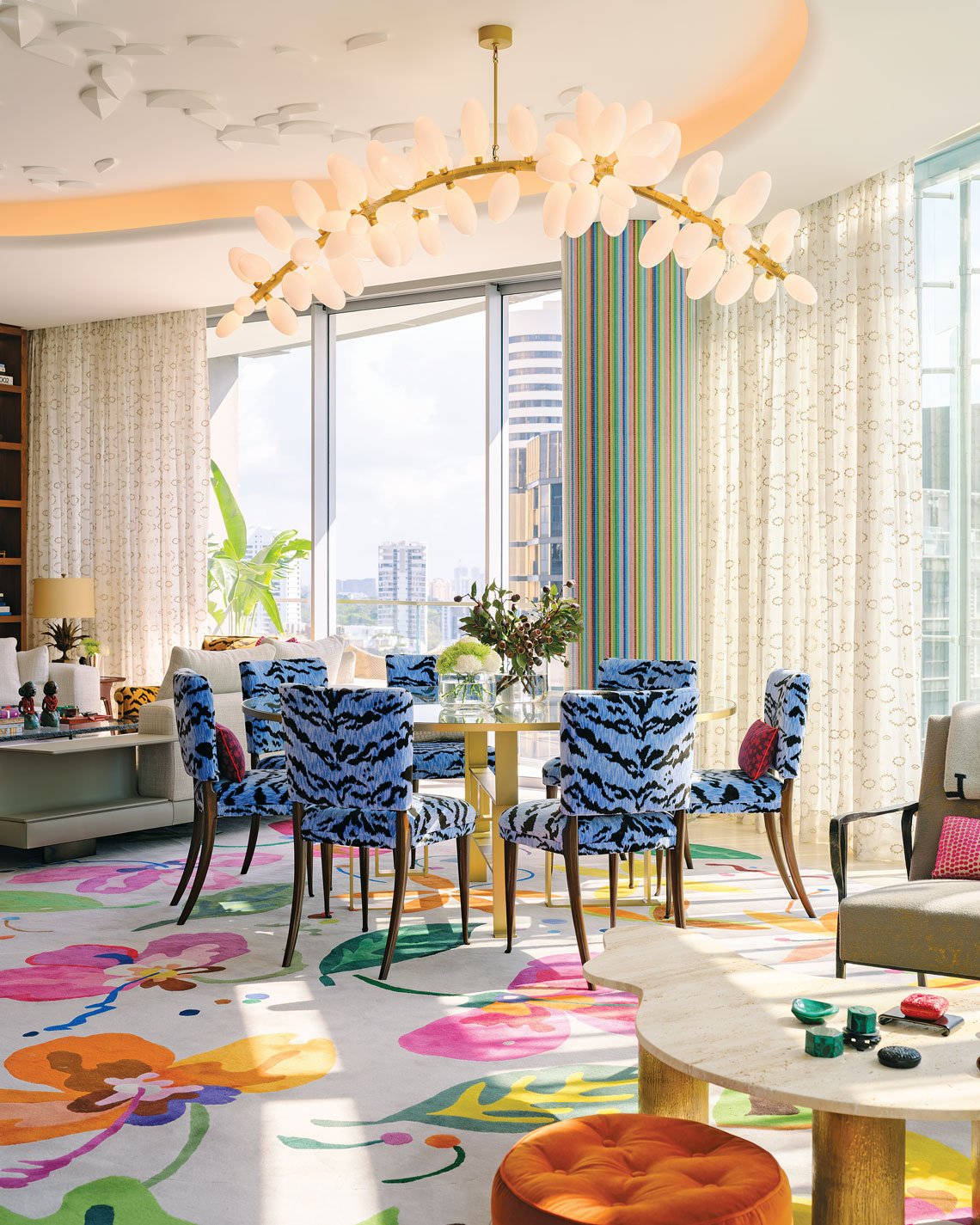 | |
The dining area, with Lindsey Adelman’s Kingdom chandelier, inspired by the cascading Burro’s Tail succulent plant. |
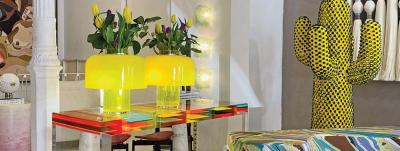
Turning a structural element into a design feature, two columns along the perimeter of the room were covered in vertical bands of Bisazza glass mosaic tiles, the color palette pulled from the bespoke rug Curley designed, which was fabricated by Mark Nelson Designs. The rug is a focal point in a room bursting with color, pattern, texture, and light. Curley hand-drew the curved, organic-shaped rug on paper, working out the placement of each flower to interact with the furniture plan. “It was months of drawings,” Curley explained, “and I selected a total of 32 colors, tested onsite with samples from the weavers in India, to see the color accurately in the light here.” With two grown sons who visit often and an active social life, the space had to serve a variety of situations, which Curley accomplished by creating multi-purpose zones for entertaining large groups, intimate gatherings, and everyday living. Two seating groups and a dining area stretch out along the curved exterior wall, with a large island counter and stools where guests can chat with the host while refreshments are offered. The counter was a bespoke creation, a year in the making. Originally all black, Curley lightened the effect by adding a layer of creamy marble and commissioned the famous Fornasetti Atelier in Milan to produce a hand-painted panel with their signature intricate malachite pattern as the background, and a school of fish in brilliant colors accented with gold and silver leaf. A row of hand-blown, hand-cut French crystal pendant lights from Saint-Louis sparkle overhead. Strategically positioned on an adjacent mirrored wall, fine art photographer Roe Ethrige’s Butterfly floats in a pool of light, catching reflections of the sky. Nearby is a large bar cabinet designed by Curley and fabricated by Naula in Brooklyn, with blue lacquered doors, bold ball feet, and vintage cabinet handles shaped like fish by mid-century Mexican Modernist designer Pepe Mendoza.
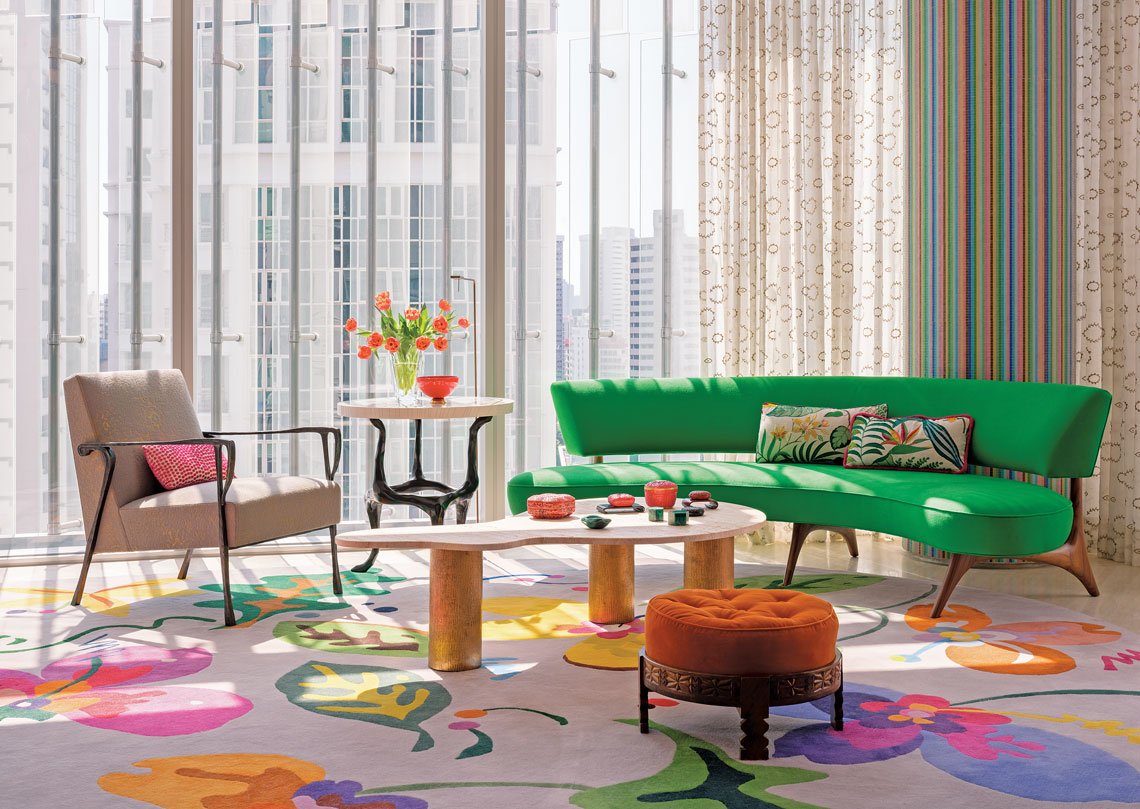 |
Curvy, organic furniture shapes complement the show-stopping custom rug, while low profiles and open forms keep the cityscape in view and allow light to flow through and under each piece. |
Curley designed the two seating groups in contrasting forms: one open, airy, and round, the other more solid and square. Placed into the curvature of the window wall, the first group is anchored by Vladimir Kagan’s Floating Curved Sofa in leafy green. Designed in 1952, it unites two of his favored elements: curves and sculptural carved wood frames. The sofa’s open design, like the other pieces in the group, lets light pour into and around the room. An organic form coffee table in travertine and hammered bronze is by Umberto Bellardi Ricci; the sinuous-legged side table is from the Alexander Lamont’s Bangkok atelier. An open armchair with a slender frame and a carved vintage stool purchased in Bali by the owners complete the composition. The dining area is crowned by the Lindsey Adelman chandelier, with a round table from Jean de Merry surrounded by custom chairs by Gregorius Pineo, upholstered in exotic light blue tiger-stripe Bevilaqua cut velvet from Fortuny Venice. The second seating area is a comfortable, loungey arrangement with a pair of large Minotti sofas, two armchairs, and a sizeable coffee table, backdropped by a set of shelves in walnut accented with dividers in vividly saturated blue. The dividers are the special touch Curley devised, making this custom piece uniquely perfect for the setting. Continuing the play of contrast, two neutral-colored sofas are accented with chairs in vivid colors and contrasting forms: a curvy wood-frame armchair with extravagantly scrolled arms covered in saturated fuchsia, and a squarish lounge chair in an orange tiger-stripe pattern embellished with fluffy black brush fringe trim.
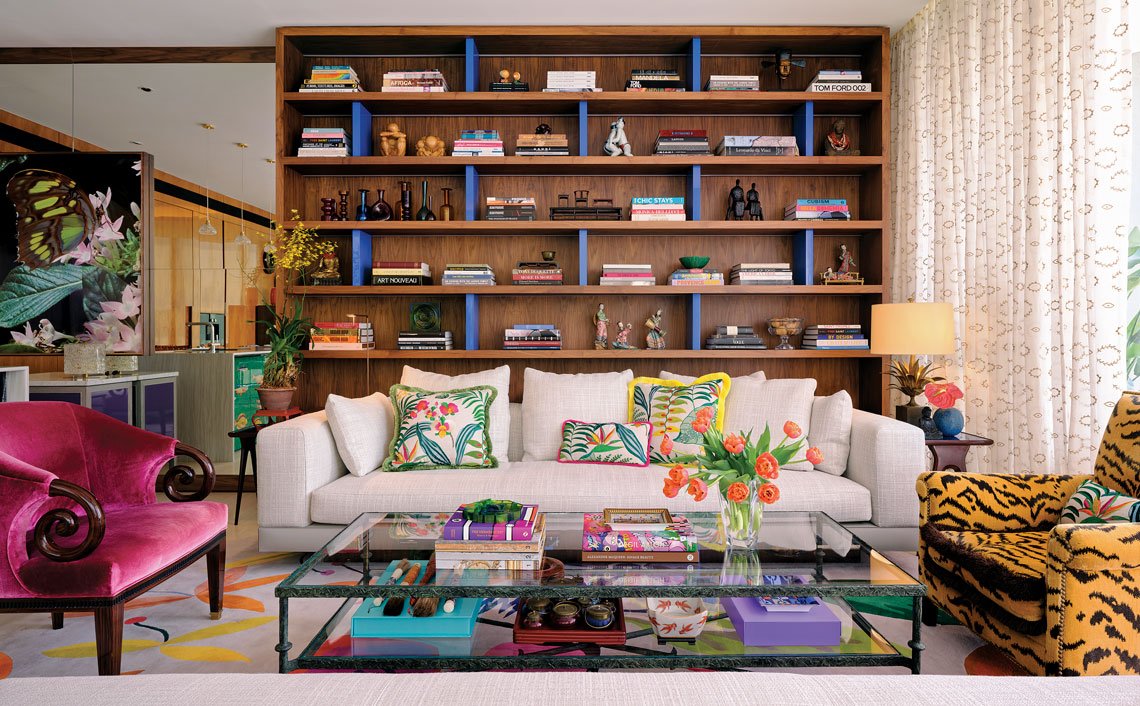 |
A second conversation group with a custom shelf unit displaying books and treasures collected through years of frequent international travel. |
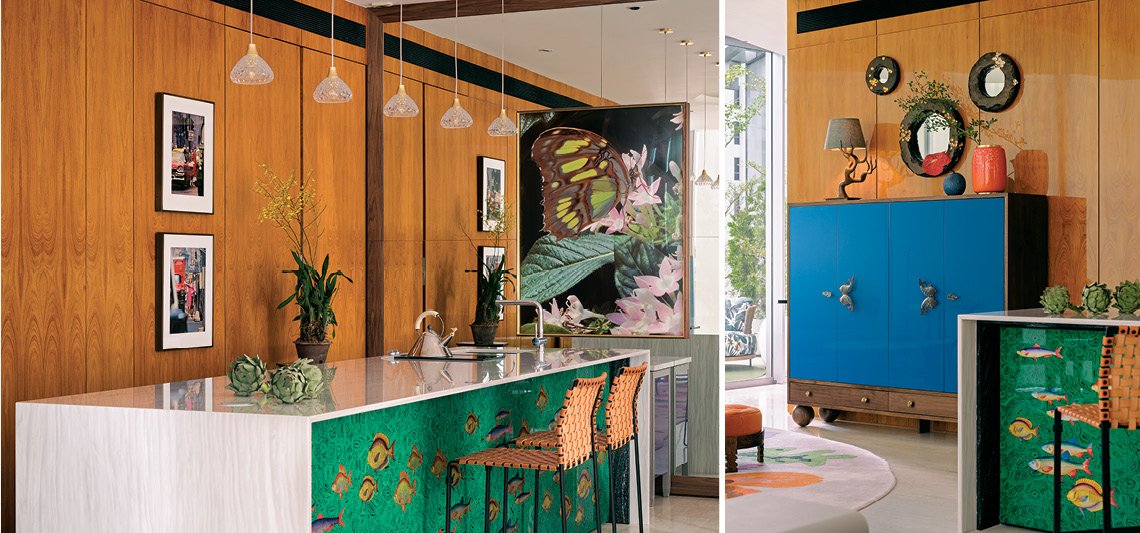 |
| Left: Behind the island counter, a pair of photographs by William Klein for Vogue magazine, taken on New York City streets in the late 1950s and early 1960s. The butterfly image is by photographer Roe Etheridge. The island front panel was commissioned from the Fornasetti Atelier in Milan and depicts their iconic malachite pattern with a colorful school of fish. Right: A custom bar cabinet designed by Mark Curley, with vintage Pepe Mendoza fish-shaped door pulls. |
The compact kitchen is outfitted with plenty of storage; cabinets, drawers, and shelves line the walls. Curley optimized capacity by adding more cabinets and counters and hanging glass shelves from the ceiling to display a collection of teapots. Making and serving tea is an important part of Singapore culture, stemming from both native Chinese and colonial British influences. Even this functional space is memorable, with showy Bisazza glass mosaic tiles on the walls, a mirrored backsplash to expand the sense of space, and vintage 1960s Italian textured-glass sconces.
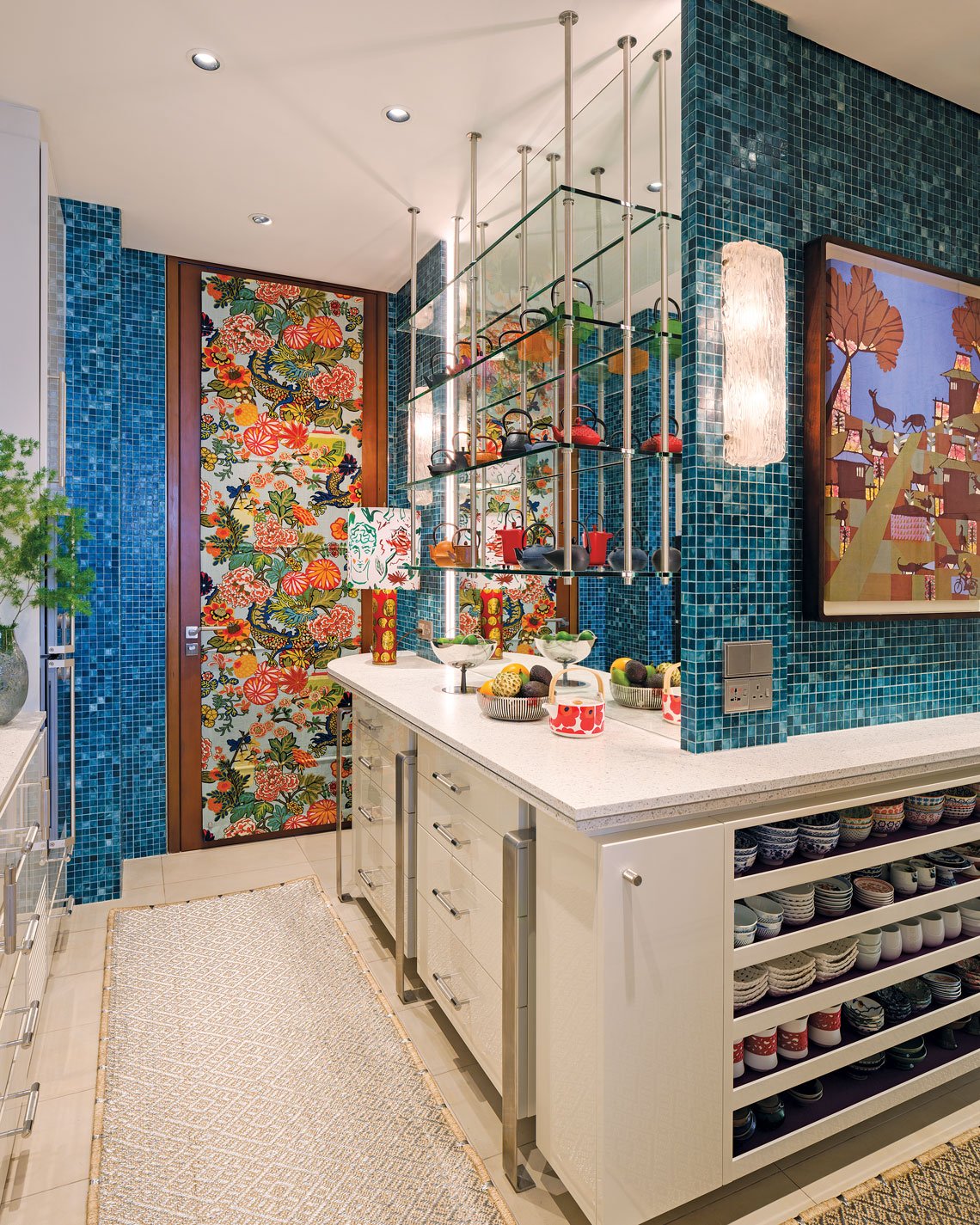 | 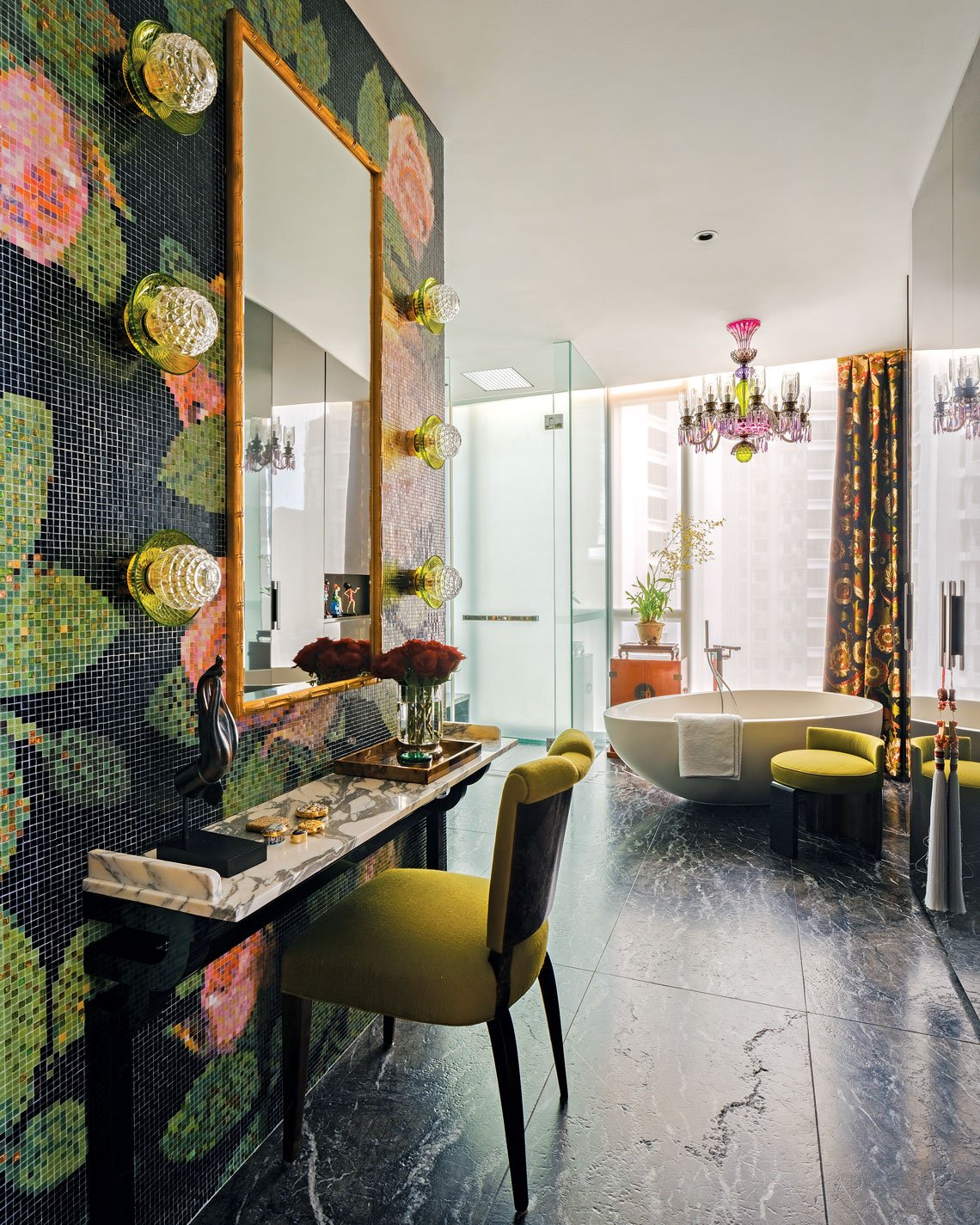 | |
Left: A glamorous yet functional kitchen, with a vintage lamp by Fornasetti. Right: The primary bath with Bisazza Springrose Nero glass mosaic tile and a custom vanity with marble top. | ||
 | |
Vintage pieces in the primary bedroom: You Stole my Heart mirror in torched bronze and mirrored glass by Philip and Kelvin LaVerne, circa 1960; James Mont 1950s silver leaf table lamp with gilded goddess and a custom Fortuny fabric shade. |
A curved hallway leads from the foyer to the private spaces, with walls covered in hand-painted scenic wallpaper by Gracie in a tropical design with palm trees, lush foliage, and a view of distant islands across serene waters. The custom rug is also curved to follow the shape; a school of fish swims along, creating a sense of fluid motion. A pair of antique Chinese ancestor portraits adorns a wall in the hallway, installed in accordance with specific traditional rules for displaying such venerated images. Curley said, “It was very important to get this exactly right, because they are culturally very important in Singapore and must be treated with great respect.” The effect is palpable; they radiate dignity, history, and sense of place.
Down the hallway, an office does double duty as a lounge, with a built-in desk, drawers, and bookshelves in walnut, all custom fabricated, as was the sofa, designed to nestle perfectly along the full length of the wall. On the walls around the sofa, the collection of vintage fashion photographs is by famed Harper’s Bazaar photographer Lillian Bassman. Bassman, along with Richard Avedon and Irving Penn, blurred the lines between fine art and commercial photography. These rare prints were the last she processed before she died in 2012.
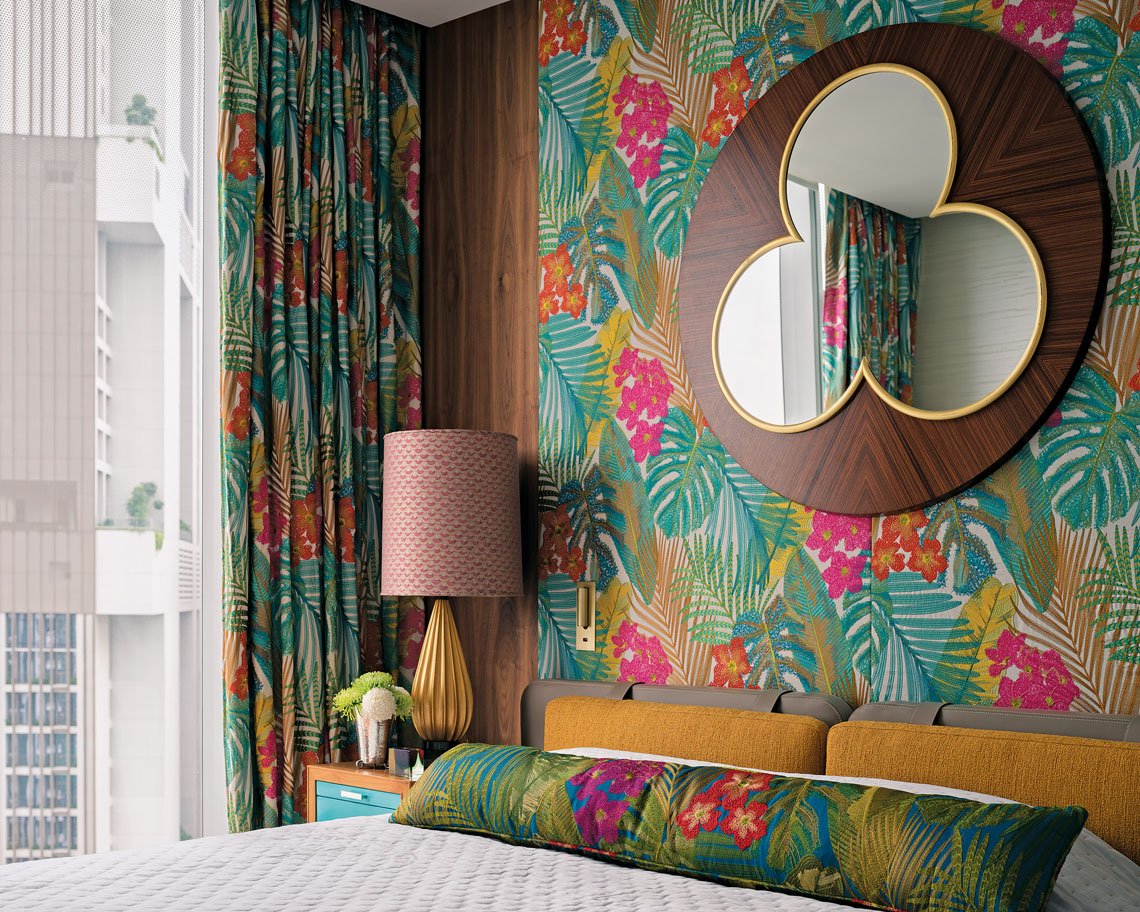 | 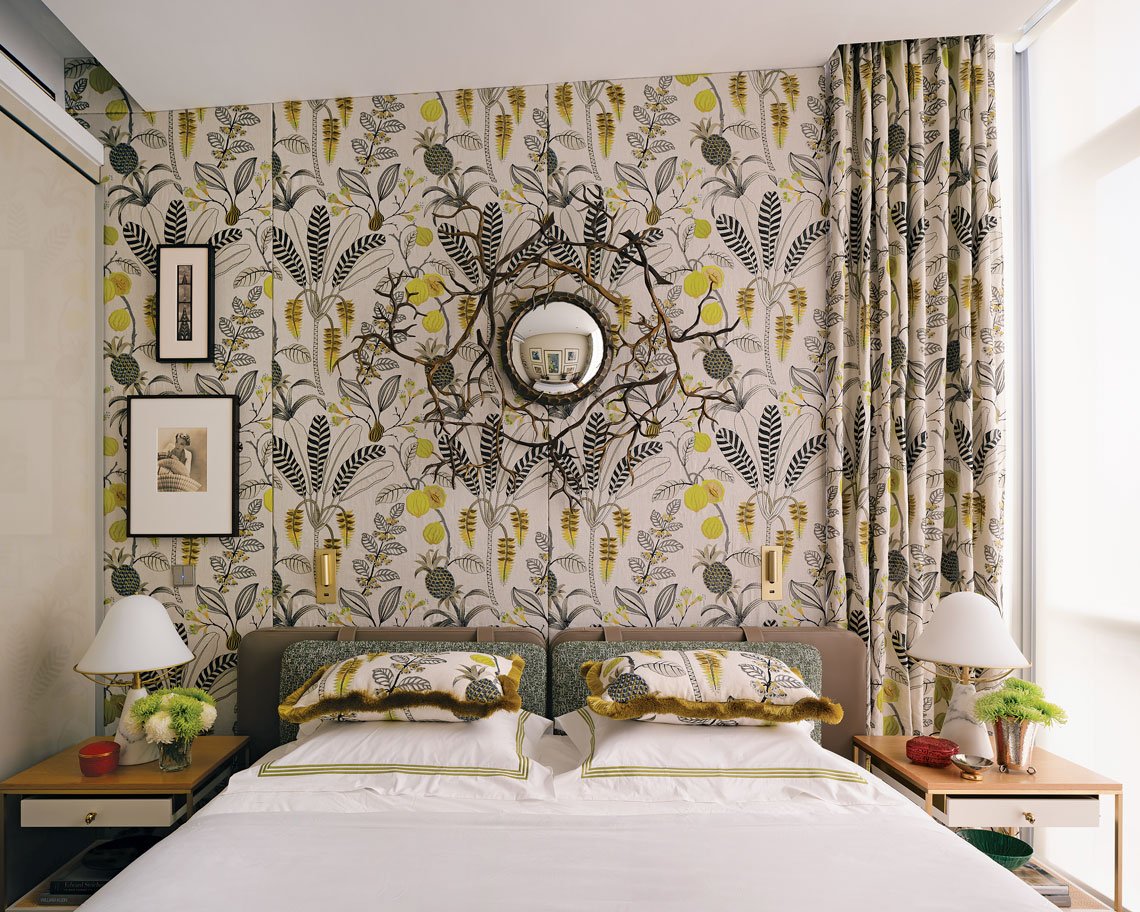 | |
Left: Gilt and rosewood limited edition cloverleaf mirror by French master ébéniste Jean-Bérenger de Nattes. Wall panel, curtains and bolster pillow in Jim Thompson Moorea embroidered fabric. Right: Hervé Van der Straeten’s Branches mirror becomes one with the exotic blooms of Daiquiri embroidered linen by Nobilis. Vintage 1960s nightstands were sourced from The Gallery at 200 Lex, powered by Incollect. | ||
There are three bedrooms, each decorated with custom and vintage furnishings, luxe textiles and fine rugs, and custom wall treatments. The primary bedroom has a custom walnut bedframe with upholstered panels in a Dedar fabric. Custom hand-embroidered linens by E. Braun & Co., New York dress the Minotti bed. The heart mirror above the bed is vintage 1960s by Philip and Kelvin LaVerne, sourced from Incollect dealer Donzella LTD, whose gallery is at the New York Design Center. Curley designed the pink leather and walnut nightstands, handmade by Naula in New York, along with a matching kidney-shaped dressing table. On the nightstand sits a vintage 1950s lamp in silver leaf with a gilded goddess figure by the flamboyant designer James Mont, sourced from The Gallery at 200 Lex, powered by Incollect. Mont frequently incorporated Asian themes in his exotic designs.
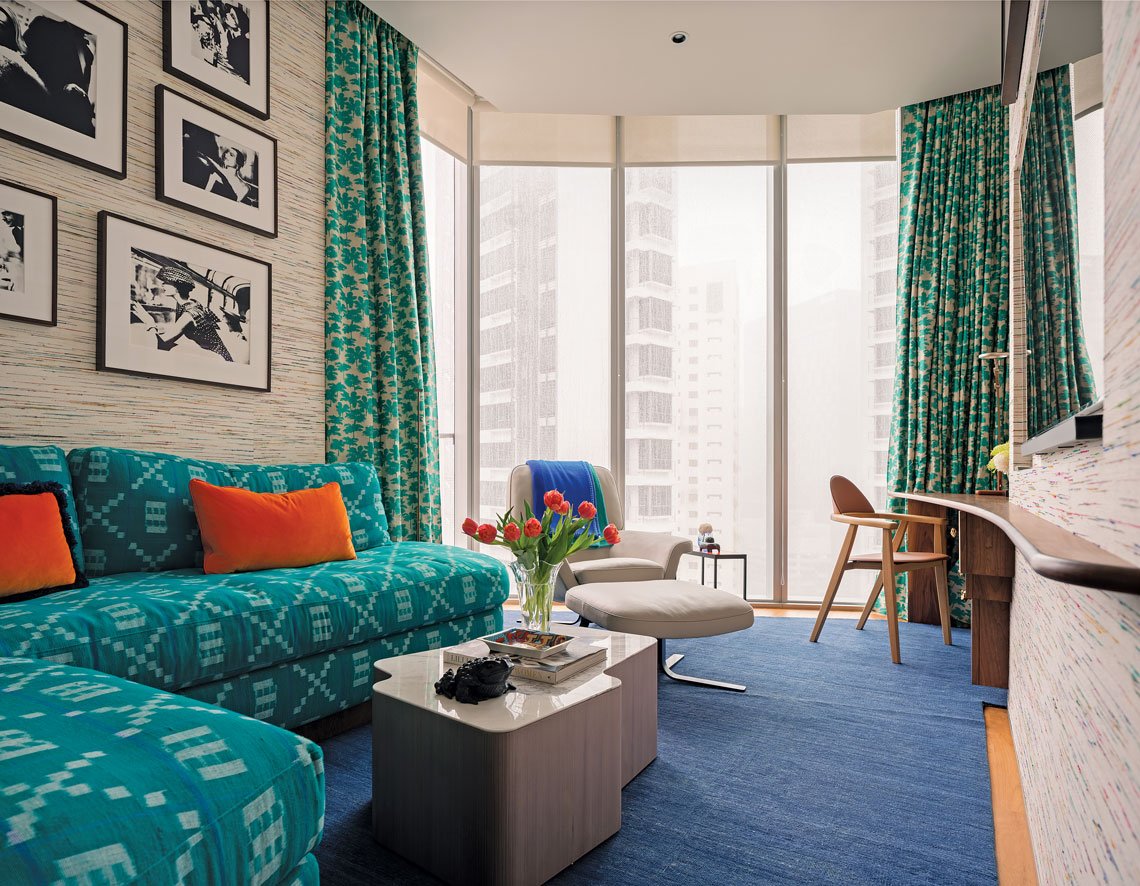 |
A dual-purpose office and lounge space with a custom-fabricated walnut desk and a walnut and leather desk chair by Hermès. The lounge chair, ottoman, and coffee table are by Minotti. |
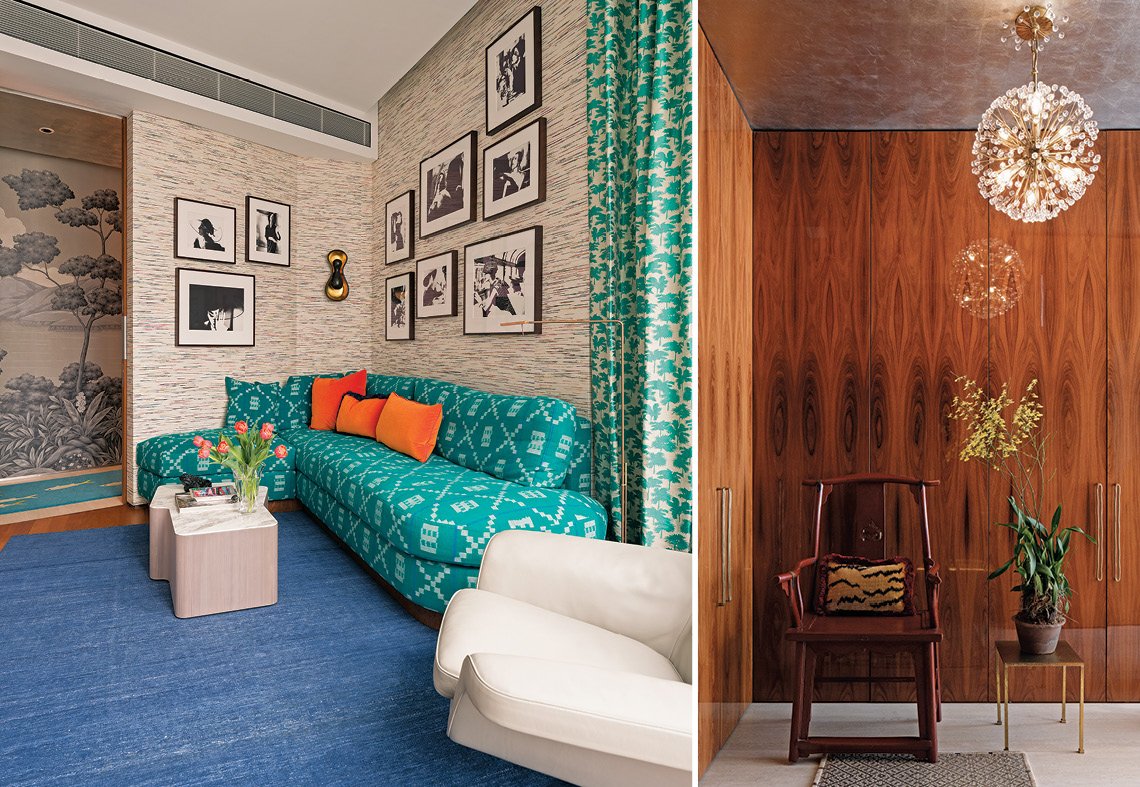 |
| Left: The clients collect vintage fashion photography. These are by famed American fashion photographer Lillian Bassman, renowned for her work at Harper’s Bazaar. Right: Against a dramatic backdrop of bookmatched cathedral-grain paneling and a shimmery silver-leaf ceiling, a glittering crystal Dandelion pendant and an antique Chinese yoke-back chair in the entrance vestibule form an alluring preview of what’s to come. |
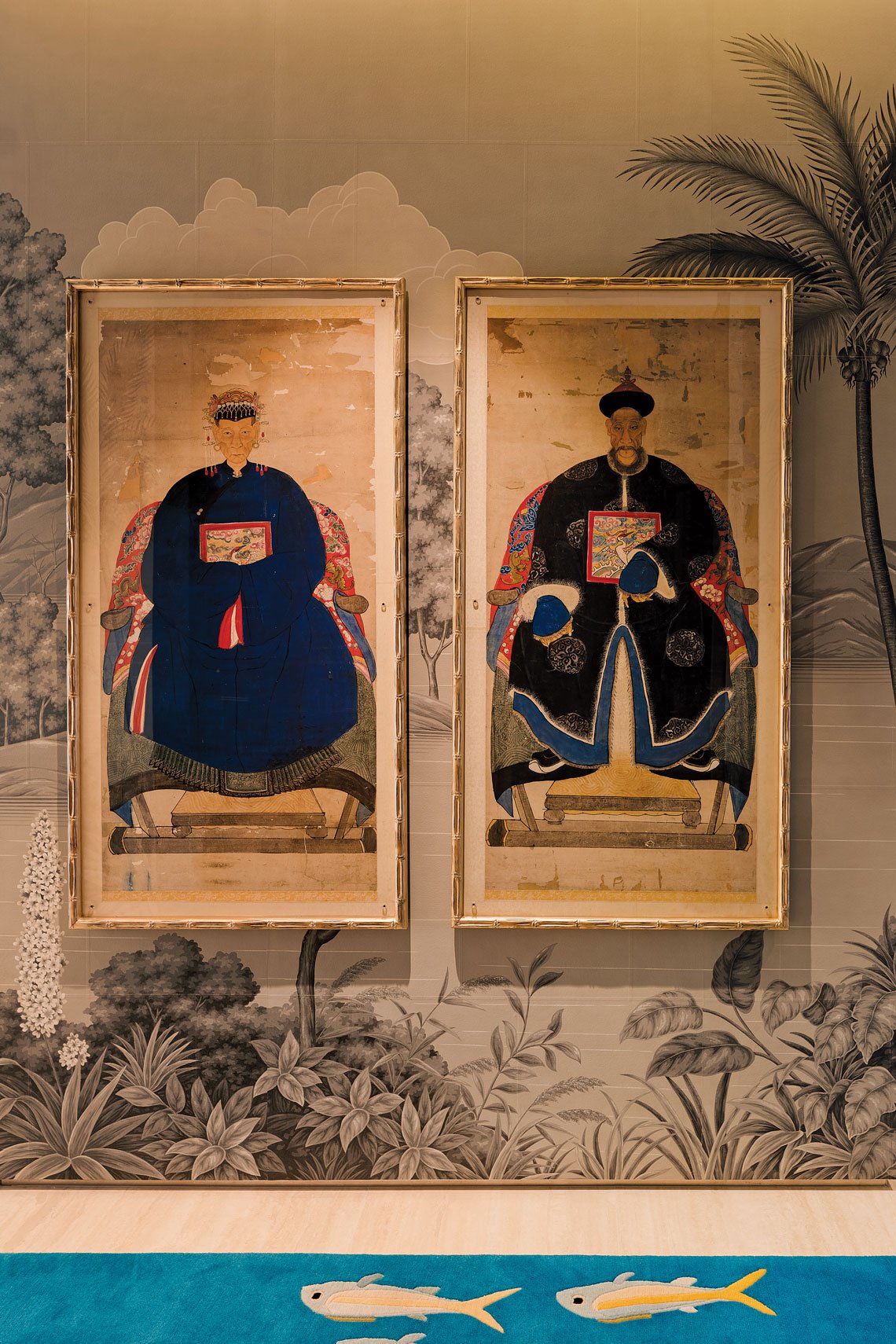 | 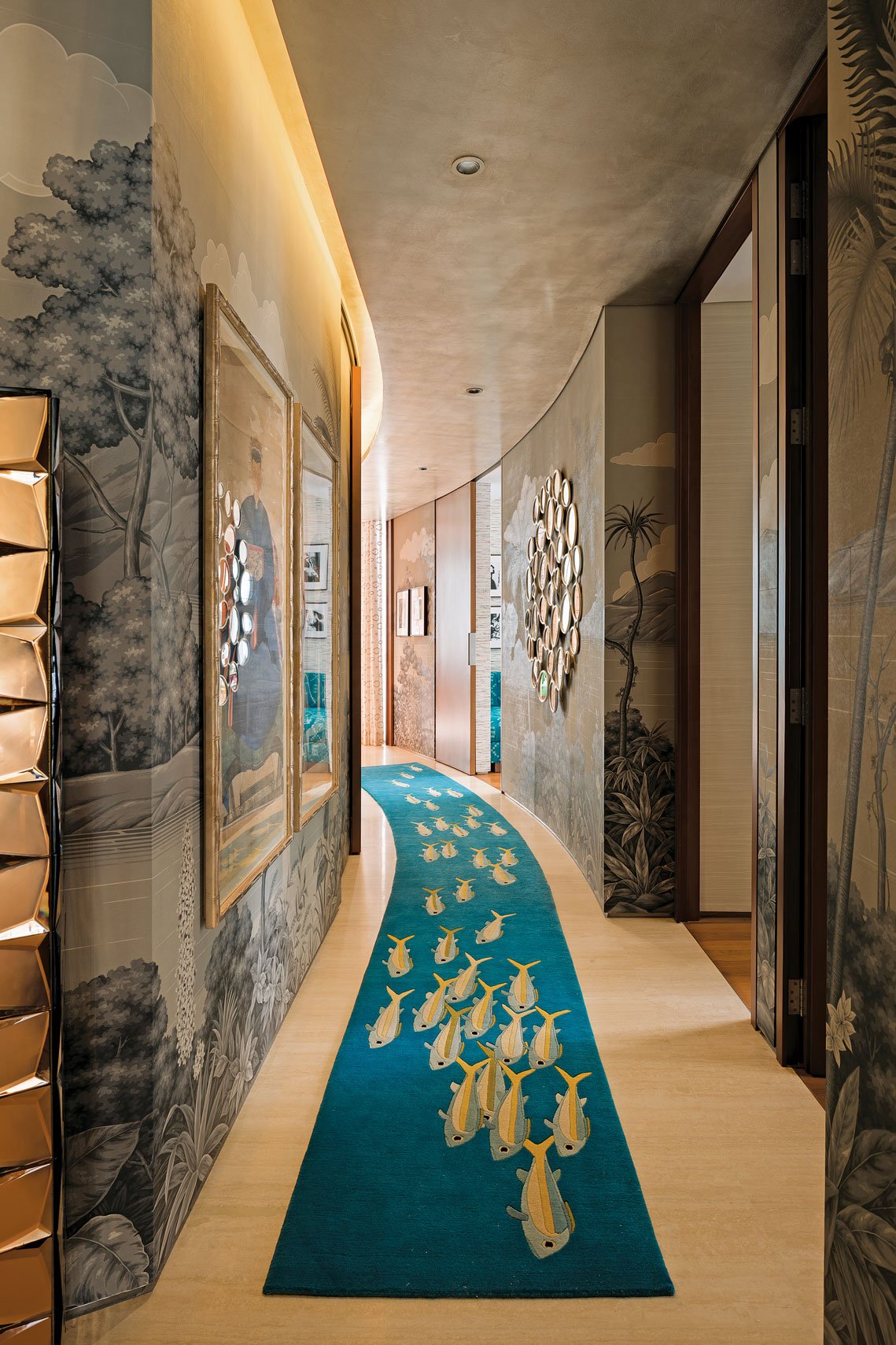 | |
Left: Rare Chinese ancestor portraits must be properly displayed according to a specific set of rules. One is that women must always be on the left. These were installed with great care; the hand-painted Gracie wallpaper was carefully mapped out to frame them. Right: The hallway is curved, echoing the contours of the exterior walls. A custom curved rug with a playful school of swimming fish from The Rug Company enhances the curve and creates a dynamic sense of movement. Hubert Le Gall’s Remus mirror can be seen on the wall to the right. More artwork than mirror, the limited-edition collectible design is an organic, swirling composition of two dozen varied shape mirrors in gilt bronze. | ||
In the master bath, a Bisazza glass mosaic wall is abloom with giant pink roses; the brushed brass and crystal sconces and colorful Arlequin chandelier are by Saint Louis Crystal. 1940s vintage chairs are from New York Incollect dealer Karl Kemp. A second bedroom has a wall of walnut panels upholstered with intricately embroidered fabric featuring a tropical rainforest of exotic blooms and leaves by Jim Thompson, with a matching bolster pillow. Since Singapore has a tropical rainforest climate, this thoughtful touch brings the outdoors inside, minus the heat and humidity. The gilt and rosewood cloverleaf mirror is from a limited edition of eight, designed in 2008 by French master ébéniste Jean-Bérenger de Nattes. Another bedroom is also features botanical references. The padded, upholstered wall is in Nobilis Daiquiri embroidered linen, with matching curtains and bed pillows. Contemporary French designer Hervé Van der Straeten created the Branches mirror in convex mirror glass and patinated bronze. A highly sought-after work of collectible design, the first iteration debuted in 2003. Together, these spaces extend the color story into quieter private rooms.
Designing this project, with its intricate details and multinational sources, builders, and artisans, while incorporating a vibrant color palette along with tons of pattern and texture, and maintaining an elegant feel, was a complicated endeavor. Still, the result proves that Mark Curley was more than up to the task. The couple is overjoyed with the outcome, and Curley, who often travels with the couple, can bask in the magical setting he created, awaiting what’s next with his special “dream clients,” who also have become special friends.