





-
FINE ART
-
FURNITURE & LIGHTING
-
NEW + CUSTOM
- Featured Bespoke Articles
- Hélène de Saint Lager’s Designs…
- Amorph-Where wood comes to life
- Markus Haase: Translating Artistic...
- Trent Jansen: Design Meets Heritage
- Hoon Moreau: Sculptural Poetry
- Kam Tin: The Art of Modern Baroque Furniture
- Gregory Nangle and Outcast Studios
- Roman Plyus Designs Furniture That’s…
- Ervan Boulloud: Daring Ingenuity
- Julian Mayor: Mirror Image
-
DECORATIVE ARTS
- JEWELRY
-
INTERIORS
- Interior Design Books you Need to Know
- By the Book #10
- By the Book #9
- By the Book #8
- By the Book #7
- By the Book #6
- By the Book #5
- Torrey: Private Spaces: Great American Design by Andrew Torrey and Marshall Watson’s Defining Elegance
- Peter Pennoyer Architects: City | Country and Jed Johnson: Opulent Restraint
- Distinctly American: Houses and Interiors by Hendricks Churchill and A Mood, A Thought, A Feeling: Interiors by Young Huh
- By the Book #1
- Featured Projects
- East Shore, Seattle, Washington by Kylee Shintaffer Design
- Apartment in Claudio Coello, Madrid by L.A. Studio Interiorismo
- The Apthorp by 2Michaels
- Houston Mid-Century by Jamie Bush+ Co.
- Sag Harbor by David Scott
- Park Avenue Aerie by William McIntosh Design
- Sculptural Moderns by Kendell Wilkinson Design
- Noho Loft by Frampton Co
- Greenwich, CT by Mark Cunningham Inc
- West End Avenue by Mendelson Group
-
MAGAZINE
- Featured Articles
- Northern Lights: Lighting the Scandinavian Way
- Milo Baughman: The Father of California Modern Design
- A Chandelier of Rare Provenance
- The Evergreen Allure of Gustavian Style
- Every Picture Tells a Story: Fine Art Photography
- Vive La France: Mid-Century French Design
- The Timeless Elegance of Barovier & Toso
- Paavo Tynell: The Art of Radical Simplicity
- The Magic of Mid-Century American Design
- Max Ingrand: The Power of Light and Control
- The Maverick Genius of Philip & Kelvin LaVerne
- 10 Pioneers of Modern Scandinavian Design
- The Untamed Genius of Paul Evans
- Pablo Picasso’s Enduring Legacy
- Karl Springer: Maximalist Minimalism
- See all Articles
Listing
Period
Location
Size
- Clear All
Philip Howard Evergood
American, 1901 - 1973
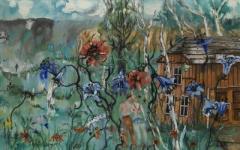
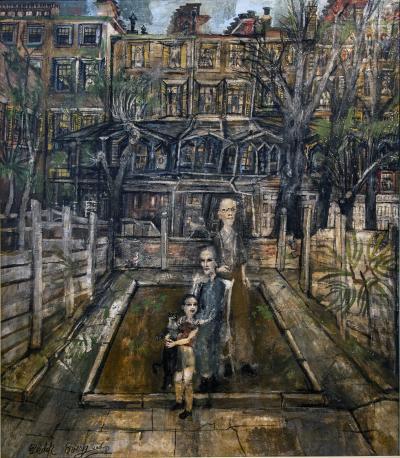
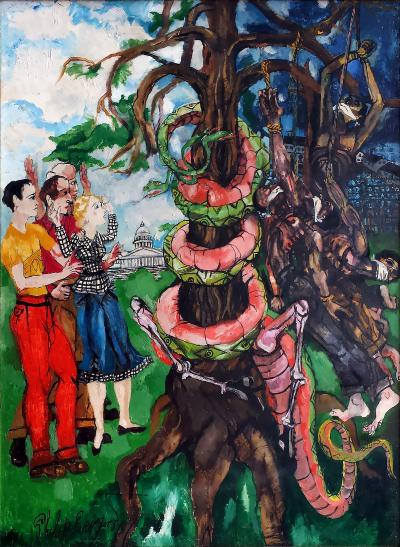
Born Philip Blashki in New York City, Philip Evergood was educated in England, at Eton College and Cambridge University. He studied sculpture at the Slade School of Art in London from 1921 to 1923, after which time he briefly attended the Art Students League of New York, working under George Luks. He continued his training at the Academie Julian in Paris during 1924-25, visited southern France and Italy in 1926, and then returned to New York, where he had his first solo exhibition composed of religious and allegorical works in 1927. He traveled abroad again in 1929, spending the next three years in France and Spain.After settling in New York in 1931, he was strongly influenced by the depression and its effects on the American people. As a result, he turned his attention to social themes, such as political oppression and racism, as well as depictions of the daily life of the common man. While essentially realistic, his style had strong Expressionist overtones created through line and color. A leading Social Realist, he belonged to the American Artists Congress, the Arrests Union, the Works Progress Administration, and other related organizations. During the 1940s, Evergood incorporated a greater degree of Surrealist fantasy into his paintings, drawings, and prints, while retaining the graphic linearity that remained so important to his work.Biography courtesy of Roughton Galleries.
philip-evergood-paintings-art
Loading...